Best Smart Scale for a Home Gym in Canada (2026 Buyer's Guide)
The Best Smart Scale for a Home Gym in Canada: What Actually Matters
If you have built a home gym in Canada, the smartest upgrade might be the one you stand on. The best smart scale for a home gym in Canada does more than flash a weight. It reads body fat, muscle, water and other body-composition numbers, so you can see whether your training is actually working, not just whether the total on the scale moved. This guide walks through what to look for, which metrics matter for training, how accurate these scales really are, and where FitAmplify, a Canadian smart scale and coaching system, fits in.
Why weight alone is the wrong scoreboard for a home gym
Here is the frustrating part of training at home: you can do everything right for eight weeks, feel stronger, look leaner, and watch the number on an old scale barely budge. That is not failure. It is often body recomposition, where you lose fat and build muscle at roughly the same time, so your total weight stays flat while your body changes underneath it.
The research backs this up. A review in the Strength and Conditioning Journal concluded that trained people, not only beginners, can build muscle and lose fat simultaneously when they combine progressive resistance training with good nutrition. A 2025 analysis in Frontiers in Endocrinology went further, describing resistance training as the most effective way to protect lean mass and improve body composition during weight loss. A basic bathroom scale cannot see any of that. It gives you one number that blends muscle, fat, water, bone and last night's dinner into a single figure that can rise on a week you actually got leaner.
For a home-gym setup, that blind spot matters. You are the coach, the athlete and the analyst all at once, so the feedback you get has to be good. A smart body-composition scale turns one confusing number into a picture you can act on.
What to look for in a smart scale for a home gym in Canada
Not every smart scale is worth floor space. Before you buy, weigh the scale against the criteria that actually change how useful it is for training at home. The table below is the short version.
What to check | Why it matters for a home gym | What good looks like |
Body-composition metrics | Weight alone hides muscle and fat changes; you want to see the split. | Reads body fat, muscle or lean mass, body water, visceral fat and BMR, not just weight. |
Measurement method | Determines how the scale estimates fat and muscle. | Multi-electrode BIA (bioelectrical impedance), ideally segmental for arms, trunk and legs. |
App and sync | Trends beat single readings; you need history in one place. | Automatic Bluetooth sync to iOS and Android, clear charts, plain-language labels. |
Multiple profiles | Home gyms are shared; readings should not mix between people. | Several private profiles with automatic user recognition. |
Data privacy | Body data is sensitive; you should control it. | Strong encryption, no selling of data, easy export or delete. |
Human support | Numbers are only useful if you know what to do next. | Access to real coaches or dietitians, not just an app algorithm. |
Canadian availability | Simpler buying, shipping, returns and support. | Sold and supported by a company based in Canada. |
Build and power | A home-gym scale gets daily, sometimes sweaty, use. | Tempered glass, stable readings, long battery life, standard batteries. |
Table 1: A buyer's checklist for choosing a smart scale for a home gym in Canada.
One honest note before you shop. Avoid getting pulled in by a single headline stat. A scale that promises hyper-precise weight but reads nothing else is still just a scale. The value in a home gym comes from the full body-composition picture plus a way to understand it.
The body metrics that matter most for training
Once a scale reads more than weight, the question becomes which numbers to actually watch. You do not need all 56-plus metrics on day one. A handful tell most of the story for fat loss, muscle building and general health. Here is what they mean and the general reference ranges, drawn from recognized sources rather than from any one product.
Metric | What it is | Why it matters for training | General reference |
Body fat % | Share of your body made up of fat. | The clearest read on fat loss when weight stays flat. | See ranges by sex below (ACE). |
Muscle / lean mass | Weight of muscle and other non-fat tissue. | Confirms training is building, not just burning. | Trend up over weeks is the goal. |
Visceral fat | Deep fat around the abdominal organs. | Linked to metabolic and heart-health risk. | Lower is better; watch the trend. |
Body water | Total body water and hydration balance. | Explains many day-to-day weight swings. | Varies with intake, heat and training. |
BMR | Calories your body burns at rest. | Anchors sensible nutrition targets. | Rises as lean mass increases. |
Segmental analysis | Fat and muscle read per limb and trunk. | Flags left-right imbalances to train around. | Aim for balanced sides over time. |
Table 2: The body-composition metrics most worth tracking in a home gym, with general reference points.
Body fat percentage is the metric most people ask about, so it helps to see healthy ranges laid out. The American Council on Exercise groups adults into categories that differ by sex, because women carry more essential fat for normal physiology. Treat these as a general wellness reference, not a diagnosis or a target handed down from a scale.
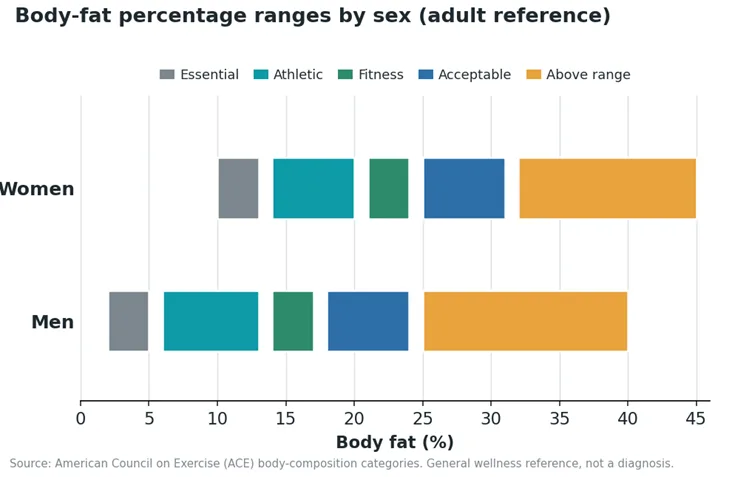
Body-fat percentage ranges by sex, based on ACE body-composition categories.
Visceral fat deserves a special mention. It is the deeper abdominal fat that sits around your organs, and it behaves differently from the fat just under your skin. Cleveland Clinic notes that visceral fat is metabolically active and, in excess, is associated with higher risk of conditions like type 2 diabetes and heart disease. An international consensus in Nature Reviews Endocrinology even argued that waist circumference should be treated as a vital sign alongside blood pressure. A scale that tracks a visceral-fat trend gives you an early, at-home signal to pay attention to, which you can then raise with a qualified health professional if it climbs.
How accurate are smart scales, really?
This is where honesty matters. Most smart scales, including FitAmplify's, use bioelectrical impedance analysis, or BIA. A gentle, unnoticeable electrical signal passes through your body, and because muscle, fat and water conduct that signal differently, the scale estimates your body composition from how the current behaves.
BIA is genuinely useful for tracking change over time, but it is an estimate, not a lab scan. Research is clear that readings shift with hydration, recent meals, exercise and time of day. One study found that drinking about two litres of water could swing the estimated body-fat reading by several percentage points. A separate reliability analysis of multi-frequency BIA found it tracks trends well when conditions are kept consistent. The takeaway is not that BIA is unreliable. It is that your habits around the reading decide how trustworthy your numbers are.
So the accuracy you get is partly in your hands. Standardize how you weigh in, and the day-to-day noise drops away, leaving the trend that actually reflects your training.
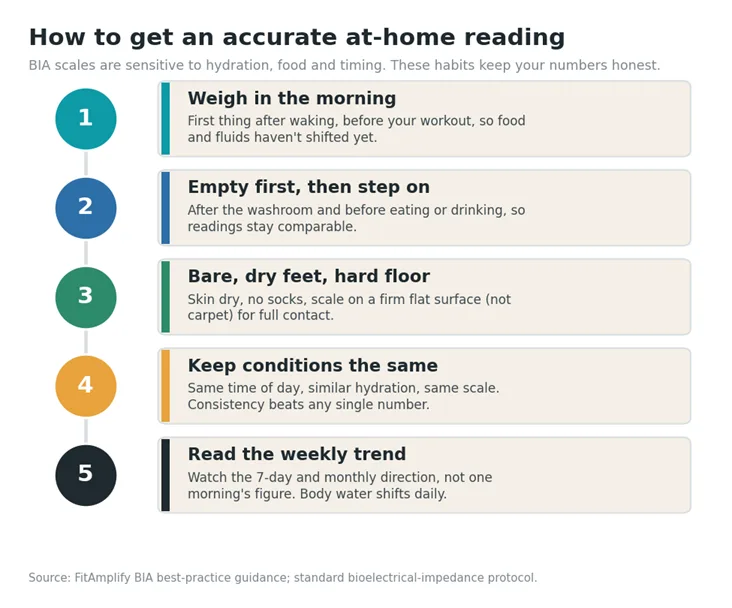
A simple routine for consistent, comparable at-home readings.
You will also see bold precision claims on product pages, including FitAmplify's own "plus or minus 0.1 pound" figure, positioned as far more precise than a typical scale. Read those as marketing precision for the weight measurement, and keep the wellness framing in mind for the body-composition estimates: they are for general tracking, not medical diagnosis.
Where FitAmplify fits, and the human difference
Plenty of scales can hand you numbers. The gap most home-gym owners hit is knowing what to do with them. This is the part we built FitAmplify around, so treat this section as our own perspective rather than a neutral scorecard.
The FitAmplify smart scale uses 8-point BIA with eight precision electrodes to read 56-plus body metrics in one scan, including segmental analysis of your arms, trunk and legs. Results sync automatically over Bluetooth 5.0 to the free app on iOS or Android, where raw numbers become plain-language scores and trends, no medical degree required. Up to eight private profiles mean the whole household can share one scale without mixing readings, which suits a family home gym. Your data is protected with AES-256 encryption and is never sold, and you can export or delete it in the app.
The real differentiator is people. Instead of leaving you to interpret a dashboard alone, FitAmplify connects you with real dietitians and coaches who read your actual data and tell you what to adjust. As our coach Chandradip Ghosh puts it, "I don't guess. Every program I write starts from your body scan results." That is the loop the system runs on: measure, review, adjust, improve. You can start with the free app and add expert coaching only if and when you want it.
On buying in Canada: FitAmplify is operated by Micronix System Inc, based in Brampton, Ontario, and sells its smart scale and virtual coaching to Canadian customers. The scale is a one-time purchase of about 50 dollars (listed in US dollars on the site), with no subscription required to own the device, plus a 30-day risk-free trial. Because coaching is fully virtual, distance across the country is not a barrier. For current Canadian-dollar pricing, shipping timelines and warranty terms, confirm the details at checkout, since those can change.
Is a smart scale worth it for a home gym?
For most people training at home, yes, provided you use it as a trend tool rather than a daily verdict. If your goal is fat loss, a body-composition scale helps you confirm you are losing fat and not muscle. If you are chasing strength or size, it shows lean mass moving in the right direction even on weeks the scale total is flat. If you are on a GLP-1 medication, tracking muscle while you lose weight is especially valuable so you can protect it. And if several people share your home gym, multiple profiles turn one device into a whole-household tool.
Where a smart scale is not the right buy: if you want a medical diagnosis, or you will only ever check weight and ignore the rest. In those cases, save your money or see a healthcare professional directly.
Frequently asked questions
What is the best smart scale for a home gym in Canada?
There is no single winner for everyone. The best smart scale for a home gym in Canada is the one that reads real body-composition metrics, syncs cleanly to an app, protects your data, supports multiple users, and is easy to buy and support locally. FitAmplify is a Canadian option that adds real dietitian and coach support on top of the scale, which many home-gym owners find is the missing piece.
Are smart scales accurate for body fat?
They are good for tracking trends, less so as a one-time lab-grade measurement. Smart scales use BIA, which is affected by hydration, food, exercise and time of day. Weigh in under the same conditions each time and watch weekly trends rather than daily numbers, and the readings become far more meaningful.
How much does the FitAmplify smart scale cost in Canada?
The scale is a one-time purchase of about 50 dollars, priced in US dollars on the site, with no subscription needed to own the device and a 30-day risk-free trial. The free app is included. For the exact Canadian-dollar total, shipping and any duties, check the current figures at checkout.
Can my whole family use one smart scale?
Yes. FitAmplify supports up to eight private profiles and recognizes users automatically, so a shared home-gym scale keeps each person's readings and trends separate.
How often should I weigh myself in a home gym?
For body composition, a few consistent readings a week is plenty. Look at the weekly and monthly direction, not one morning's figure, because body water naturally shifts day to day.
Do I need a paid plan to use the scale?
No. You own the device outright and the app has a free forever tier with all the metrics, history and trends. Personalized diet plans, training and one-on-one expert sessions are optional add-ons if you want human guidance.
See your full body picture
Ready to stop guessing on your home-gym progress? Explore the smart body-composition scale, track 56+ metrics in the free app, or have real dietitians and coaches review your data. You can also meet the expert team or book a free 20-minute consultation to talk it through with a real person.
References
1. American Council on Exercise (ACE) — Body-fat percentage categories for men and women
3. Resistance training as a strategy for high-quality weight loss — Frontiers in Endocrinology (2025)
5. Effect of altered hydration status on BIA body-composition analysis
6. Visceral Fat: What It Is and How It Affects You — Cleveland Clinic
7. Waist circumference as a vital sign — Consensus Statement, Nature Reviews Endocrinology
Disclaimer: FitAmplify is a wellness product and is not a medical device. It is not intended to diagnose, treat, cure or prevent any disease, and BIA body-composition readings are for general wellness tracking, not medical diagnosis. Always consult a qualified healthcare professional regarding any medical concern.