Do Smart Scales Work for Tracking Fat Loss on a Cut?
Do Smart Scales Work for Tracking Fat Loss on a Cut?
By The FitAmplify Team · Updated July 2026 · 8 min read
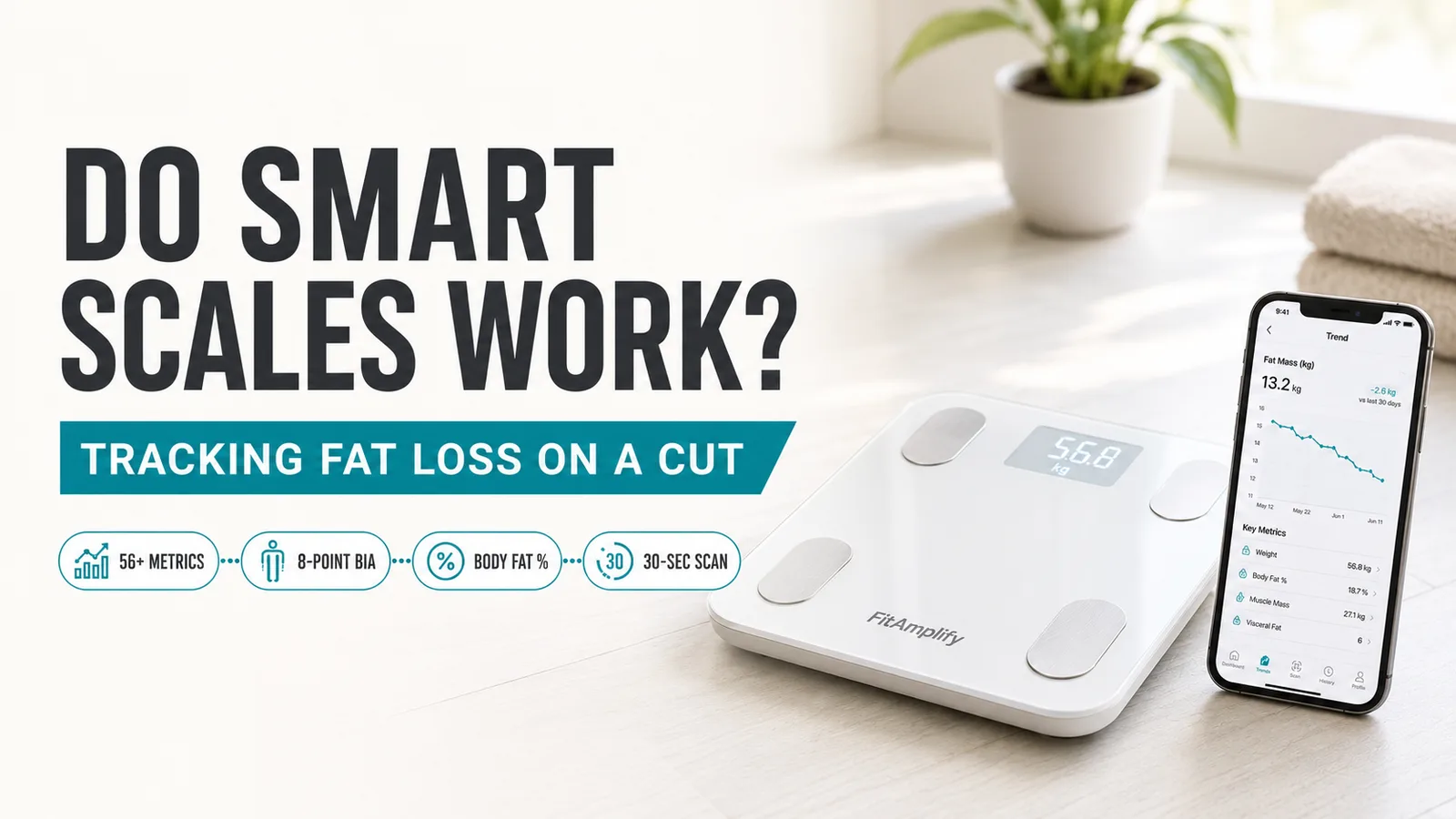
Do smart scales work for tracking fat loss on a cut? The short version is yes, but only if you read them the right way. When you are dieting, the plain scale number can sit still for a week while you are genuinely losing fat, because water and food move your weight far more than fat does from day to day. A smart scale splits that weight into fat, muscle, and water, so you can watch your fat mass fall even when the scale sticks. This guide covers what these scales can and cannot do, how accurate they really are, and how to set up your cut so the numbers move.
The short answer
Smart scales estimate body composition using bioelectrical impedance analysis, or BIA. A painless signal passes through your body, and because fat, muscle, and water conduct that signal differently, the scale estimates each one. For tracking fat loss this matters, because the goal of a cut is to lose fat while holding on to muscle, and a single weight number cannot tell those two apart. The honest catch is that BIA is far better at showing change over time than at nailing an exact body fat figure on any given day. Used as a weekly trend tool, a smart scale works well. Used as a precise lab reading, it does not.
Why the scale alone lies during a cut
A safe cut aims for about 0.5 to 1 kg (1 to 2 lb) of loss per week, which is roughly half a percent to one percent of body weight. That is real progress, but it is small next to your normal daily swings. A salty meal, a hard workout, a short night of sleep, or a change in carbs can move the scale by a kilogram or more through water alone. So weight tends to come off in fits and starts: flat for a week or two, then a sudden drop that lifters sometimes call a whoosh. The chart below shows what that can look like over a 12-week cut. Scale weight plateaus and jumps, while the fat-mass trend keeps sliding down and muscle holds steady.
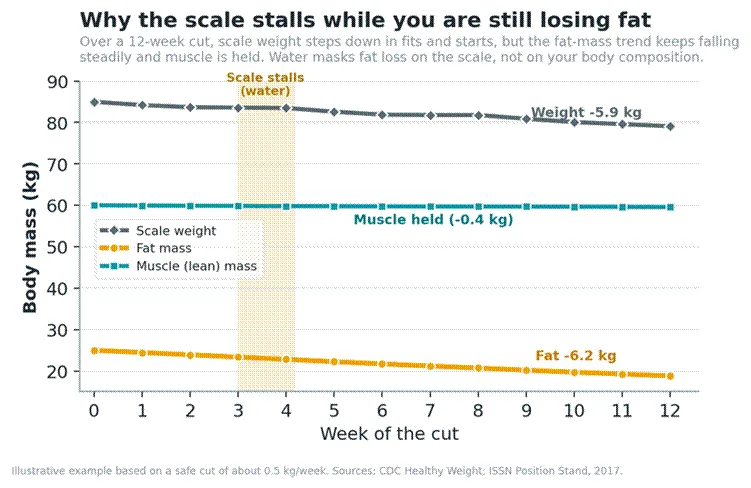
Figure 1. On a cut, scale weight stalls and jumps while the fat-mass trend keeps falling. Water masks fat loss on the scale, not in your body composition.
What a smart scale tracks that a regular scale cannot
A regular scale gives you one number that mixes fat, muscle, water, and last night's dinner together. A smart body-composition scale pulls them apart. The FitAmplify scale uses 8-point BIA with 8 precision electrodes to read your arms, trunk, and legs separately, and reports 56+ metrics after each scan. On a cut, a handful of them do the real work.
Metric | What it is | Why it matters on a cut | How to read it |
Body fat % | The share of your weight that is fat | Confirms the weight you lost was fat, not muscle | Follow the weekly trend, not one day |
Fat mass | The actual weight of body fat you carry | The number a cut is really trying to move | Watch the direction over several weeks |
Muscle / lean mass | Everything that is not fat | Shows you are keeping muscle, not burning it | Should hold roughly steady on a good cut |
Visceral fat | Fat stored around your organs | A health marker that often improves as you lean out | Slow to shift, so track it monthly |
Body water | Your total body water | Explains the sudden scale jumps and stalls | Expect it to swing, and do not panic |
Table 1. The body-composition metrics worth watching during a cut. Definitions reflect standard body-composition terminology.
You can track all 56+ metrics in the app after each scan, and the smart body-composition scale syncs them automatically over Bluetooth.
How accurate are smart scales for body fat?
Here is the straight answer. Consumer BIA scales estimate body composition, they do not measure it directly the way a DEXA scan does, and in absolute terms they can be off by several pounds of fat mass. Their readings also shift with hydration, recent meals, and the time of day. What they are genuinely good at is consistency. If you weigh under the same conditions every time, that error tends to stay steady, so the trend line still points the right way even when the exact percentage is a little off. On a cut, a reliable direction is what you actually need, not a lab certificate. Treat the readings as general wellness tracking, not a medical measurement.
How to set up a cut the scale can actually track
A smart scale can only show progress on a cut that is working in the first place. A few evidence-based levers keep fat coming off while muscle stays put.
Lever | Practical target | Backed by |
Rate of loss | About 0.5 to 1 kg (1 to 2 lb) per week | CDC |
Calorie deficit | Roughly 300 to 500 kcal below maintenance | Harvard Health |
Daily protein | About 1.6 to 2.2 g per kg of body weight | ISSN |
Resistance training | At least 2 days a week, all major muscle groups | CDC |
Table 2. Evidence-based targets for losing fat while preserving muscle on a cut.
Protein and resistance training are the two biggest muscle-savers in a deficit. Pushing the deficit much larger than this speeds weight loss on the scale, but tends to cost you more muscle, which is the opposite of what a good cut is for. If you are not sure where to set your deficit, you can talk to a registered dietitian who will read your body-composition trend alongside your intake.
How to weigh and read it on a cut
Weigh first thing in the morning, before eating or drinking, after using the bathroom, on the same spot each time. Do it most mornings and judge yourself on the weekly average, not any single reading. On a cut especially, one high morning after a big weekend meal is almost always water, not new fat. If you want the full accurate-reading checklist, the support guide covers best practice.
What our experts watch first
On a cut, our team looks at the fat-mass trend and your protein before it looks at scale weight. As our registered dietitian Ms. Shivani Tomar puts it, “Every body is biochemically different. Your plan should be too.” A real dietitian can read your body-composition trend next to your actual intake and adjust the deficit before you start losing muscle, instead of guessing from a stalled scale. You can talk to our expert team, or meet the people who review your data first.
Frequently asked questions
Do smart scales work for tracking fat loss?
Yes, as a trend tool. They estimate fat mass and body fat percentage and update after each scan, so across several weeks they show whether your fat is actually going down. They are less reliable for a precise one-day number, so read the weekly trend rather than a single morning.
How accurate are smart scales for body fat percentage?
They estimate rather than measure, so in absolute terms they can be off by several pounds of fat compared with a lab method like DEXA. Weighed under the same conditions each time, though, they are consistent enough to track the direction of your fat loss reliably.
Why is the scale stuck but I look leaner on a cut?
Almost always water. Fat loss on a safe cut is small week to week, and normal shifts in water, sodium, carbs, and glycogen can hide it on the scale for a week or two. A smart scale helps because the fat-mass trend keeps moving even when scale weight sits still.
Can a smart scale tell if I am losing fat or muscle?
It separates fat mass from lean mass, so you can watch both. On a good cut, fat mass falls while muscle holds roughly steady. If muscle is dropping too, that is a signal to eat more protein, train with resistance, or ease the deficit.
How often should I weigh on a cut?
Most mornings is ideal, because more readings make the weekly average more reliable. Just avoid reading meaning into any one day, since daily numbers bounce with food and water far more than fat changes.
How fast should I lose weight on a cut?
About 0.5 to 1 kg, or 1 to 2 lb, per week is the general guidance for steady, sustainable loss. Bigger deficits drop scale weight faster but tend to cost more muscle, so slower is usually better for body composition.
Want to watch fat mass instead of guessing at the scale? Explore the smart body-composition scale, track your 56+ metrics in the app, or book a free 20-minute consultation with a real dietitian who can set up your cut.
References
1. U.S. Centers for Disease Control and Prevention. “Steps for Losing Weight” (Healthy Weight and Growth). https://www.cdc.gov/healthy-weight-growth/losing-weight/index.html
2. U.S. Centers for Disease Control and Prevention. “Adult Activity: An Overview” (Physical Activity Basics). https://www.cdc.gov/physical-activity-basics/guidelines/adults.html
3. Jäger R, et al. “International Society of Sports Nutrition Position Stand: Protein and Exercise.” Journal of the ISSN, 2017. https://pmc.ncbi.nlm.nih.gov/articles/PMC5477153/
4. Harvard Health Publishing. “Calorie deficit explained: Is it a safe, sustainable approach to weight loss?” https://www.health.harvard.edu/weight-loss/calorie-deficit-explained-is-it-a-safe-sustainable-approach-to-weight-loss
5. Ugras S. “Evaluating of altered hydration status on effectiveness of body composition analysis using bioelectric impedance analysis.” Libyan Journal of Medicine, 2020. https://pmc.ncbi.nlm.nih.gov/articles/PMC7144212/
6. Lee SY, et al. “Comparison between Dual-Energy X-ray Absorptiometry and Bioelectrical Impedance Analyses for Accuracy in Measuring Whole Body Muscle Mass and Appendicular Skeletal Muscle Mass.” Nutrients, 2018. https://www.ncbi.nlm.nih.gov/pmc/articles/PMC6024648/
FitAmplify is a wellness product and is not a medical device. It is not intended to diagnose, treat, cure, or prevent any disease. Body-composition readings are for general wellness tracking, not medical diagnosis. Always consult a qualified healthcare professional regarding any medical concern