How Accurate Are Smart Scales for Body Fat? A Lifter's Guide
How Accurate Are Smart Scales for Body Fat Percentage? What Lifters Actually Need to Know
By The FitAmplify Team · Updated July 2026 · 7 min read
Short version: a good smart scale won't pin your body-fat percentage to the decimal. A single reading can sit a few points off a lab scan. But it stays remarkably consistent from one day to the next, and that consistency is exactly what you need to track a cut or a lean bulk. For lifters, the trend line matters far more than any single reading. Here's how accurate these scales really are, where they go wrong, and how to pull numbers you can actually train by.
The short answer
Smart scales measure body fat with bioelectrical impedance analysis (BIA). A tiny, safe electrical current passes through your body; because fat, muscle and water conduct it differently, the scale estimates your composition from how much resistance it meets. Against a laboratory reference like a DEXA scan or a research-grade four-compartment model, a single BIA body-fat reading commonly lands within roughly 3 to 8 percentage points of the truth. For a one-time “what is my real body fat” answer, that's a wide margin.
But the same technology gets much tighter when you measure your own change over weeks. In device-validity testing, the error for tracking change dropped to about 1.7 to 2.6 points, and day-to-day repeatability (precision) was near-perfect, around 0.0 to 0.49%. The takeaway for anyone in the gym is simple: treat the absolute number as an estimate, and trust the direction and size of your change.
Accuracy vs. precision: the distinction lifters live by
These are two different questions. Accuracy is how close a reading is to your true body fat. Precision is how repeatable it is. Do you get the same answer under the same conditions? Picture a dartboard. An accurate scale lands near the bullseye; a precise scale lands in a tight cluster, even if that cluster sits slightly off-center.
For a lifter mid-cut, precision is the one that pays the bills. If your scale reads a point or two high but reads high consistently, every weekly data point shifts by the same amount, so the slope of your fat-loss line is still correct. You'll still see the drop even if the exact figure runs a little flattering or a little harsh.
How the main methods compare
Not all body-fat tools work the same way, and the measurement path matters. Here's how the common options stack up.
Method | How it works | Typical single-reading error* | Best for |
Basic bathroom scale | Weight only, no composition | n/a (no body-fat reading) | Tracking total weight |
Foot-to-foot BIA scale | Current runs up one leg and down the other; the trunk is estimated, not measured | ~4–8 points | Affordable daily trend tracking |
8-electrode BIA (hands + feet) | Current passes through arms, trunk and legs for a segmental read | ~3–6 points | Home tracking with segmental detail |
DEXA scan | X-ray attenuation measures fat, lean and bone directly | ~3 points | Periodic ground-truth check |
4-compartment model | Combines several lab methods; the research criterion | Lowest (reference) | Research gold standard |
*Approximate error of a single reading vs. a lab reference. Ranges reflect BIA validity research; individual results vary. Sources [1][4][5].
What the research actually says
A large validity study that tested fifteen different BIA devices against a four-compartment model found the pattern lifters should care about. Single-snapshot accuracy varied, with the standard error of estimate running from about 3.1% to 7.5% of body fat, and some devices carried a consistent bias. But precision was excellent (error of roughly 0.0–0.49% on repeat readings), and when the same devices were used to track change over time, the error shrank to about 1.7–2.6% [1].
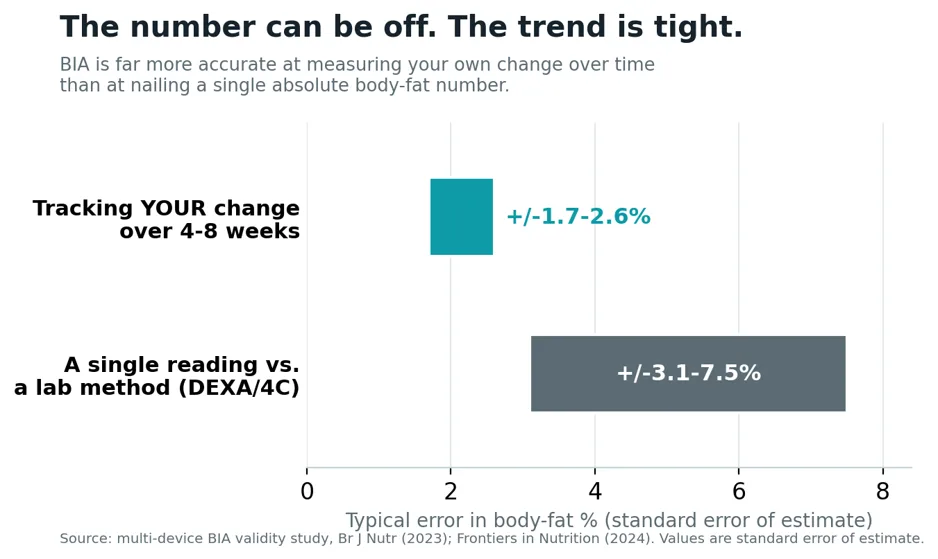
A single BIA reading can be several points off a lab method, but tracking your own change over time is far tighter.
A 2024 review reached a similar conclusion: multi-frequency BIA is reliable and moderately accurate under controlled conditions, and importantly, everyday swings in food and hydration had relatively little effect on repeated measurements taken the same way each time [2]. And remember the benchmark isn't perfect either: even DEXA carries around a 3% margin, so “lab-accurate” is a spectrum, not an absolute [5].
Where smart scales go wrong (especially for lifters)
The estimate breaks down in a few predictable ways. Knowing them is the difference between trusting a bad number and reading the scale correctly.
• The athlete skew. BIA tends to overestimate body fat in lean, muscular people and underestimate it in those carrying more fat. So a shredded lifter may read a couple of points higher than reality. It's annoying, but it's consistent, so your trend still holds.
• Foot-to-foot scales skip your trunk. When current only travels leg-to-leg, everything above the hips (trunk fat, visceral fat, upper-body lean) is inferred rather than measured [4]. Eight-electrode scales that add your hands close much of that gap.
• Hydration is the biggest lever. BIA reads water. Dehydration raises impedance and inflates your body-fat number; over-hydration does the opposite [3]. A carb-loaded, creatine-saturated, well-watered lifter will read differently than a fasted morning weigh-in.
• Post-workout is the worst time. Sweat loss, fluid shifts and a warmer body after training all move the reading, usually in a misleading direction.
How to get numbers you can train by
You can't make BIA a lab, but you can make it consistent, and that consistency is what turns a noisy estimate into a clean trend line. Standardize the conditions, then judge the multi-week slope instead of any single day.
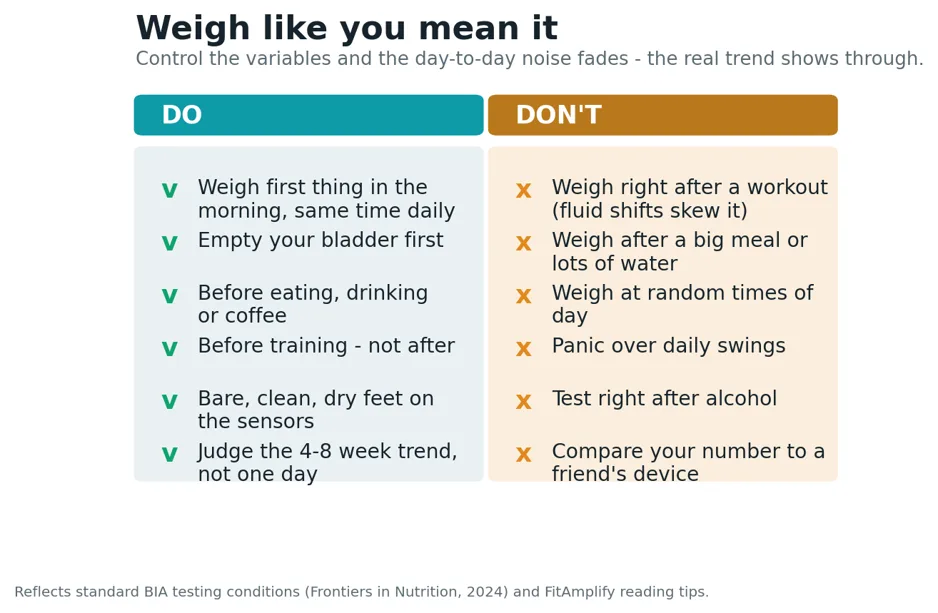
Control the variables and the day-to-day noise fades, letting the real trend show through.
One more rule: never compare your number to a friend's device or a gym InBody printout. Different algorithms give different absolutes. Your scale versus itself, over time, is the only comparison that means anything.
What lifters should actually track
Body fat percentage alone is a thin signal. Pair it with lean (muscle) mass and you can confirm the thing every lifter wants proof of: recomposition, where muscle climbs while fat falls, even when the number on the scale barely moves. That's exactly the scenario where the weight-only scale lies and a body-composition trend tells the truth.
Practically: watch weekly averages rather than daily readings, track fat and lean mass together, and keep an eye on segmental balance if your scale reports it (left-vs-right arm and leg lean mass). The scale's job is to catch the direction; your training and nutrition do the rest.
Where FitAmplify fits
The FitAmplify Smart Scale uses 8-point BIA, sending current through both hands and feet, for a segmental read across your arms, trunk and legs, which directly addresses the foot-to-foot blind spot. Every scan syncs 56+ metrics and trend charts to the app, so you're always looking at the slope over weeks, not a single day's estimate.
And because BIA is an estimate, the numbers don't stop at the app. A registered dietitian and coach on your team read your actual trends and adjust the plan. A real person, not an algorithm. If you want that guidance built around your data, meet the expert team behind it or book a free consultation. FitAmplify is a wellness tool for tracking your body over time, not a medical diagnosis.
Frequently asked questions
How accurate are smart scales for body fat percentage?
A single reading typically lands within about 3–8 percentage points of a lab method like DEXA. Accuracy improves dramatically when you track your own change over time, where the error narrows to roughly 1.7–2.6 points.
Are smart scales accurate enough to track a cut or a bulk?
Yes, as long as you measure the same way every time. BIA's day-to-day precision is high, so the weekly trend reliably shows whether fat is falling and muscle is holding, even if the exact percentage is an estimate.
Why does my body-fat reading jump around day to day?
Mostly hydration, food, exercise and time of day. Water is the biggest factor: being dehydrated reads higher, being over-hydrated reads lower. Weigh under consistent conditions and judge the 4–8 week trend, not single days.
Is a DEXA scan worth it over a smart scale?
DEXA is a better one-time snapshot (about a 3% margin), but it's overkill for weekly tracking. Many lifters use both: an occasional DEXA for a reference point and a smart scale for the frequent trend.
Do smart scales overestimate body fat for muscular people?
Often, slightly. BIA tends to read a bit high for lean, athletic bodies and a bit low for higher-fat bodies. Because the bias is consistent, your personal trend line is still trustworthy.
When is the most accurate time to weigh in?
First thing in the morning, after using the bathroom, before eating or drinking, before training, on bare, dry feet, at the same time every day.
See the whole picture, not just a number
Weight is one data point. Track 56+ body metrics with the FitAmplify scale and app, watch the trends that actually matter, and let a real dietitian and coach turn your data into a plan. Book a free 20-minute consultation to see how it applies to your goals.
FitAmplify is a wellness product and is not a medical device. It is not intended to diagnose, treat, cure, or prevent any disease. Always consult a qualified healthcare professional regarding any medical concern.