How Often Should You Weigh Yourself for Body Composition?
How Often Should You Weigh Yourself to Track Body Composition?
By The FitAmplify Team · Updated July 2026 · 9 min read
How often should you weigh yourself to track body composition? The honest answer is that it depends on which number you are chasing, because your weight and your body composition move on completely different clocks. Your weight can swing a kilogram or two between breakfast and bedtime, while the fat and muscle underneath it change over weeks and months. So the best plan is to step on the scale often but read it slowly. This guide breaks down how often to weigh for your weight, for your bodyweight trend, and for real body-composition change, backed by research and by the way a smart scale actually works.
It depends on what you are measuring
There is a real difference between your weight and your body composition, and it changes the whole question. Weight is a single number on the floor. Body composition is what that weight is made of: fat, muscle, water, and bone. A smart scale estimates that breakdown using bioelectrical impedance analysis, or BIA, sending a painless signal through your body and reading how fat, muscle, and water resist it differently. Because those tissues change at different speeds, there is no single right weighing frequency. There are three, depending on whether you want today's weight, this week's trend, or the slow shift in your body composition.
How often to weigh, by what you want to track
Here is the whole framework in one picture. Weigh daily to build the habit and feed the trend, review a weekly average to see your real bodyweight direction, and check your body-composition numbers monthly, because fat and muscle move slowly enough that a month is the smallest window where the change actually means something.
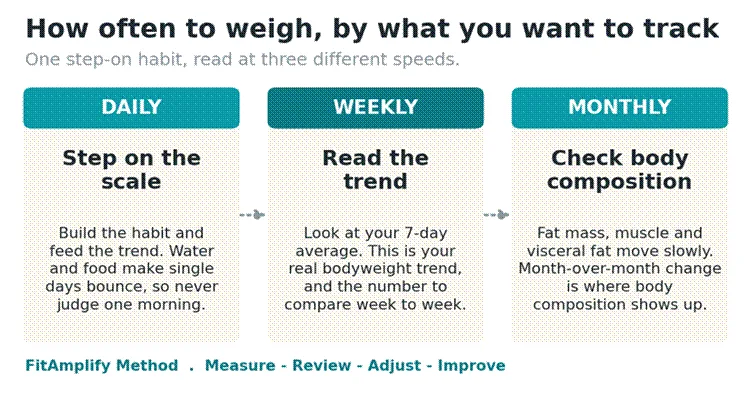
Figure 1. One step-on habit, read at three speeds: daily for the habit, weekly for the trend, monthly for body composition.
The daily step-on takes about half a minute, and the smart body-composition scale syncs each 30-second scan to the app automatically, so the habit costs you almost nothing. The weekly read is where you actually make decisions, and the monthly check is where fat mass, muscle, and visceral fat finally show their hand. You are not adding work, you are just choosing which timescale to trust for each number.
Why your daily weight bounces, and why that is fine
If you weigh every day, you will watch your weight rise and fall for reasons that have nothing to do with fat. For someone in a healthy weight range, daily weight commonly swings by about 1 to 2 kg (2 to 4 lb). Water is the main culprit. Salt makes your body hold water, so a single restaurant meal can leave you a couple of pounds heavier the next morning. Carbohydrates pull water into your muscles too, because every gram of stored glycogen holds roughly 3 to 4 grams of water with it. Add a hard workout, a short night of sleep, normal hormonal shifts, and the food and drink still moving through you, and any single morning number becomes noisy.
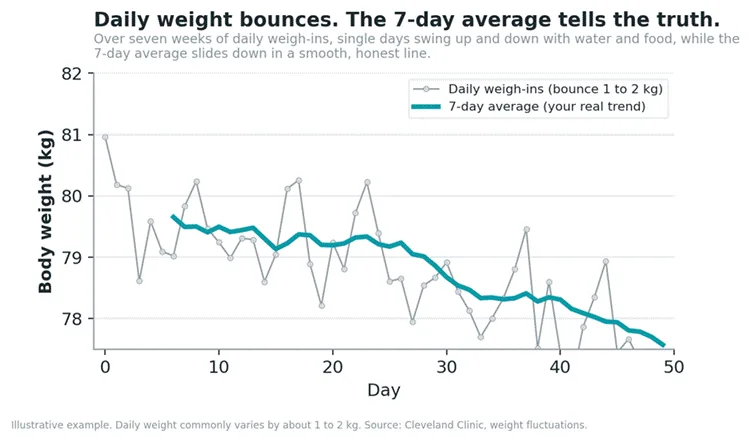
Figure 2. Daily readings jump with water and food, while the 7-day average slides down in a clean line. The average is the signal.
That average is the entire point of weighing often. Each single day is a blurry snapshot. Stack seven of them together and the random noise cancels out, leaving the real trend behind. This is why weighing daily and weighing for a trend are not in conflict. You collect the daily data precisely so the weekly average has something honest to show.
What the research says about weighing often
Weighing frequently is not only about cleaner data, it also seems to support behavior. A systematic review of self-weighing studies found that people who weighed themselves daily or weekly lost more weight, and kept it off better, than people who weighed less often. The reviewers found no evidence that frequent weighing harmed mood or body image for most people. If anything, more frequent self-weighing was linked to greater dietary restraint and slightly better body satisfaction. There is one caution worth naming clearly: if you have a history of disordered eating, a daily number can become a source of stress rather than information, and it is worth talking with a qualified professional about whether a weekly or trend-only approach suits you better.
How fast does body composition actually change?
This is where the monthly rhythm earns its place. The tissues a body-composition scale is really tracking change slowly. A beginner might add only about 0.3 to 0.5 kg of muscle in a good month, and a safe rate of fat loss is around 0.5 to 1 kg per week. Those are meaningful changes over time, but on any given day they are dwarfed by water. Checking your body fat percentage every single morning will drive you a little crazy, while checking it once a month tells a clear story. The table below lines up how fast each number really moves against how often it is worth checking.
What you are tracking | How much it really moves | How often to check |
Daily body weight | Swings about 1 to 2 kg from water and food | Daily, but read the weekly average |
Bodyweight trend | Around 0.25 to 0.5 kg per week on a plan | Weekly |
Body fat % and fat mass | Slowly, over weeks | Every 2 to 4 weeks |
Muscle / lean mass | About 0.3 to 0.5 kg per month for beginners | Monthly |
Visceral fat | A slow-moving health marker | Monthly or longer |
Table 1. How fast each metric changes versus how often it is worth checking. Rates reflect general body-composition research (see references).
How to weigh for a reading you can trust
Frequency only helps if every reading is taken the same way. BIA is sensitive to hydration, food, and the time of day, so the trick is to hold all of that steady and let your body be the only thing that changes. Weigh first thing in the morning, after using the bathroom, before you eat or drink anything, on the same scale and the same spot, barefoot. Then log it and judge the weekly average. Done consistently, your day-to-day error stays steady, and steady error is exactly what makes a trend trustworthy.
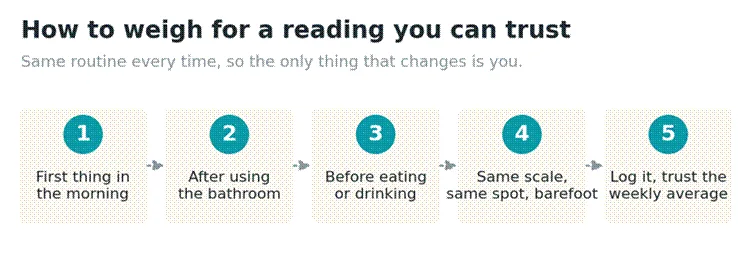
Figure 3. Same routine every time, so the only thing that changes is you.
One practical note for FitAmplify scales: use fresh alkaline batteries rather than rechargeables, because rechargeables can throw the reading off. If you want the complete accurate-reading checklist, the support guide covers best practice.
A simple weighing routine that works
Put it together and the routine is easy to live with. Step on most mornings, right after the bathroom, and let the app auto-sync your scan. Once a week, look at the 7-day average instead of the latest number, and compare it with last week. Once a month, open your body-composition metrics, your fat mass, muscle mass, and visceral fat, and see where they have actually moved. You can track all 56+ metrics in the app, which turns a string of daily scans into weekly and monthly trends you can read at a glance, and up to 8 private profiles means the whole family can share one scale. If a month goes by and the composition numbers are not moving the way you want, that is the moment to adjust your plan, not after a single stubborn morning.
What our experts tell people who weigh in daily
Plenty of people step on the scale every morning and let one number set the tone for the whole day. Our coach Chandradip Ghosh flips that habit around. “I don’t guess. Every program I write starts from your body scan results.” In practice that means he reads the trend, not the daily blip, and pairs it with your segmental and composition data before changing anything. A real coach or dietitian can look at a month of your scans and tell you whether a plateau is water, a genuine stall, or simply progress you cannot see from one day to the next. You can talk to the expert team, or meet the people who review your data first.
Frequently asked questions
How often should you weigh yourself to track body composition?
Step on most days to build the habit and feed the trend, read your 7-day weight average once a week, and check body-composition metrics like fat mass and muscle roughly once a month. Weight changes daily, but body composition only shows meaningful movement over weeks.
Is it bad to weigh yourself every day?
For most people, no. Reviews of self-weighing research link daily or weekly weighing to better weight loss and maintenance, with no sign of harm to mood or body image on average. The exception is anyone with a history of disordered eating, who may do better with weekly or trend-only tracking and some professional guidance.
Why do I weigh more the morning after eating out?
Almost always water, not fat. A salty restaurant meal makes your body hold extra water, and higher-carb meals pull water into your muscles with stored glycogen. It usually clears within a day or two, which is why the weekly average matters more than any single morning.
Should I look at daily weight or the weekly average?
The weekly average. A single day is noisy, swinging 1 to 2 kg with water and food. Averaging your daily weigh-ins across the week cancels out that noise and shows the real direction you are heading.
How often does body fat percentage change enough to notice?
Slowly. Fat and muscle shift over weeks, not days, so checking your body fat percentage every 2 to 4 weeks is plenty. Daily body-fat readings mostly reflect hydration swings, not real change.
What is the best time of day to weigh yourself?
First thing in the morning, after using the bathroom and before eating or drinking, on the same scale each time. Consistent conditions keep your readings comparable, which is what makes the trend reliable.
Want to see the trend instead of stressing over one morning? Explore the smart body-composition scale, track your 56+ metrics in the app, or book a free 20-minute consultation with a real coach who can read your numbers with you.
References
1. Zheng Y, et al. “Self-weighing in weight management: A systematic literature review.” Obesity, 2015. https://onlinelibrary.wiley.com/doi/full/10.1002/oby.20946
2. Cleveland Clinic. “Why Does My Weight Fluctuate So Much?” https://health.clevelandclinic.org/weight-fluctuations
3. Morton RW, et al. “A systematic review, meta-analysis and meta-regression of the effect of protein supplementation on resistance training-induced gains in muscle mass and strength.” British Journal of Sports Medicine, 2018. https://pubmed.ncbi.nlm.nih.gov/28698222/
4. U.S. Centers for Disease Control and Prevention. “Steps for Losing Weight” (Healthy Weight and Growth). https://www.cdc.gov/healthy-weight-growth/losing-weight/index.html
5. Ugras S. “Evaluating of altered hydration status on effectiveness of body composition analysis using bioelectric impedance analysis.” Libyan Journal of Medicine, 2020. https://pmc.ncbi.nlm.nih.gov/articles/PMC7144212/
6. Lee SY, et al. “Comparison between Dual-Energy X-ray Absorptiometry and Bioelectrical Impedance Analyses for Accuracy in Measuring Whole Body Muscle Mass and Appendicular Skeletal Muscle Mass.” Nutrients, 2018. https://www.ncbi.nlm.nih.gov/pmc/articles/PMC6024648/
FitAmplify is a wellness product and is not a medical device. It is not intended to diagnose, treat, cure, or prevent any disease. Body-composition readings are for general wellness tracking, not medical diagnosis. Always consult a qualified healthcare professional regarding any medical concern.