How to Track Muscle Gain With a Smart Scale (8-Week Method)
How to Track Muscle Gain With a Smart Scale: A Simple 8-Week Method
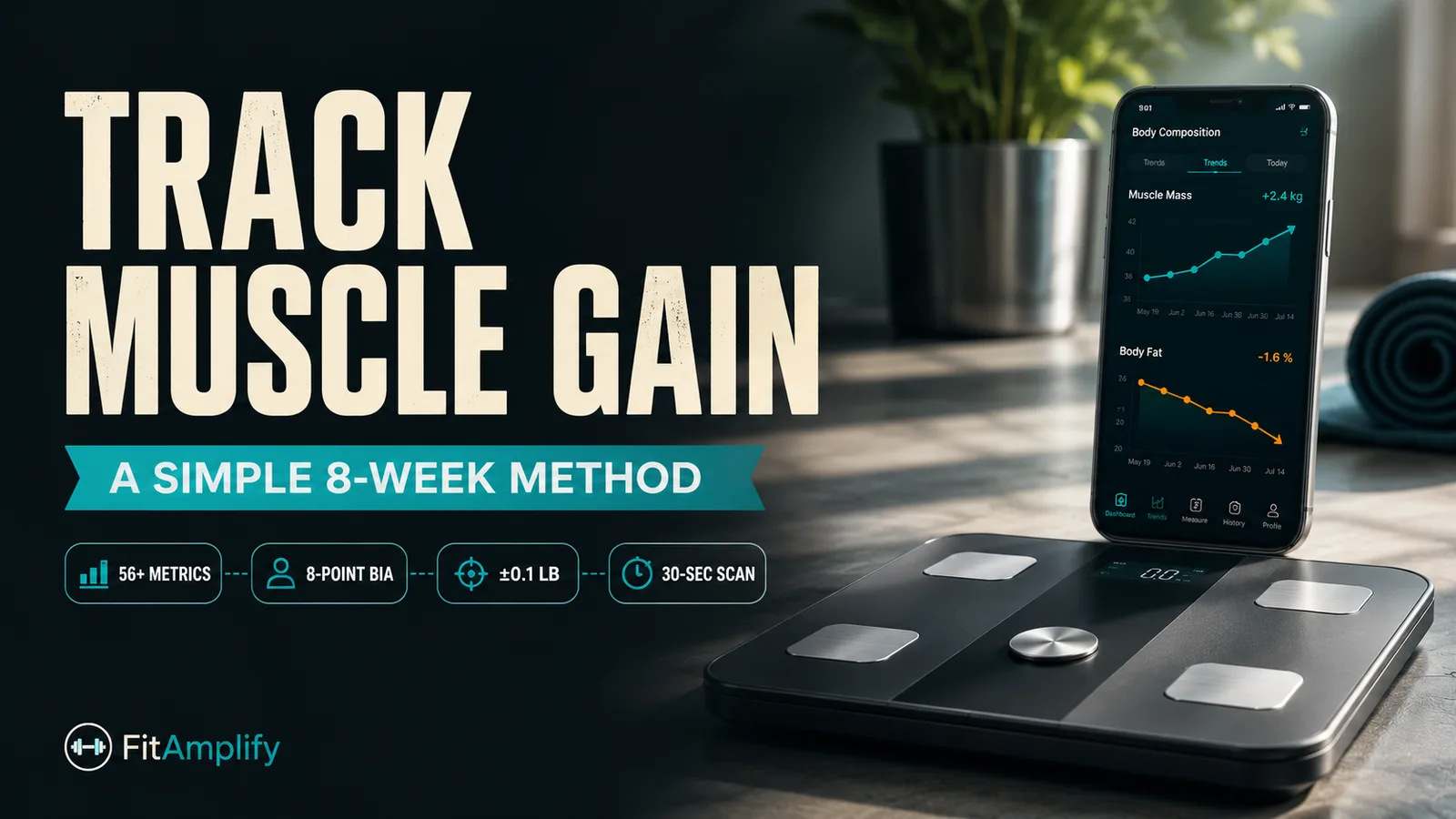
Building muscle is slow, quiet work, and a regular bathroom scale barely notices it. This guide shows you how to track muscle gain with a smart scale by watching body-composition metrics like muscle mass and body fat percentage instead of one flat weight number. You will get a simple 8-week routine, the right way to weigh, and a way to read your results that actually reflects the tissue you are building.
Why the scale number hides your muscle gain
Muscle is dense and it comes on slowly. When you start lifting, you often add a little muscle while dropping a little fat at the same time. The scale can sit still, or even creep up, while your body is genuinely changing shape. On top of that, your weight swings from hour to hour with food, salt, and how hydrated you are. Studies on impedance scales show that drinking as little as 500 mL to 2,000 mL of water measurably shifts the readings, so a single morning number can move a pound or two for reasons that have nothing to do with muscle.
Here is the scale of the problem. Reviews of resistance-training studies suggest a beginner adds only about 0.3 to 0.5 kg (roughly 0.7 to 1.1 lb) of muscle in a good month, and the rate slows as you get more trained. That real gain can easily hide underneath a kilogram of day-to-day water noise. So one weight reading cannot separate muscle from water from fat. A smart body-composition scale pulls that single number apart into the parts you care about.
What muscle gain looks like on a smart scale
Smart scales estimate body composition using bioelectrical impedance analysis, or BIA. Gentle, painless signals pass through your body, and because muscle, fat, and water conduct those signals differently, the scale estimates each one separately. The FitAmplify scale uses 8-point BIA with 8 precision electrodes, which reads your arms, trunk, and legs on their own rather than sending one signal up and down through your feet. That segmental view is useful for muscle, because it shows where growth is showing up and whether one side is lagging.
When you are tracking muscle gain, a handful of the 56+ metrics do most of the work. Here is what each one tells you.
Metric | What it is | Why it matters for muscle gain | How to read it |
Muscle mass | The estimated weight of muscle tissue in your body | The most direct signal that your training is adding tissue | Follow the weekly trend, never a single day |
Lean body mass | Everything that is not fat: muscle, water, bone, organs | Rises as you build muscle, but also moves with hydration | Read it next to muscle mass, not on its own |
Body fat % | The share of your weight that is fat | Confirms that gains are muscle, not added fat | Healthy ranges vary by age and sex |
Segmental analysis | Arm, trunk, and leg readings measured separately | Catches left-right imbalances and shows where you grow | Compare sides over several weeks |
Body water | Your total body water, a hydration marker | Explains most of the daily bounce in your numbers | Standardize hydration before you weigh |
Table 1. The body-composition metrics that matter most when you are tracking muscle. Metric definitions reflect standard body-composition terminology.
How to track muscle gain with a smart scale: the 8-week method
Eight weeks is long enough to see a real change in muscle mass and short enough to stay motivated. The plan is simple: weigh under the same conditions, let the app collect the numbers, and judge yourself on the trend rather than any one morning. The FitAmplify app auto-syncs your scan over Bluetooth, so every reading lands in your history without you typing anything.
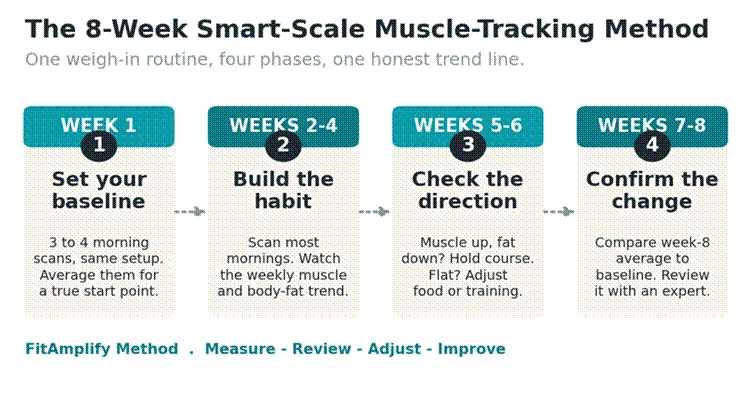
Figure 1. The 8-week smart-scale muscle-tracking method, built on FitAmplify's Measure, Review, Adjust, Improve loop.
Week 1, set your baseline. Take three or four morning scans in the same conditions and average them. One reading is a snapshot with a lot of noise, so an average gives you an honest starting point for muscle mass and body fat.
Weeks 2 to 4, build the habit. Scan most mornings and let the numbers stack up. You are not looking for daily jumps yet. You are teaching the app your normal range so a real trend can appear. Keep resistance training on at least two days a week, working all the major muscle groups, which is the general activity guideline for adults.
Weeks 5 to 6, check the direction. Now the weekly trend should say something. If muscle mass is drifting up and body fat is drifting down, hold your course. If both are flat, that is your cue to look at food and training before week 8, not after.
Weeks 7 to 8, confirm the change. Compare your week-8 average against your week-1 baseline. A small rise in muscle mass with steady or lower body fat is exactly what progress looks like over two months. You can track all 56+ metrics in the app and, if you want a second set of eyes, share the trend with a coach.
How to weigh so the numbers actually mean something
BIA is excellent for tracking change over time, but it is sensitive. Food, fluid, exercise, and even the time of day all move the reading, and impedance scales tend to read muscle mass a little higher than a lab method like a DEXA scan. None of that makes the scale useless. It means your job is to remove as many variables as you can so the trend reflects your body and not your breakfast. Standardizing the conditions is the single biggest thing you can do for a reliable reading.
Do this for a clean reading | Avoid this |
Weigh first thing in the morning, before eating or drinking | Weighing after a big meal or a lot of fluid |
Go after using the bathroom | Weighing right after a workout or a sauna |
Stand barefoot on clean, dry feet, same spot each time | Random times of day that you cannot repeat |
Keep the scale, time, and conditions consistent | Comparing one single day to the next single day |
Use fresh alkaline batteries, not rechargeables | Judging progress from one reading in isolation |
Table 2. Best-practice do's and don'ts for an accurate smart-scale reading. Timing and hydration guidance reflect published BIA research and FitAmplify's own measurement advice.
FitAmplify recommends alkaline batteries specifically, because rechargeables can cause inaccurate readings. If you want the full setup checklist, the support guide covers accurate-reading best practice.
Read the trend, not the daily number
This is the habit that separates people who track muscle well from people who quit in frustration. Your daily readings will bounce around. The weekly average will move slowly and honestly. The chart below shows what a realistic two months can look like: muscle mass climbing a little, body fat easing down, and the scale weight barely moving. That pattern, muscle up and fat down while weight holds, is called body recomposition, and it is the exact change a plain scale would completely miss.
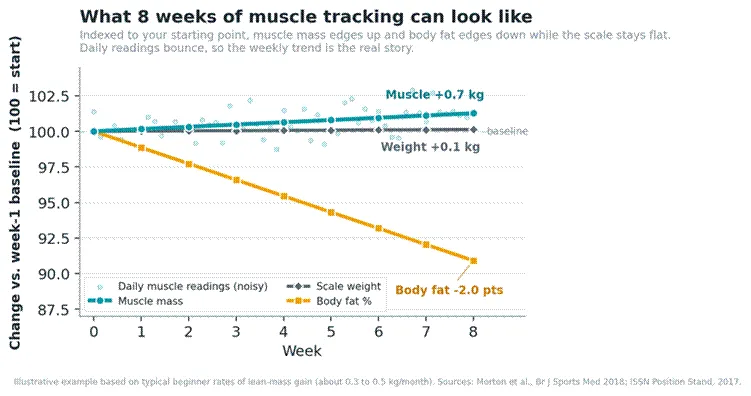
Figure 2. Muscle mass edges up and body fat edges down while the scale stays flat. Daily readings are noisy, so the weekly trend is the number to trust.
When the numbers stall, a real person should read them
A trend that flattens is information, not failure. It usually means one lever needs a nudge: a bit more protein, a bit more training volume, or better recovery. This is where FitAmplify is built differently from a scale that just hands you an algorithm. Your data goes to real dietitians and coaches who read your actual scans and tell you what to change next.
Our coach Chandradip Ghosh puts it plainly: “I don’t guess. Every program I write starts from your body scan results.” On the nutrition side, protein is usually the first thing our team checks, because research on building and keeping muscle points to a daily intake of roughly 1.4 to 2.0 grams of protein per kilogram of body weight for people who train. If your muscle trend has stalled, a registered dietitian can look at your intake and your readings together instead of guessing. You can talk to a registered dietitian or coach about your own numbers, or meet the expert team first if you want to see who reviews your data.
Frequently asked questions
How do I track muscle gain with a smart scale?
Weigh under the same conditions each morning, let the app record your muscle mass and body fat, and judge your progress on the weekly trend rather than any single reading. Over an 8-week block, a slow rise in muscle mass with steady or lower body fat is what real gain looks like.
How long before a smart scale shows muscle gain?
Expect weeks, not days. Beginners tend to add only about 0.3 to 0.5 kg of muscle per month, so a clear trend usually shows up around weeks 4 to 8. That gain is easy to miss day to day because normal water swings are often larger than a week of muscle growth.
Can a smart scale tell muscle from water weight?
It estimates them separately using bioelectrical impedance, which is why a good smart scale is far more useful than weight alone. Hydration still influences the reading, though, so the reliable signal is the weekly muscle-mass trend, not one morning's number.
How accurate are smart scales for muscle mass?
They are very good at showing change over time, which is what tracking is about. Compared with a lab method like a DEXA scan, impedance scales tend to read muscle mass somewhat high, so treat the numbers as a consistent tracking tool for wellness, not a medical measurement.
How often should I weigh to track muscle?
Most mornings is ideal, because more readings make the weekly average more reliable. Just resist reading meaning into any single day. The average across the week is the number that reflects your muscle, not the daily bounce.
Do I need a gym to gain muscle worth tracking?
No. The general guideline for adults is muscle-strengthening activity on at least two days a week that works all the major muscle groups, and that can be free weights, machines, or resistance bands at home. The scale will track the result either way.
Want to see your full body picture instead of one number on the floor? Explore the smart body-composition scale, track your 56+ metrics in the app, or book a free 20-minute consultation with a real coach who will read your numbers with you.
References
1. U.S. Centers for Disease Control and Prevention. “Adult Activity: An Overview” (Physical Activity Basics). https://www.cdc.gov/physical-activity-basics/guidelines/adults.html
2. Morton RW, et al. “A systematic review, meta-analysis and meta-regression of the effect of protein supplementation on resistance training-induced gains in muscle mass and strength.” British Journal of Sports Medicine, 2018. https://pubmed.ncbi.nlm.nih.gov/28698222/
3. Jäger R, et al. “International Society of Sports Nutrition Position Stand: Protein and Exercise.” Journal of the ISSN, 2017. https://pmc.ncbi.nlm.nih.gov/articles/PMC5477153/
4. Lee SY, et al. “Comparison between Dual-Energy X-ray Absorptiometry and Bioelectrical Impedance Analyses for Accuracy in Measuring Whole Body Muscle Mass and Appendicular Skeletal Muscle Mass.” Nutrients, 2018. https://www.ncbi.nlm.nih.gov/pmc/articles/PMC6024648/
5. Ugras S. “Evaluating of altered hydration status on effectiveness of body composition analysis using bioelectric impedance analysis.” Libyan Journal of Medicine, 2020. https://pmc.ncbi.nlm.nih.gov/articles/PMC7144212/
FitAmplify is a wellness product and is not a medical device. It is not intended to diagnose, treat, cure, or prevent any disease. Body-composition readings are for general wellness tracking, not medical diagnosis. Always consult a qualified healthcare professional regarding any medical concern.