Best Smart Scale Alternatives to Renpho Canada Guide
Best Smart Scale Alternatives to RENPHO for Canadians Who Want CAD Pricing and Local Warranty

The FitAmplify Team · Reviewed by Ms. Shivani Tomar, RD, Registered (clinical) Dietician, M.Sc Nutrition, 12 years' experience · Updated August 2026 · 11 min read
Renpho gets you a number on a screen, not the full picture. If you want the best smart scale alternatives to Renpho Canada, look for a device that pairs solid tracking with real people who can explain what your results mean. A renpho smart scale can log weight fine, but body composition readings vary between devices, so any best rated smart scale should come with expert guidance, not just numbers. That's where expert review makes the difference.
Why Canadians Look Past Renpho
A number on a screen means little if it does not match reality. Body fat readings on consumer scales, including a typical renpho smart scale, can miss the mark by 2.2 to 4.4 kg compared to DEXA scans, even when the weight itself is accurate to within a kilogram. That gap is exactly why so many people start comparing a smart bathroom scale on more than price alone.
The good news is that weight tracking still works well, so a smart scale for weight stays useful for spotting trends over time. The catch is that not every device analyzes body composition the same way, so switching brands mid-journey can throw your trend line off. Canadians shopping for alternatives tend to weigh a few of the same factors, laid out below.
Feature | Renpho | Typical Alternative |
|---|---|---|
Weight accuracy (kg, median error) | under 1 | under 1 |
Body fat error vs DEXA (kg) | 2.2-4.4 | 2.2-4.4 |
Body metrics tracked (count) | fewer | 56+ |
Electrode contact points (count) | 4 | 8 |
Expert review included (yes/no) | no | yes |
If those numbers matter to you, it is worth seeing how expert review works before you commit to a new scale.
What Makes a Smart Scale Worth Buying
Before you compare specs, it helps to know what actually separates a good scale from a gimmick. Not every device labeled "smart" gives you numbers you can trust, and the ones that do still have limits worth understanding.
Accuracy and sensor design
Weight readings on most modern scales are solid, with median error under 1 kg. Body fat percentage is a different story. Even the most accurate smart scale on the market tends to underestimate fat mass by 2.2 to 4.4 kg compared to a DEXA scan, so treat that number as a trend indicator, not a lab result.
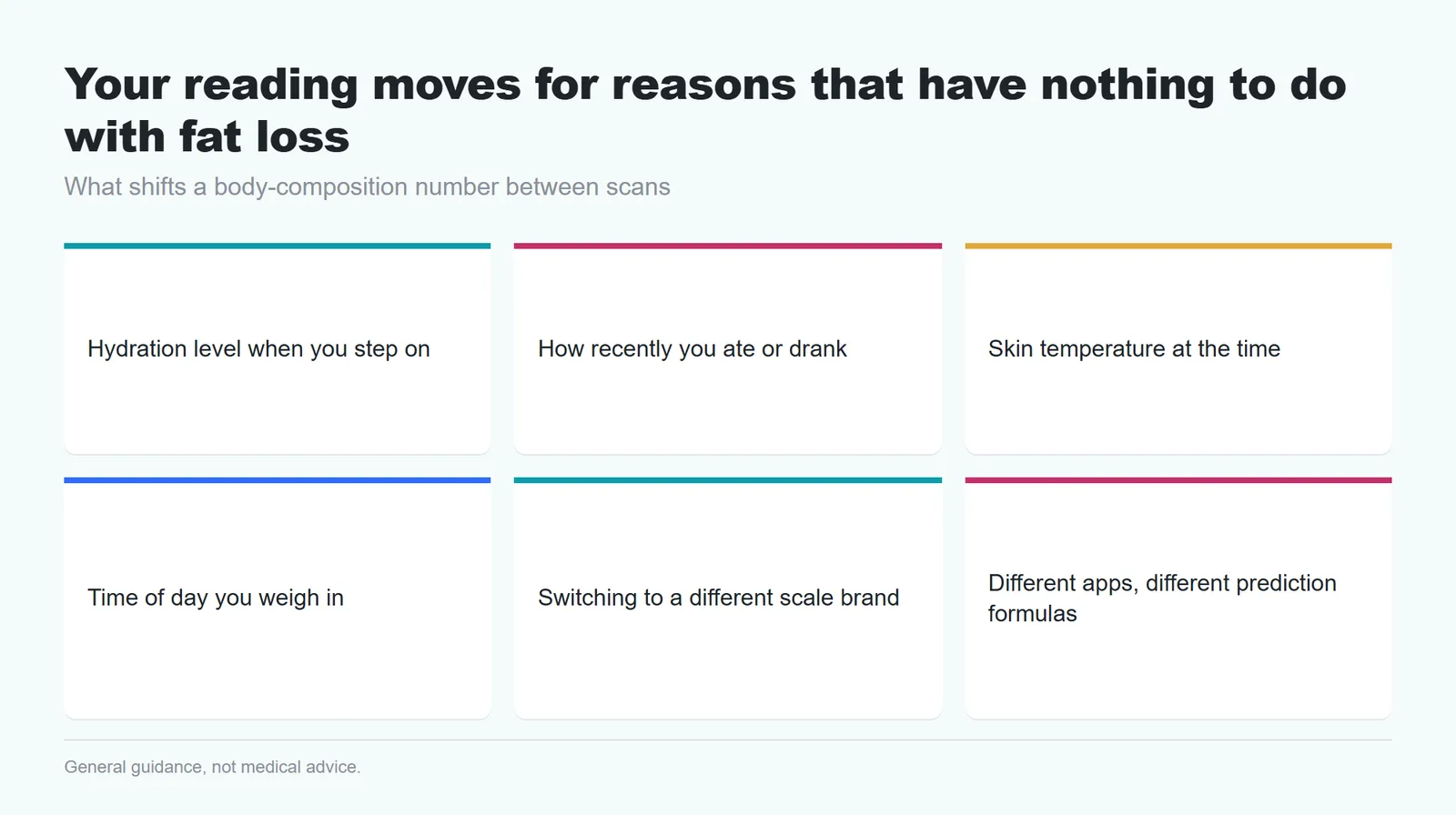
Electrode count and placement matter here. A body composition scale with more contact points reads your arms, trunk, and legs individually instead of guessing from your feet alone, which matters if you carry weight unevenly. Because different BIA analyzers use different formulas, switching devices mid-journey can make your history look inconsistent even when your body hasn't changed much. Hydration, recent meals, and skin temperature all shift the reading too, so weigh in under similar conditions and give it a couple of months before you judge real progress.
App and data ownership
The scale is only half the picture. A smart scale app should store your full history, sync automatically, and let you actually see trends over time, not just a single snapshot. Before buying, check whether expert review or coaching support comes bundled in, since raw numbers mean little without someone to help you read them.
Smart Scale Alternatives Compared
Since no two BIA analyzers read your body the same way, and hydration or a recent meal can nudge the numbers around, your best bet is to compare scales on things you can actually verify, not just marketing claims. That means looking past app screenshots and checking real specs like electrode count, metrics tracked, and what you get for the price. This is how you separate a top rated smart scale from one that just looks good in a photo.
A smart body-composition scale built for a wide range of body types typically uses more contact points and reports more data per scan. Here is what to line up side by side when you are shopping for the best smart scale 2025 has to offer:
Spec to Compare | Number | Why It Matters |
|---|---|---|
Electrodes (points) | 8 | More contact points mean segmental reads for arms, trunk, and legs, not just a single full-body guess |
Metrics per scan | 56 | A wider metric set gives you more to track than weight and body fat percentage alone |
Price (CAD, one-time) | 50 | No subscription fee to keep using the scale itself |
Battery life (months) | 12 | Fewer battery swaps means fewer excuses to skip a weigh-in |
Private profiles | 8 | Households can track separately without mixing up data |
None of this makes any scale a stand-in for a DEXA scan, since even reliable weight tracking still comes with fat mass estimates that can run 2.2-4.4 kg off from lab results. What a good comparison gives you is a scale that is at least consistent with itself over time, paired with an app that tracks 56+ metrics so the trend line, not any single reading, tells the real story.
How FitAmplify Compares on Value
Price is only half the comparison. The real question is whether an advanced smart scale gives you numbers you can trust from one week to the next, and that depends on more than the sensor inside it.
Every body fat scale smart enough to read impedance is still working with the same physics, and that comes with limits. BIA readings shift with hydration, recent meals, and even skin temperature, so a scale that reads low one morning and high the next isn't necessarily broken. Different analyzers and prediction equations also don't agree with each other, which is why switching brands mid-tracking muddies your data more than a single reading ever could.
This is where a smart fitness scale earns its keep less through raw accuracy and more through consistency and support. The FitAmplify Smart Scale uses the same 8-point BIA method every time you step on, and pairs each scan with expert review from a registered dietitian who can put the number in context instead of leaving you to guess what it means. That combination, a device that measures the same way every time plus a person who reads the trend with you, is the actual value comparison. Because most body composition methods carry some margin of error, giving results a couple of months before checking again is still the honest way to confirm real change, and that patience matters more than which scale sits under your feet.
Which Scale Fits Your Goal
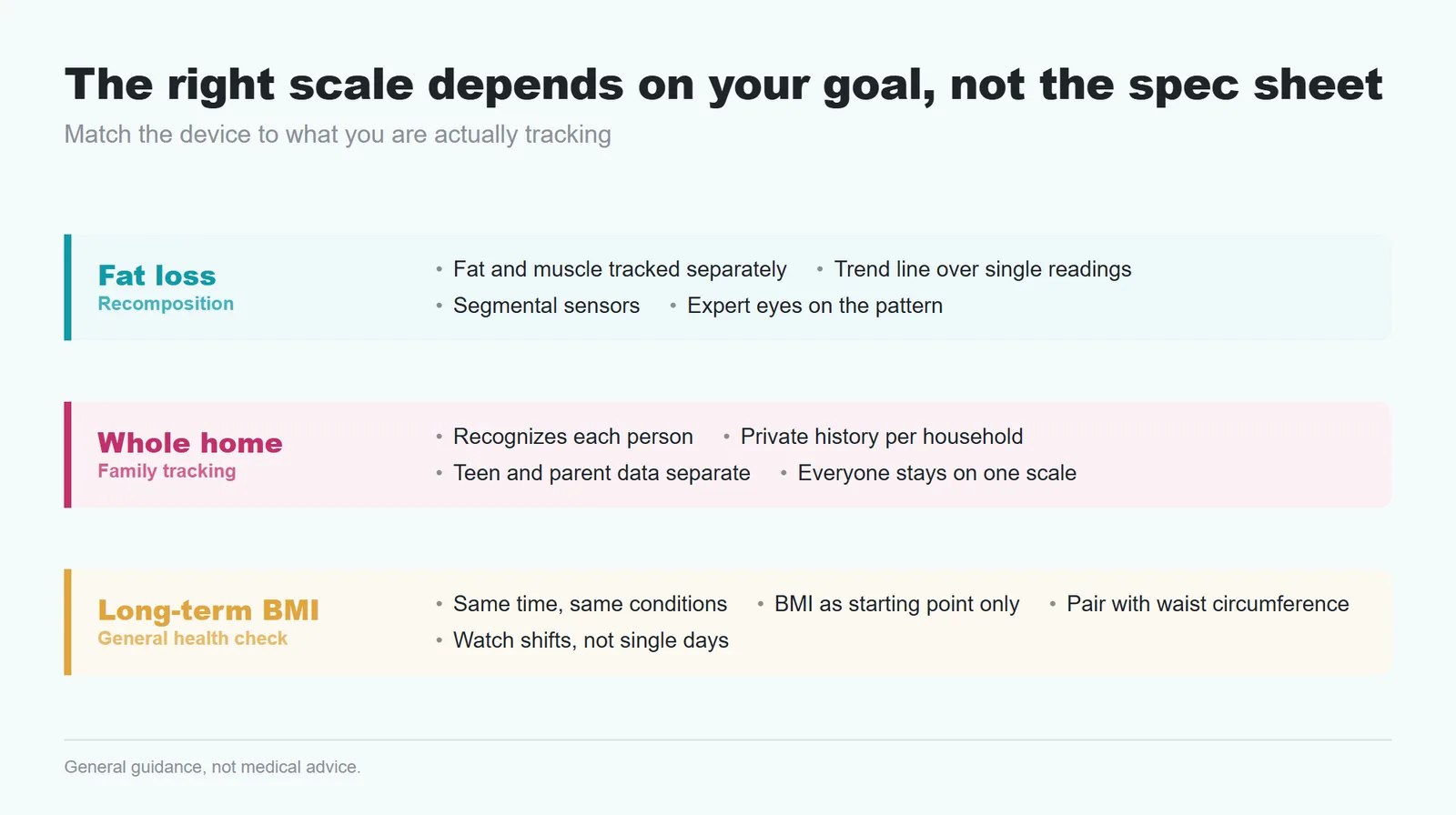
The right answer depends on what you're actually trying to do, not which scale has the most impressive spec sheet. A BMI reading alone puts you in a CDC category from underweight to obese, but that number says nothing about whether your weight is muscle or fat, or whether it's moving in the direction you want.
Fat loss and recomposition
If you're losing fat while building muscle, a single weight number will lie to you. You need a smart scale for body composition that tracks fat mass, muscle mass, and how those shift relative to each other, since the scale is under-counting your fat mass by a couple of kilograms is far less important than whether that same measurement is trending down over time. The best body fat scale for this goal is the one you'll actually use consistently, paired with someone who can read the trend and tell you if your recomposition is real progress or normal fluctuation.
Family and whole-home tracking
Households have different needs entirely. What matters here is a best smart weight scale that recognizes each person automatically and keeps everyone's history separate, so a teenager's numbers never mix with a parent's. The FitAmplify app supports up to 8 private profiles for exactly this reason, and because different BIA devices can read the same body differently, the whole family staying on one consistent scale matters more than chasing a fancier model.
Checklist Before You Buy
Before you swap your Renpho for something new, run through this short list so you don't just trade one imperfect scale for another.
Confirm it's a real Bluetooth smart weight scale, not just a digital one. A basic smart digital scale gives you weight. A smart Bluetooth scale should sync automatically and build a history you can actually see over time.
Check how many metrics it tracks, and how. More data points only help if the scale uses real segmental sensors, not a single estimate stretched across a dozen labels.
Look at BMI as a starting point, not a verdict. Health Canada classifies 18.5-24.9 as least risk and 30.0 and above as high risk, and CDC uses the same 18.5-24.9 normal range, but pair that number with waist circumference, since a normal BMI with a larger waist roughly doubles disease risk.
Don't expect DEXA-level fat readings. Any smart bluetooth scale, including this one, tends to underestimate fat mass by several kilograms compared to DEXA scanning.
Decide if you want expert eyes on your data. If you'd rather not interpret trends alone, you can talk to a registered dietitian once you've got a few weeks of readings.
How to Get Accurate Readings
A single reading can shift for reasons that have nothing to do with your progress. Hydration, recent meals, and even your skin temperature all change how electricity moves through your body, and that's the signal a smart weigh scale is actually reading. So if a body scale smart enough to track 56+ metrics shows a weird jump overnight, it's usually noise, not news.
Here's what actually helps. Weigh in around the same time of day, ideally before eating or drinking, so conditions stay consistent from one scan to the next. Then give it time. Because body fat measurements carry some built-in error no matter which device you use, it's smarter to wait a couple of months before comparing numbers seriously.
One more thing worth knowing: results from different scales, or even different smart scale application tools, aren't meant to be swapped. Pick one device, stick with it, and judge yourself against your own trend line. If the pattern still confuses you, someone on the FitAmplify app can walk through it with you.
FAQ
Is a smart scale as accurate as a body composition test at a clinic?
No. Research shows smart scales get weight right, but they underestimate fat mass by several kilograms compared to DEXA, a clinical imaging method. Think of a smart scale as a trend tool, not a diagnostic one. It is great for spotting patterns over weeks, not for pinning down an exact fat percentage.
How often should I weigh in on a smart scale?
Weigh in as often as you like for consistency, but hold off on judging body composition changes for a couple of months. Bioelectrical impedance readings carry natural error, and short-term swings often reflect hydration, not fat. Patience gives you a more honest picture.
What is the best smart bathroom scale for tracking BMI over time?
The best smart bathroom scale for BMI tracking is one you use consistently, at the same time of day, under the same conditions. BMI itself is grouped into standard ranges, from underweight to obese, and tracking it over time helps flag meaningful shifts rather than one-off numbers. Consistency matters more than which brand you pick.
What makes a smart scale the best choice for a household?
A smart scale is best for a household when it supports multiple private profiles and keeps each person's history separate. Look past the flashy marketing and ask whether the app is genuinely free and whether real people back up the data.
Do all smart scale apps show the same numbers?
No, and that catches people off guard. Different devices and apps use different algorithms, so numbers rarely match across tools. Stick with one scale and one app so your trend line stays meaningful, and book a free 20-minute consultation if you want a second opinion on what the numbers mean.
Conclusion
Renpho gets you a number on a screen. It does not get you someone to call when that number does not make sense, or an explanation for why your fat mass reading jumped overnight. Smart scales in general underestimate fat mass by a real margin compared to lab methods, so treat any single reading as a rough guide, not a verdict, and give it a couple of months before you compare again.
That is where a best rated smart scale earns its place: pairing 56+ tracked metrics with dietitians who can put your BMI and trends into context. If you want that backup built in from day one, explore the FitAmplify smart scale or book a free 20-minute consultation to talk through your goals first.
References
Accuracy of Smart Scales on Weight and Body Composition: Observational Study, NCBI/PMC
Accuracy of Smart Scales on Weight and Body Composition: Observational Study, NCBI/PMC
Body Composition: Which Numbers Matter?, ACE Fitness (American Council on Exercise)
Body Mass Index (BMI) Nomogram, Health Canada / Canada.ca
Canadian guidelines for body weight classification in adults: application in clinical practice to screen for overweight and obesity and to assess disease risk, NCBI/PMC (Canadian Medical Association Journal)
FitAmplify is a wellness product and is not a medical device. It is not intended to diagnose, treat, cure, or prevent any disease. Always consult a qualified healthcare professional regarding any medical concern.