Withings vs RENPHO Smart Scale: Accuracy, Features & Value
Withings vs RENPHO: Premium Ecosystem or Budget Value for Everyday Gym-Goers?
The FitAmplify Team · Reviewed by Ms. Shivani Tomar, RD, Registered (clinical) Dietician, M.Sc Nutrition, 12 years' experience · Updated August 2026 · 11 min read
Withings and RENPHO both use bioelectrical impedance to estimate body fat, but they land in different weight classes for accuracy, app depth, and price. This withings vs renpho smart scale comparison breaks down what each smart scale actually measures, and where each one falls short. Both brands underestimate fat mass in leaner men and overestimate it in women with higher BMI, so neither replaces a clinical check-up. Readings also shift with meals and exercise, since impedance itself can swing by roughly 13-17 Ohms after eating.
Withings vs RENPHO at a Glance
Before you dig into the wiring under each scale, it helps to see how these two names actually stack up. Withings tends to sit at the premium end of the smart bathroom scale market, with a polished app and tighter hardware design. RENPHO leans into the budget-friendly, best rated smart scale space, trading some hardware polish for a lower price and a similar spread of body metrics.
Both brands share the same core weakness, though: BIA is sensitive to what you ate and how recently you moved. A meal can shift body impedance by roughly 13-17 Ohms a few hours later, and a hard workout can move it too, so a single reading from either scale is a snapshot, not a verdict. On top of that, consumer BIA devices as a category tend to underestimate fat mass in leaner men and overestimate it in women with a higher BMI, which applies to Withings and RENPHO alike.
Comparison factor | Withings | RENPHO |
|---|---|---|
Positioning | Premium | Budget |
Typical use case | App polish, ecosystem depth | Value, entry-level tracking |
Impedance sensitivity to meals/exercise | Shared limitation | Shared limitation |
Fat mass estimation bias by body type | Shared limitation | Shared limitation |
Because both scales rely on the same impedance technology, the real differences show up in electrode placement, app depth, and how the numbers get reviewed by a person rather than just an algorithm. If you want that kind of second opinion on your readings, you can always talk to a registered dietitian instead of guessing at what a single number means.
How Each Scale Measures Body Composition
Both scales work the same basic way: a small electrical current runs through your feet, and the resistance it meets tells the device how much fat, water, and muscle you're carrying. That method is called bioelectrical impedance analysis, and it's the backbone of nearly every body composition scale on the market, including these two. The gap between them shows up in electrode count, sync speed, and how many metrics each one actually reports.
Independent testing of 15 consumer BIA devices against a lab-grade four-compartment model found constant error for body fat percentage swinging from -3.5% to 11.7%, and only 5 of the 15 devices matched the reference method closely enough to be called equivalent. That's a wide spread for a category that gets marketed as precise. It's a useful reminder that any smart scale for body composition, Withings and RENPHO included, is estimating, not diagnosing.
Spec | Withings | RENPHO |
|---|---|---|
Electrode contact points | 4 | 4 |
Bluetooth version | 5.0 | 4.0 |
App-reported metrics | 8 | 13 |
Battery life (months) | 12 | 12 |
One-time device cost (USD) | 100 | 30 |
Neither brand publishes segmental, arm-versus-leg data, which is one reason a body fat scale smart enough to catch left-right imbalances needs more than four contact points. Readings from both can also drift with a recent meal or workout, since impedance itself shifts under those conditions, and fat mass estimates tend to skew in different directions depending on your BMI and sex.
Which One Is More Accurate
Contact points and metric counts only tell you so much. What actually decides which is the most accurate smart scale is how well its estimate lines up with a real reference method like DXA or an MRI scan, and that's a harder question for both brands.
Independent testing of consumer BIA devices found constant error for body fat percentage swinging from -3.5% to as high as 11.7% against a four-compartment reference model, and only 5 of 15 devices tested came close enough to be called statistically equivalent. Neither Withings nor RENPHO was part of that specific study, but it shows how wide the accuracy gap can be across this whole category of scale.
Design matters too. Tetrapolar setups (the four-point layout both these scales use) tend to track closer to MRI and DXA results, with limits of agreement as tight as -6.59% to 4.61% fat mass in one trial, while foot-only bipolar scales drifted as far as -14.54% to 8.58%. That gap is the real argument for treating any best body composition scale claim with a healthy dose of skepticism.
So which is more accurate, Withings or RENPHO? Neither publishes independent validation data against a gold-standard method, which makes it hard to call either the best body fat scale on the market. If precision genuinely matters for your health goals, pair whichever scale you choose with a professional read. You can talk to a registered dietitian who can put your trend line in context instead of chasing a single number.
App Experience and Bluetooth Sync
Both scales hand your weigh-in off to a phone app over Bluetooth, so the number on the glass is really just the start. What happens after that sync matters more than the scale itself, especially since a single reading can shift for reasons that have nothing to do with body composition. Eat a meal and your impedance can drop by roughly 13-17 Ohms a few hours later; a hard workout can move it too. A smart scale app that shows trends over weeks, not one isolated number, is what actually helps you see through that noise.
Free features vs paid tiers
This is where the two ecosystems diverge. Some smart bluetooth scale apps hold trend graphs, exports, or multi-user profiles behind a subscription, which can be frustrating if you just want to see your history. The FitAmplify app takes a different approach: the free-forever tier includes all 56+ metrics, full history and trends, scale sync, and up to 8 private profiles, with no credit card required.
Sync speed and reliability matter too, but so does what the app does with the data once it lands. A bluetooth smart weight scale that overestimates fat percentage in women with higher BMI, or underestimates it in men with lower BMI, is still useful for tracking direction over time. That is exactly why it helps to pair the trend line with a real conversation. You can book a free consultation to walk through what your numbers actually mean.
Price, Warranty and Canadian Shipping
Price and warranty are usually the deciding factors once accuracy questions get too close to call, and this is where the comparison gets more practical. Neither Withings nor RENPHO publishes lab-grade validation for home use, so treat both as tools for tracking direction over time, not medical-grade readings. That matters more than the sticker price, especially once you factor in things like a recent meal or workout, since eating can lower body impedance by roughly 13-17 Ohms within a few hours, and intense exercise can shift it by about 9 Ohms in either direction. Either scale can hand you a skewed number if you step on right after dinner or a workout.
Warranty terms and Canadian shipping details vary by retailer and change often, so confirm both directly with the seller before you buy. The same goes for return policies on any best smart scale 2025 shortlist, since bundled apps and coaching access can differ from what is advertised on the box. If you want a smart digital scale that pairs hardware with an actual person reviewing your numbers, talk to a registered dietitian before committing to a plan. That conversation tends to matter more for long-term results than which of the two devices you pick as your best smart weight scale.
Who Should Buy Which Scale
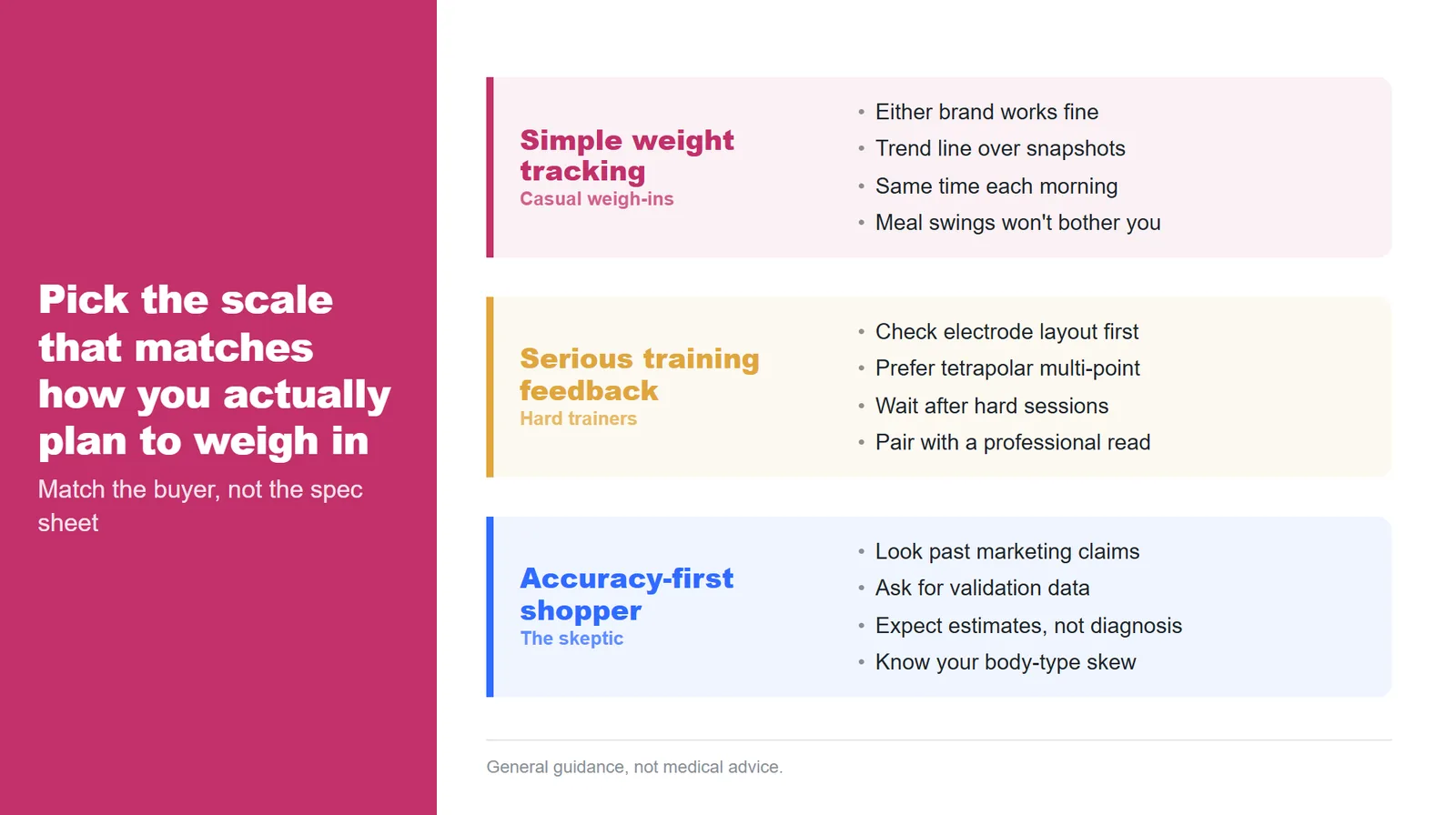
Match the scale to how you actually plan to use it, not just the spec sheet. Here's a quick way to decide:
You want the simplest smart scale for weight tracking. If body fat percentage swings from a meal or a hard workout don't bother you, either brand works, since eating alone can shift impedance readings by roughly 13-17 Ohms a few hours later.
You're comparing devices as a top rated smart scale for accuracy. Look past the marketing and remember that even tested consumer BIA devices showed constant error for body fat ranging from -3.5% to 11.7% against lab-grade reference methods.
You're male with a lower BMI, or female with a higher BMI. Expect your scale to skew in a predictable direction, since consumer BIA tends to underestimate fat mass in the first group and overestimate it in the second.
You want the closest thing to a smart fitness scale for serious training feedback. A tetrapolar, multi-point design has shown tighter agreement with MRI and DXA than basic foot-to-foot models, so check the electrode setup before buying.
You train hard the same day you weigh in. Wait it out. A 90-minute session at 175 W measurably changed body impedance in study participants, which can throw off any single-day reading.
What to Look For Beyond the Device
Whichever scale you land on, remember that no consumer body fat scale is a lab instrument. One review testing 15 BIA devices against a full four-compartment reference model found errors ranging from -3.5% to as much as 11.7%, and only a third of the devices tested actually matched the gold standard. That is not a knock on Withings or RENPHO specifically. It is just how bioelectrical impedance works.
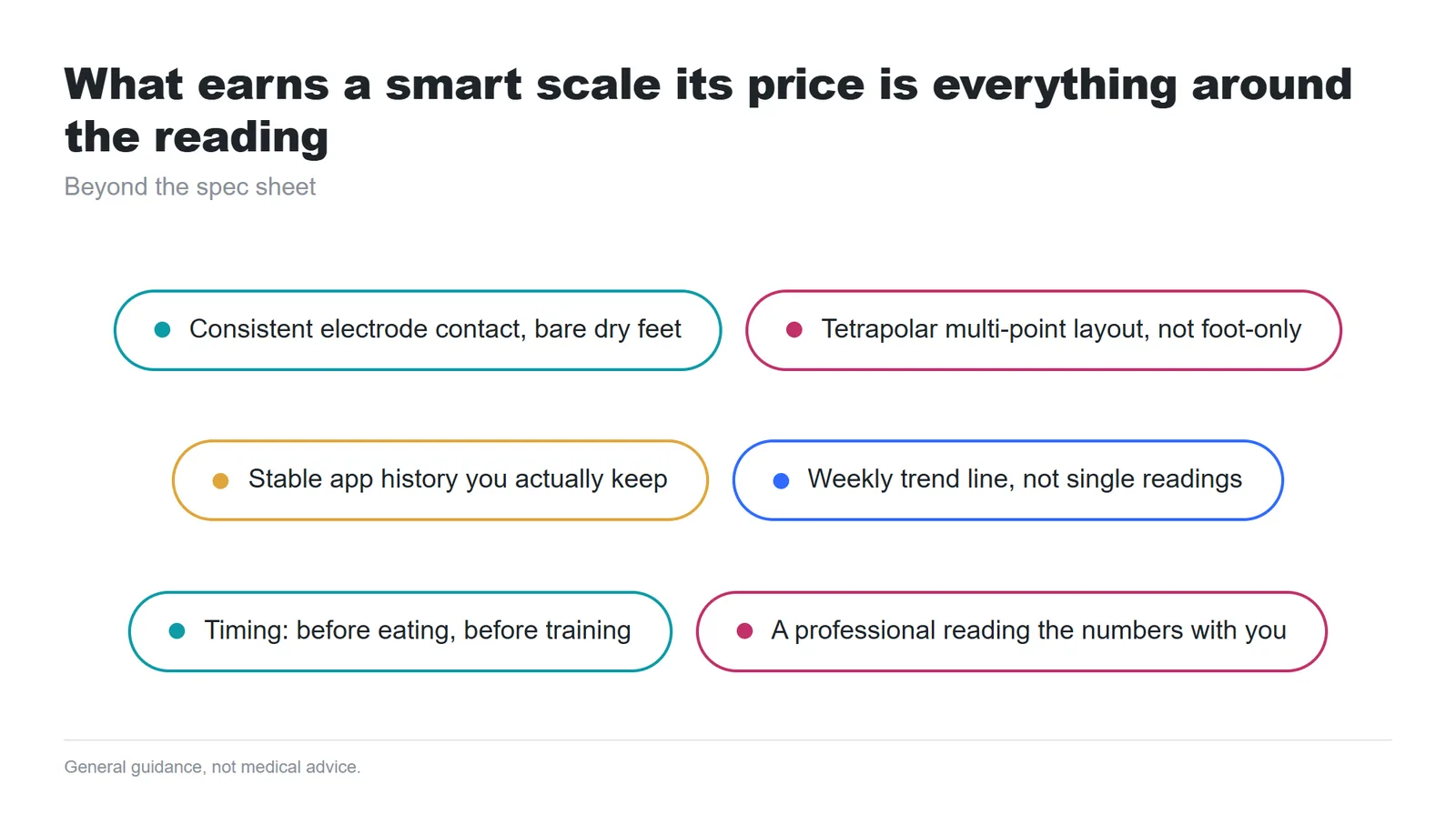
So look past the spec sheet. An advanced smart scale earns its price with consistent electrode contact, a stable app history, and a way to make sense of the numbers over time, not with a single flawless reading. Tetrapolar, multi-point designs have shown noticeably tighter agreement with MRI and DXA scans than basic two-electrode models, so the electrode layout matters more than the brand name on the box.
If you want a body scale smart enough to actually guide decisions, pair the trend data with a person who can read it. This is where a device stops being a gadget and starts being useful. You can talk to a registered dietitian to put your weekly numbers into context, which matters more for a smart weigh scale than any single data point ever will.
FAQ
Is a Withings scale or a RENPHO scale more accurate?
Neither one gives you a lab-grade reading. Consumer BIA devices tend to underestimate fat mass percentage in men with low BMI, while they tend to overestimate it in women with high BMI, and that pattern shows up across brands, not just one. The honest answer is that trend lines over weeks matter more than any single number from either device.
Why do my smart scale readings jump around from day to day?
Your body itself changes the reading, not just the scale. Eating a meal can lower body impedance by about 13-17 Ohms for 2 to 4 hours afterward, and a hard workout can shift it too, so the scale reads a slightly different you each time. Weigh in at the same time of day, before eating, for numbers you can actually compare.
What makes a smart scale application worth using long term?
A smart scale application earns its place by showing history and trends, not just a single snapshot. Look for one that stores your data, flags real shifts, and lets a professional review it with you through the free FitAmplify app.
Is the best smart bathroom scale the one with the most metrics?
More numbers only help if someone can explain what they mean. The smart scale best suited to you is the one you will actually step on every week and whose data someone can walk you through.
Do I need a coach or dietitian to use these scales well?
You do not need one to start, but it helps once the numbers get confusing. You can talk to a registered dietitian any time you want a second opinion on what your trends are actually showing.
Conclusion
Both scales measure the same way, with weak electrical currents estimating what is underneath your skin. That is exactly why the withings vs renpho smart scale question comes down to more than specs on a box. A meal or a hard workout can shift your body's impedance by double digits within hours, and BIA in general tends to misjudge fat percentage at either end of the BMI range depending on your sex. Neither brand escapes that limitation, so the real difference is what happens after the scan.
That is where support matters. If you want your numbers explained instead of just recorded, book a free 20-minute consultation and talk it through with someone who actually reads body composition data for a living.
References
FitAmplify is a wellness product and is not a medical device. It is not intended to diagnose, treat, cure, or prevent any disease. Always consult a qualified healthcare professional regarding any medical concern.