Affordable Home Health Monitoring Devices That Change Habits
Home Health Monitoring on a Budget: Simple Devices That Actually Change Your Habits
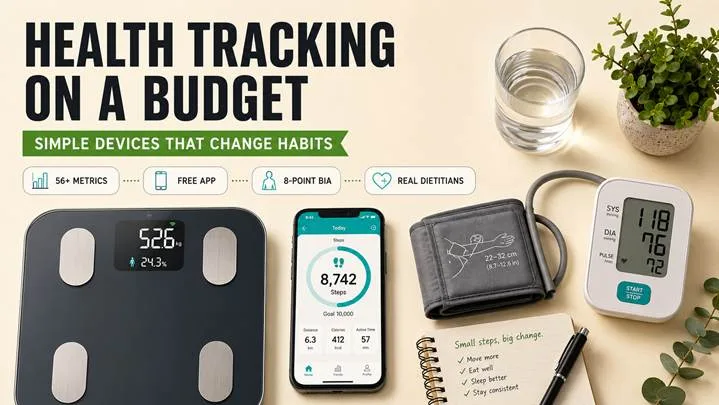
You do not need an expensive setup to understand your health at home. In fact, the device most likely to change your habits is usually the cheap one you actually use every day, not the premium gadget that ends up in a drawer by March. What matters is not the price on the box. It is whether the device gives you clear feedback and nudges you to do one small thing differently, day after day. This guide walks through the affordable home health monitoring devices worth starting with, what the research actually says about each, the mistakes that quietly sink most people, and how to make the data stick long enough to matter.
Key takeaways
· The best budget health device is the one you will use daily. A simple tool with clear feedback beats an expensive one you ignore.
· Self-monitoring genuinely changes behaviour. In one meta-analysis, just using a step counter added about 2,000 to 2,500 steps a day and raised activity by 27%.
· Start with one device tied to one goal. Tracking everything at once is how people quit.
· Data only works when you act on it. A device changes habits when it closes a loop: measure, see it, act, repeat.
· Some home devices, like blood pressure monitors, are tools you use with your doctor, not a substitute for medical care.
· A number is more powerful with a plan behind it. Pairing data with a real person or a simple routine is what makes it last.
In this article
· Why cheap devices often win
· What the evidence says about self-monitoring
· The affordable devices worth starting with
· How to pick one that actually sticks
· The loop that changes a habit
· Common mistakes that make a device fail
· A note on the medical stuff
· Where FitAmplify fits
· Frequently asked questions
Why cheap devices often win
It is easy to assume the most expensive tracker is the most effective one. Usually it is not. The device that changes your habits is the one you reach for without thinking, every single morning, and the price on the box has very little to do with that. A $30 tool you use daily will teach you more about your body than a $300 one you charge twice and then forget in a drawer.
There is a simple reason for this. Every device carries a small amount of friction, meaning the effort it takes to actually use it. A tracker you have to strap on, sync, charge, and then decode has far more friction than a scale you step on for ten seconds while the coffee brews. The more friction there is, the sooner most people quit. Affordability usually travels alongside simplicity, and simplicity is exactly what turns a gadget into a routine you keep.
A lower price also lowers the stakes in a helpful way. When a device costs $40 rather than $400, you are not afraid to try it, and you are not resentful if it turns out not to suit you. You can start, learn something real about your habits, and adjust without feeling you have wasted money. That freedom to experiment cheaply is underrated. At the very beginning, the goal is not a perfect measurement to three decimal places. It is building the daily act of checking in, and a low-cost, low-friction device is simply the easiest on-ramp to that habit.
The question | The short answer |
What makes a device work? | You use it daily and act on what it shows |
Best budget place to start | A body-composition scale or a step counter |
Rough cost to begin | Under $100, sometimes free with your phone |
The common trap | Buying data you never look at |
What multiplies the effect | Pairing the data with a plan or a person |
The one rule | One device, one goal, one small action |
At a glance. The rest of this article backs each answer up.
What the evidence says about self-monitoring
Simply watching a number can change your behaviour, and the research on this is surprisingly strong. In a 2007 review that pooled dozens of studies, people who started using a pedometer took about 2,000 to 2,500 more steps a day than those who did not, which worked out to a 27% jump in activity. The same review linked that new habit to a small drop in body mass index and a meaningful fall in blood pressure. None of those people were handed a gym membership or a strict diet. They were simply handed a way to see their own steps.
That effect has a name in behaviour science: self-monitoring. When you measure something and then see the result, you become more aware of it, and awareness quietly pulls your behaviour toward your goal without much willpower. Reviews of weight management have found the same pattern again and again. People who consistently track their food, their activity, or their weight tend to do better than those who do not, and the tracking itself turns out to be one of the strongest predictors of success, not a side note to it.
The point is not that a pedometer is magic, or that a scale burns fat on its own. It is that the act of measuring, and then actually looking at the result, nudges you to move a little more, eat a little more mindfully, or get to bed on time. Any affordable device that closes that loop can do the same thing. The device is just the object that makes the number visible enough to act on.
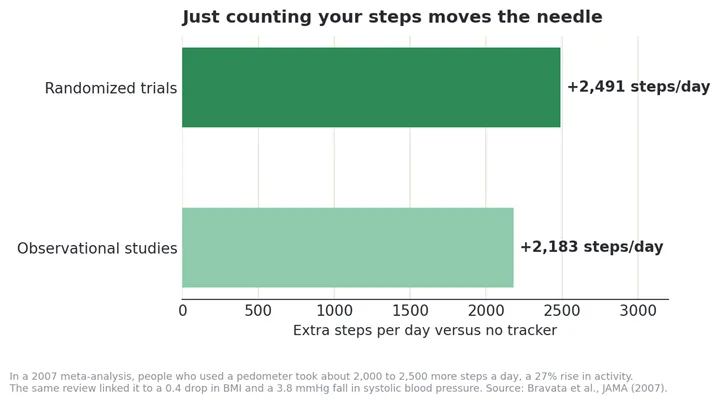
The measured effect of simply using a step counter. Source: Bravata et al., JAMA (2007).
It is worth reading a chart like this carefully, because it also shows the honest limit of tracking. It does not promise a specific result for you. It shows an average nudge across many people, which is exactly how any tracking claim should be read. Your own result depends on what you do with the number once you see it. The measurement opens the door. You still have to walk through it.
The affordable devices worth starting with
You do not need all of these. Pick the one that matches the habit you want to build, and cheerfully ignore the rest for now. Prices below are approximate Canadian retail and move around with sales and brands, so treat them as a rough guide rather than a quote.
Device | What it tracks | Rough cost (CAD) | The habit it can build | Keep in mind |
Body-composition scale | Weight, body fat, muscle, trends | $50 to $150 | A weekly weigh-in you review | Read the trend, not daily numbers |
Step tracker or phone | Steps, activity, movement | Free to $60 | A daily step target | Your phone likely does this already |
Home blood pressure monitor | Blood pressure at rest | $40 to $80 | Logging readings for your doctor | Use with a healthcare provider |
Sleep tracker or app | Sleep timing and consistency | Free to $60 | A consistent bedtime | Consumer sleep data is approximate |
Habit or food journal app | Meals, water, daily habits | Free | Noticing what you actually do | Simple beats feature-heavy |
Approximate Canadian pricing; verify current cost. FitAmplify's scale is priced in USD on our site. Blood pressure and similar devices are for use with your healthcare provider, not for diagnosis.
A few honest notes on that list. A body-composition scale is the most useful all-rounder for most people, because weight, body fat, and muscle trends touch nearly every goal, as long as you read the weekly direction rather than the daily wobble. A step tracker is often already in your pocket, since most phones count steps for free, so try that before buying a separate band. A home blood pressure monitor is genuinely valuable for the right person, but it belongs in the medical column, so choose a validated cuff and use it with your doctor rather than to self-diagnose. Sleep trackers are motivating for building a consistent bedtime, though the stage-by-stage breakdown they display is an estimate, not a lab result. And a free habit or food app can quietly outperform an expensive gadget, for the simple reason that the best tool is the one you will still be opening a month from now.
How to pick one that actually sticks
The best device for you is the one tied to a goal you genuinely care about right now, this month, not the goal you feel you should have. Match that goal to a single device and a single habit, then let it run for a few weeks before you add anything else. Trying to track weight, steps, sleep, food, and blood pressure all at once is one of the most common ways people burn out and abandon the whole project by the second week.
Keep the habit small enough that it survives a bad day. A weekly weigh-in is far easier to sustain than a daily one. A step target you usually hit beats an ambitious one you usually miss and feel guilty about. And decide in advance how often you will actually look at the data, because the review is where the behaviour change happens. A number you record but never read changes nothing at all.
Your goal | Start with | The one habit to build |
Understand your body beyond weight | A body-composition scale | A weekly weigh-in and a quick review |
Move more | A step tracker or your phone | Hit a daily step target |
Keep an eye on blood pressure (with your doctor) | A home blood pressure monitor | Log readings your provider can see |
Sleep more consistently | A sleep app or tracker | A steady bedtime and wake time |
Eat more mindfully | A free food or habit app | A daily one-line food note |
General wellness guidance. For any medical concern, speak with a qualified healthcare professional.
One more filter before you buy anything. Ask whether the device gives you feedback you can actually act on. If it only produces a number with no obvious next step, it will most likely join the drawer graveyard within a month. The tools that stick are the ones that answer the quiet question every reading raises, which is simply: so what do I do now?
The loop that changes a habit
Here is the part that separates a device that works from an expensive paperweight. It is not the sensor, it is the loop. A tool changes your habits only when you complete four steps. You measure, you see the result clearly, you act on it, and then you check whether the action worked. Skip any step, and especially the acting one, and even the most advanced device on the market changes nothing.
Walk through it with a simple scale. You step on at the same time each morning, which is the measure step. You look at the weekly trend in the app rather than the alarming single number, which is see it clearly. You notice the trend is drifting up, so you add a short walk after dinner, which is act on it. A week later the trend has flattened, which tells you the change worked, and the loop quietly begins again. The device did not do the work for you. It made the feedback visible enough that the next move felt obvious.
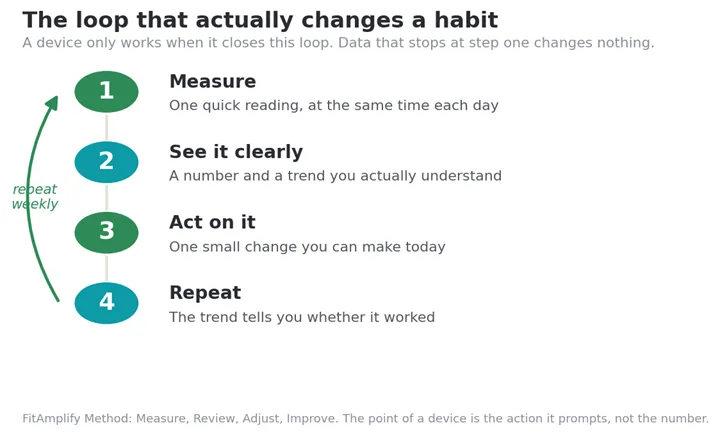
A device earns its keep by closing this loop, not by collecting numbers.
This is also why data paired with a plan beats data alone. When a number arrives with a next step attached, whether from a simple rule you set for yourself or a real person who reads the trend and tells you what to try, you are far more likely to follow through. The loop is the actual product. The device is just the place it starts.
Common mistakes that make a device fail
Most home health devices do not fail because the technology is bad. They fail because of a handful of very predictable habits, and knowing them in advance is half the battle.
The first is tracking everything at once. Five new metrics feels thorough for about a week, then overwhelming, then it gets abandoned altogether. One device and one goal will nearly always outlast a full dashboard of numbers you feel obliged to check.
The second is judging progress by a single day. Body weight, body water, blood pressure, and sleep all swing from day to day for reasons that have nothing to do with real change. A salty dinner, a hard workout, a poor night, each moves the number. The signal lives in the weekly trend, and reading a normal daily wobble as failure is exactly how people talk themselves out of a plan that was quietly working.
The third is buying for the person you wish you were. The premium tracker built for marathon runners is the wrong purchase if you have not walked regularly in a year. Buy for this month's habit, not next year's fantasy, and upgrade later if you earn the need.
The fourth, and the most important, is collecting data you never act on. A drawer full of readings is not health monitoring, it is a hobby. If a device does not lead to one small action you would not have taken otherwise, it is not doing its job. Avoid those four traps and almost any affordable device can earn its place on your counter.
A note on the medical stuff
A quick and honest boundary, because this genuinely matters. Some home devices sit close to medical care, and it is worth respecting that line rather than blurring it. A blood pressure monitor, a pulse oximeter, or a glucose meter can be truly useful, but they are tools you use alongside your doctor, not replacements for professional care, and they are not for self-diagnosis. A worrying reading is a reason to call a professional, not a reason to search your symptoms at midnight and frighten yourself.
Body-composition tools like a smart scale sit on the wellness side of that line. They are for general tracking and habit-building, not diagnosis. If a reading concerns you, or you are managing a health condition, bring the numbers to a qualified healthcare professional and let them lead. Good tracking supports that relationship by giving your provider clearer information to work with over time. It does not replace it, and it should never be asked to.
Where FitAmplify fits
FitAmplify covers one corner of this picture well: understanding your body beyond the single number on a scale. The smart scale and free app read 56+ metrics, and more importantly, they turn those numbers into plain-language trends you can act on, which is the part that actually builds a habit. A raw number is easy to ignore. A clear trend with a suggested next step is much harder to walk past.
And because a number is always stronger with a plan behind it, a real dietitian or coach can read your data and tell you the one thing worth changing next, rather than leaving you to guess at it. That is the whole loop in one place: measure, see it clearly, act, repeat. If you would like a second set of eyes on your numbers, you can book a free 20-minute consultation. FitAmplify is a wellness tool, so for anything medical, your healthcare provider stays firmly in the lead.
Frequently asked questions
What are the best affordable home health monitoring devices?
Start with a body-composition scale or a simple step tracker, both inexpensive and easy to use daily. A home blood pressure monitor, a sleep app, and a free habit journal make good next steps once the first habit is in place. The best one is not the most advanced. It is whichever you will actually pick up every day.
Do cheap health devices actually work?
Yes, when you use them. Research shows even a basic step counter can raise daily activity by around 27%. The device's price matters far less than whether it gives you clear feedback and whether you act on what it shows. A simple tool used daily beats a sophisticated one gathering dust.
Which device should I buy first?
Pick one goal and match a single device to it. If you want to understand your body, a body-composition scale is the strongest all-rounder. If you want to move more, a step tracker or your phone is enough. Adding one device at a time, rather than five at once, is how the habit actually sticks.
Is my phone enough to start?
Often, yes. Most phones already count steps and can run free food, water, and habit apps at no cost. That makes your phone one of the cheapest possible ways to begin, and it lets you test whether you will keep a tracking habit before you spend anything on hardware.
Are home blood pressure monitors reliable?
A good validated cuff can be useful, and home monitoring is associated with better blood pressure control in research. Even so, use it alongside your doctor rather than for self-diagnosis, take readings the way your provider advises, and bring any concerning numbers to them rather than acting on your own.
How do I keep using a device instead of quitting?
Tie it to one goal, keep the routine tiny enough to survive a bad day, and review a weekly trend rather than obsessing over daily numbers. Pairing the data with a plan or a real person who reads it with you makes follow-through far more likely, because the number always arrives with a next step.
Start small, and make the data count
You do not need to spend a lot to understand your health. Pick one affordable device, tie it to a single goal, build one small habit, and act on what you see each week. That is the entire method, and it works whether your tool costs nothing or a hundred dollars. If you want your body-composition data turned into plain-language trends and a clear next step, track 56+ metrics with the FitAmplify scale and app, and book a free consultation with a real coach or dietitian who can read the numbers alongside you.
FitAmplify is a wellness product and is not a medical device. It is not intended to diagnose, treat, cure, or prevent any disease. Home monitoring devices are not a substitute for professional medical care. Always consult a qualified healthcare professional regarding any medical concern.
References
1. Bravata DM, et al. Using Pedometers to Increase Physical Activity and Improve Health: A Systematic Review. JAMA (2007). https://pubmed.ncbi.nlm.nih.gov/18029834/
2. Burke LE, Wang J, Sevick MA. Self-Monitoring in Weight Loss: A Systematic Review of the Literature. Journal of the American Dietetic Association (2011). https://pubmed.ncbi.nlm.nih.gov/21185970/
3. Cappuccio FP, et al. Blood pressure control by home monitoring: meta-analysis of randomised trials. BMJ (2004). https://pmc.ncbi.nlm.nih.gov/articles/PMC478224/
4. Systematic review exploring human, AI, and hybrid health coaching in digital health interventions. Frontiers in Digital Health (2025). https://www.frontiersin.org/journals/digital-health/articles/10.3389/fdgth.2025.1536416/full