Best Body Composition Scale for Athletes | Muscle-First Picks
Best Body Composition Scale for Athletes and Lifters (Muscle-First Picks)
By The FitAmplify Team · Updated July 2026 · 9 min read
If you lift, sprint, or train hard, a basic scale can hide your best work. Muscle is dense, so a strong block of training can pull your body fat down while the number on the scale barely moves. The best body composition scale for athletes tracks what actually matters: muscle mass, body fat, and how both shift week to week. This guide covers the muscle-first features worth looking for, how the common measurement methods stack up, and where FitAmplify fits if you want real experts reading your data instead of an app guessing for you.
Why weight is the wrong headline for athletes
Two people can weigh exactly the same and be built completely differently. One carries more fat, the other more muscle. Weight alone cannot tell them apart, and for anyone who trains, that gap is the whole story. Your goal is rarely "lose weight." It is usually build or keep muscle, drop fat, and get stronger, which is the pattern coaches call body recomposition.
Muscle is not passive tissue either. Skeletal muscle is one of the biggest drivers of how much energy your body burns at rest, so protecting and building lean mass supports your metabolism over the long run [3]. That is a big reason athletes and lifters watch muscle mass as closely as body fat, and why national guidance matters here too. Canada's 24-Hour Movement Guidelines for adults recommend muscle-strengthening activities on at least two days a week, alongside regular aerobic activity [7]. If you are putting in that work, you want a way to see it.
Body fat is the other half of the picture, and athletes typically sit lower than the general population. The American Council on Exercise groups men in the athlete range at roughly 6 to 13 percent body fat and women at about 14 to 20 percent, above the essential-fat floor and below general-fitness levels [1]. These are general references, not targets to chase, and very low body fat carries its own health trade-offs, so treat them as a map rather than a finish line.
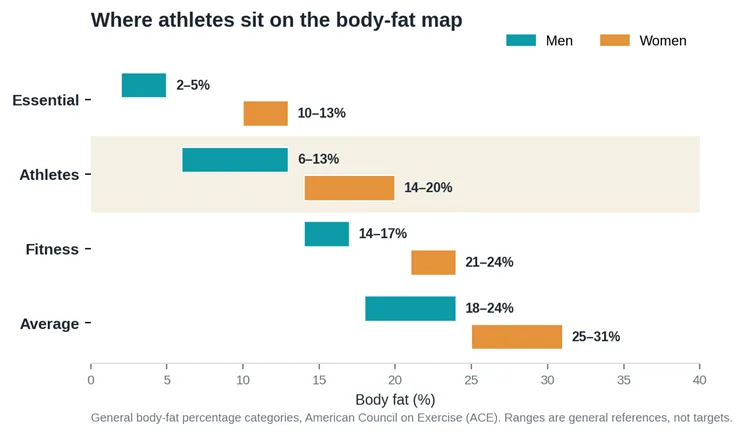
Figure 1. General body-fat percentage categories by sex (ACE). The athlete band sits below general fitness. Ranges are references, not goals.
What "muscle-first" means when you choose a body composition scale
Most smart scales can show a body fat number. Fewer are built to help you track muscle and see where it is changing on your body. When you shop with lifting and performance in mind, five features do the heavy lifting.
What to look for | Why it matters for lifters |
Reads muscle and lean mass, not just fat | Muscle mass is the number that confirms training is working, especially when the scale weight holds steady. |
8-point (hand-and-foot) BIA with segmental analysis | Full-body electrodes read your arms, trunk and legs separately, so a left-right gap can show up instead of hiding in one average. |
Repeatable readings | Consistency matters more than one perfect number. If the scale reads the same way each morning, the trend line you build is trustworthy. |
An app that shows trends over time | Weekly and monthly views beat single daily readings, which swing with water, food and sleep. |
A human who can read the data | The best scale still just hands you numbers. A coach or dietitian turns those numbers into a plan. |
Table 1. A muscle-first buying checklist for athletes and lifters.
A quick word on the electrodes, because it is the feature people skip. Cheaper scales use foot-to-foot impedance, measuring only through your lower body and estimating the rest. An 8-point setup adds handholds, so the signal travels through your arms and trunk as well as your legs. That full-body path is what makes segmental, limb-by-limb readouts possible, and segmental bioimpedance has been studied as a way to flag asymmetries and monitor status in athletes, for example in professional basketball players [4]. For a lifter chasing balanced development or coming back from an injury, seeing arms, trunk and legs on their own is genuinely useful.
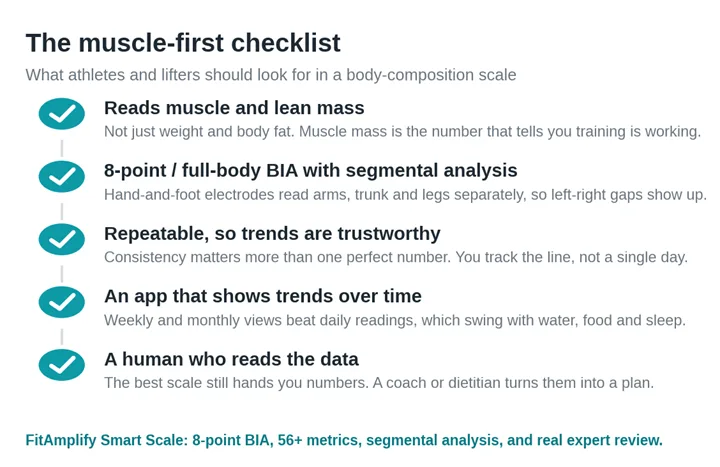
Figure 2. The five muscle-first features worth prioritizing.
FitAmplify's smart body-composition scale is built around this list. It uses 8-point BIA with eight precision electrodes for full-body segmental analysis, reports 56+ body metrics from a single scan, and syncs them to a free app over Bluetooth. You can read more about the hardware on the smart body-composition scale page, and how the numbers land in the app that tracks 56+ metrics.
The muscle-first picks, by what you are training for
There is no single "best" scale for everyone, because a powerlifter, a runner in a cut, and a family sharing one bathroom are solving different problems. Here is how the muscle-first features map to real goals.
Best for tracking muscle gain.
Pick a scale that reports muscle mass and plots it over time, not just a one-off body fat reading. During a good building phase, your scale weight might stay nearly flat while fat trends down and muscle trends up. A basic scale reads that as "no progress." A body-composition scale shows the two lines moving in your favour.
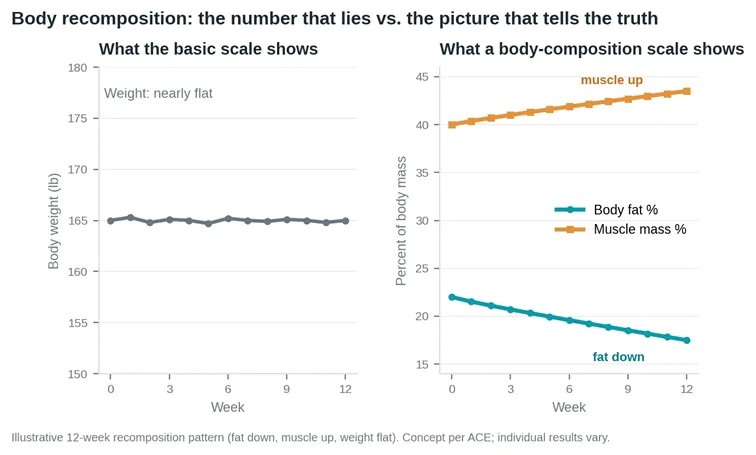
Figure 3. The same eight to twelve weeks seen two ways. Weight looks flat, while composition shows fat down and muscle up. Illustrative pattern; individual results vary.
Best for catching left-right imbalances.
If you want to spot a lagging side or track a limb after a tweak, prioritize 8-point segmental analysis. Reading arms, trunk and legs separately is what surfaces a gap that a whole-body average would smooth over.
Best for cutting without losing muscle.
When you diet down, the goal is to lose fat and keep the muscle you built. Research in trained people shows that combining resistance training with enough dietary protein helps preserve lean mass and performance even during a real energy deficit [6]. A scale that separates fat from lean mass lets you check that your cut is trimming the right tissue, not both.
Best for a whole training household.
If more than one athlete shares the scale, look for multiple private profiles. FitAmplify supports up to eight, each recognized automatically, so partners, training partners or family members keep their own history.
Best if you want a human to read your data.
This is the one most roundups skip. A scale can measure, but it will not tell you what to change. FitAmplify pairs the device and app with real dietitians and coaches who review your actual numbers, which is a different promise from an algorithm sorting you into a bucket.
BIA scale vs DEXA vs a basic scale: what each is good for
It helps to be honest about where a home scale sits among the options. Bioelectrical impedance analysis, or BIA, is the technology inside almost every smart scale. It sends a gentle, safe signal through the body and estimates fat, muscle and water from how that signal travels. For a lab-grade single snapshot, a DEXA scan is the common reference standard used in athlete research [5]. The trade-off is access and cost: you cannot get a DEXA scan every Monday morning, but you can step on a scale.
Method | Best for | Keep in mind |
Basic bathroom scale | Total body weight only | Cannot separate fat from muscle or water. Weight alone hides recomposition. |
Foot-to-foot BIA scale | A quick body fat estimate at home | Measures mainly the lower body and estimates the rest. No true segmental readout. |
8-point BIA scale (hand-and-foot) | Frequent home tracking of muscle, fat and segmental trends | Readings shift with hydration, food and time of day, so standardize conditions and follow the trend. |
DEXA scan (clinic) | A precise one-time snapshot and reference measurement | Costs money, needs an appointment, and is not practical for weekly tracking. |
Table 2. How common body-composition methods compare for athletes.
Here is the nuance that matters most. Modern multi-frequency BIA is highly repeatable. One 2024 study reported test-retest reliability for percent body fat at an intraclass correlation of about 0.998, which is excellent [2]. At the same time, the same research found a systematic offset against DEXA of a few percentage points [2]. In plain terms: a good BIA scale is very consistent with itself but may not match a DEXA number exactly. That is exactly why the muscle-first habit is to track your own trend under the same conditions, and not to treat a single reading as an absolute truth.
How to get a muscle-first reading you can trust
Because BIA responds to hydration and food, your habits around the scale decide how clean your data is. A few simple rules keep readings comparable so the trend means something.
Metric a lifter watches | What it tells you | How to read it |
Muscle mass | Whether training is adding or holding lean tissue | Follow the multi-week trend, not one reading. |
Body fat % | How lean you are relative to total weight | Compare to your own baseline, not a friend's number. |
Segmental analysis | How arms, trunk and legs compare | Watch for a persistent left-right or upper-lower gap. |
Visceral fat | Fat stored around the organs | Lower trends are generally better; discuss concerns with a professional. |
Body water / hydration | Fluid status that can move other readings | Big swings here often explain odd day-to-day changes. |
Table 3. The body-composition numbers athletes actually use, and how to read them.
For the cleanest reading, FitAmplify's own guidance mirrors the research: measure first thing in the morning, before eating or drinking, after using the washroom, and when you are neither heavily dehydrated nor overloaded with fluid. Weigh with bare feet on the same scale in the same spot, and judge progress by the weekly trend rather than any single morning. If you want the deeper method, see our guide on how often to weigh for body composition.
Where the real experts come in
A muscle-first scale gives you honest numbers. What changes results is what happens next. Our coach Chandradip Ghosh puts it plainly: "I don't guess. Every program I write starts from your body scan results." On the nutrition side, registered dietitian Shivani Tomar frames it the same way: "Every body is biochemically different. Your plan should be too."
That is the loop FitAmplify is built around. You scan, the app turns raw numbers into plain-language trends, and a real dietitian, coach and clinical reviewer read your actual data before anything is recommended. Then the plan updates as your body changes.
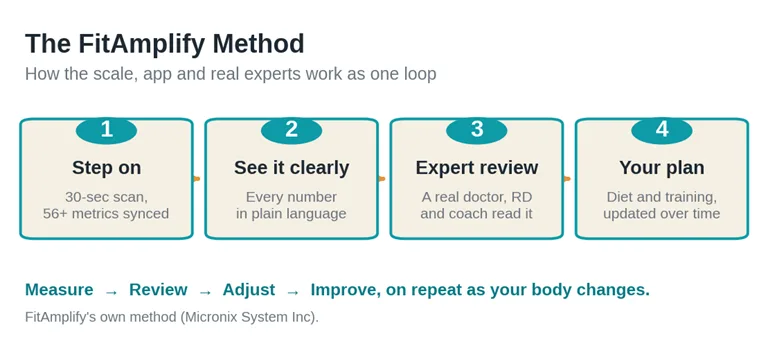
Figure 4. The FitAmplify Method: measure, review, adjust, improve, on repeat.
Across our virtual coaching, the team has guided 2,400+ people, and every plan starts from real measurements rather than a template. You can see how the real expert review works, or meet the expert team.
Want to train from your numbers instead of guessing? See your full body picture with FitAmplify and book a free 20-minute consultation with a real dietitian or coach.
Frequently asked questions
What is the best body composition scale for athletes?
The best body composition scale for athletes reads muscle and lean mass, uses 8-point BIA for segmental analysis, gives repeatable readings you can trend in an app, and ideally connects you to a human who can interpret the data. FitAmplify combines all four: 8-point BIA, 56+ metrics, segmental analysis, and review by real dietitians and coaches.
Are BIA smart scales accurate enough for lifters?
For tracking your own progress, yes. Research shows modern BIA is highly repeatable, with test-retest reliability for body fat around 0.998, though it can differ from a DEXA reading by a few percentage points. Use the same conditions each time and follow the weekly trend rather than fixating on a single number.
Body composition scale or DEXA scan, which should athletes use?
They serve different jobs. A DEXA scan is a precise reference snapshot, but it needs an appointment and costs money, so it is not practical every week. A home BIA scale is for frequent tracking between those checkpoints. Many athletes use both: DEXA occasionally, a smart scale routinely.
What body fat percentage is normal for athletes?
The American Council on Exercise places men in the athlete range at roughly 6 to 13 percent and women at about 14 to 20 percent. These are general references, not goals, and very low body fat has health trade-offs. Talk to a qualified professional before targeting a specific number.
Can a scale tell me if I am gaining muscle or just water?
A BIA scale estimates muscle, fat and water separately, but hydration can move readings day to day. The reliable signal is the multi-week trend, ideally reviewed alongside your training and nutrition by a coach or dietitian who knows your context.
How often should athletes weigh for body composition?
Weigh under the same conditions, first thing in the morning, and read the weekly trend rather than daily numbers. Daily readings swing with water, food and sleep, so the line over weeks is what tells you whether muscle and fat are moving the way you want.
Medical disclaimer: FitAmplify is a wellness product and is not a medical device. It is not intended to diagnose, treat, cure, or prevent any disease, and body-composition readings are for general wellness tracking, not medical diagnosis. Always consult a qualified healthcare professional about any medical concern. Seek prompt care for red flags such as sudden or severe pain, significant swelling, numbness or loss of sensation, or signs of infection or injury.
References
1. American Council on Exercise (ACE), Percent Body Fat Norms / Body Fat Percentage Categories.