Best Budget Smart Scale Under $50 in Canada: How to Choose
Best Budget Smart Scale Under $50 in Canada: Accurate Picks With Honest CAD Pricing
Search for the best budget smart scale under $50 in Canada and you will find a hundred near-identical options and very little honesty about what you are actually buying. So here is the honest version. At that price you can absolutely get a scale that tracks your weight and estimates your body fat well enough to be genuinely useful, as long as you know what to expect and how to read it. This guide covers what a sub-$50 scale really gets you, how to judge accuracy without a lab, what to look for before you buy, roughly what things cost in Canadian dollars, and when it is worth spending a little more.
Key takeaways
· Under $50 CAD, a smart scale can genuinely track weight and estimate body fat well enough for weekly progress, as long as you read the trend rather than a single reading.
· At that price you are getting foot-to-foot bioelectrical impedance (legs only), a phone app, and a handful of estimated metrics. That is plenty to start.
· Accuracy for tracking your own change is good even on cheap scales. The single-reading number is the part that wobbles.
· What to look for: a reliable app, multiple user profiles, consistent readings, and trustworthy weight, more than a long metric list.
· Honest note: FitAmplify's own scale is $50 USD, about $68 CAD, so it sits just above the budget line, and adds 8-point BIA, 56+ metrics, and real expert review.
· Spend more only when you want deeper metrics or a real person to help you act on them. For plain tracking, budget is fine.
In this article
· What “under $50” actually buys you
· Are cheap smart scales accurate?
· What to look for in a budget smart scale
· Honest CAD pricing, and where FitAmplify sits
· How to get accurate readings from any scale
· When it is worth spending more
· Where FitAmplify fits
· Frequently asked questions
What “under $50” actually buys you
A budget smart scale is not a cut-down mystery box. It is a fairly standard piece of technology, and once you know what is inside, the whole category makes more sense. For under $50, you are typically getting a scale with foot-to-foot bioelectrical impedance analysis, or BIA, which sends a small, safe current up one leg and down the other to estimate your body composition. On top of your weight, that gives you estimates of body fat, body water, muscle mass, and often a BMR figure, all synced to a phone app over Bluetooth.
What you are not getting at this price is the fancier hardware. Budget scales measure through your legs only, so they do not read your upper body directly the way an eight-electrode, hand-to-foot scale does. The metric list is usually shorter, the app is often more basic, and the body-composition estimates are exactly that, estimates. None of that makes a cheap scale useless. It simply means you should treat it as a trend tracker, which is what most people actually need, rather than a lab in your bathroom.
For a lot of people, that trade is completely fine. If your goal is to step on a couple of times a week, watch your weight and body-fat trend move in the right direction, and share the scale with your household, a sub-$50 model does that job well. Here is the honest summary before we get into accuracy.
The question | The honest answer |
Typical price (CAD) | Roughly $25 to $50 for a basic smart scale |
What you get | Weight plus estimated body fat, water and more |
The measurement | Foot-to-foot BIA (current through the legs) |
Accuracy for trends | Good, as long as you weigh consistently |
Best for | Anyone starting to track beyond weight |
The honest catch | Estimates, not lab numbers. Read the trend |
At a glance. Prices are approximate Canadian retail; verify current cost.
Are cheap smart scales accurate?
This is the question that stops most people from buying, so let us answer it plainly. The accuracy of a smart scale splits into two very different things: how close a single reading is to the truth, and how well it tracks your own change over time. Budget scales are weakest on the first and genuinely good on the second, which happens to be the one that matters.
On a single reading, any BIA scale, cheap or premium, can be off. Validity research on body-composition scales shows a single body-fat reading can sit a few percentage points away from a lab method like a DEXA scan. That is not a budget-scale flaw, it is how bioelectrical impedance works, and expensive scales share it because they use the same underlying principle. What you are paying extra for on a pricier model is more electrodes and more metrics, not a magic fix for that single-reading wobble.
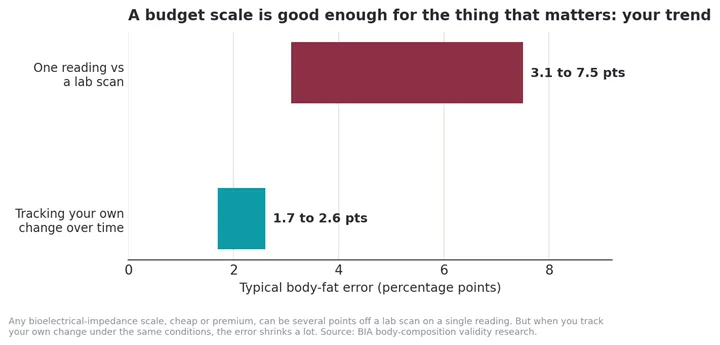
Single readings wobble on any BIA scale. Tracking your own change is far tighter. Source: BIA validity research.
Track your own change under the same conditions, though, and the error shrinks dramatically. Your weight, which is the number most people care about most, is usually accurate to within about a tenth of a kilogram on nearly any digital scale. So a budget scale is not a compromised version of the truth. For the job most people actually want, which is watching a trend move in the right direction week over week, it is honestly good enough.
What to look for in a budget smart scale
Because the hardware is so similar across budget brands, the spec sheet is not where you should shop. The things that decide whether a cheap scale becomes a daily habit or a drawer ornament are mostly about the software and the fit for your household. Use this as your checklist.
Feature | Why it matters | What to expect under $50 |
A reliable app | You will live in the app, not on the glass | Look for good ratings and simple, clear trends |
Multiple profiles | Households share one scale | Most budget scales support several users |
Consistent readings | Trends need repeatability to mean anything | Step on the same way, same time, each day |
Trustworthy weight | Weight is the number you rely on most | Most are accurate to about 0.1 kg |
Data you control | Health data is personal | Check the export and privacy options |
Metric honesty | Long metric lists can oversell | Treat the extras as estimates, not gospel |
Notice what is not on that list: a giant number of metrics. A scale that advertises fifty readings is not better than one with fifteen if the underlying measurement is the same foot-to-foot estimate. More numbers on a cheap scale mostly means more estimates, not more truth. A solid app you will actually open, and readings you can repeat, will do more for your progress than an impressive-looking feature count.
Honest CAD pricing, and where FitAmplify sits
Let us talk money plainly, in Canadian dollars, because that is the whole point of this search. A basic smart scale in Canada usually lands somewhere around $25 to $50. Step up to roughly $50 to $120 and you start to get more metrics, often an eight-electrode design that reads through your hands and feet, and a more capable app. Beyond that, the price is less about the scale and more about what surrounds it, such as a service that pairs the device with real human guidance.
Price band (CAD) | What you typically get | Best for |
Under $50 | Weight and basic estimates, foot-to-foot BIA, an app | Starting to track beyond weight |
About $50 to $120 | More metrics, often 8-point BIA, a better app | Wanting a fuller, sharper picture |
Scale plus coaching | 56+ metrics and a real expert reading them | Turning the data into an actual plan |
Approximate CAD price bands, not specific product quotes. Verify current pricing before buying.
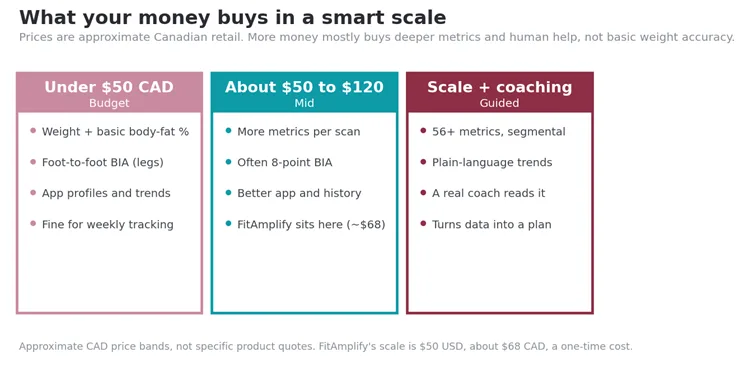
What extra money actually buys: deeper metrics and human help, not basic weight accuracy.
Here is where we will be straight with you, because honesty is the point of this guide. FitAmplify's own scale is not a sub-$50 CAD budget pick. It is $50 USD, which is roughly $68 CAD, a one-time cost with no subscription to own it. That places it just above the budget line, in the step-up tier, where the money goes toward 8-point BIA, 56+ metrics, and the option to have a real dietitian or coach read your data. If a $30 scale is what fits your budget today, that is a genuinely fine place to begin, and we would rather tell you that than pretend our scale is the cheapest option.
How to get accurate readings from any scale
A budget scale rewards good habits, because consistency is what turns a rough estimate into a clean trend. The good news is that these rules cost nothing and work on any scale, cheap or premium. Weigh first thing in the morning, after using the washroom and before eating or drinking. Stand on bare, dry feet in the same spot each time. Then judge the weekly average rather than any single day, because a lot of daily movement is simply water.
Two more rules matter. Do not compare your number with a friend's different scale or a gym machine, since every device uses its own algorithm and they will not agree. And give it a few weeks before you trust the trend, because one or two readings tell you almost nothing. Follow those habits and a $30 scale will give you a trend you can genuinely act on, which is more than most people ever get from an expensive one they use carelessly.
When it is worth spending more
Budget is the right answer more often than the industry would like you to believe, but not always. It is worth spending more in a few specific cases. If you are a lifter or an athlete who wants a segmental read of your arms, trunk, and legs, an eight-electrode scale earns its price. If you will genuinely use deeper metrics like visceral fat trends or a more detailed muscle breakdown, paying up makes sense. And if you know from experience that raw numbers do not change your behaviour on their own, then the real upgrade is not a fancier scale at all. It is a person who can read the data and tell you what to do next.
What is almost never worth it is paying for a long list of metrics you will glance at once and forget. Buy for the way you will actually use the scale, not for the spec sheet. For a lot of people, that honestly points back to a simple budget model plus the free habit of weighing consistently.
Why FitAmplify ?
To be clear about our own place in this, FitAmplify is not trying to be the cheapest scale on the shelf. The smart scale is $50 USD, about $68 CAD as a one-time cost, which puts it a little above the budget tier. What that buys is 8-point BIA reading through your hands and feet, 56+ metrics in a free app, and the part a budget scale cannot include: a real dietitian or coach who can read your trends and tell you the one thing to change next. If a sub-$50 scale gets you tracking, that is a real win. If you would rather have the numbers turned into a plan, you can book a free 20-minute consultation and see whether the step up is worth it for you.
Frequently asked questions
What is the best budget smart scale under $50 in Canada?
The best one is whichever has a reliable app, supports your household's profiles, and you will actually use daily. At this price the hardware is similar across brands, so the app and consistency matter more than the spec sheet. Read the weekly trend rather than a single reading.
Are cheap smart scales accurate?
For tracking your own change, yes. A single reading can be several points off a lab scan, but that is true of expensive scales too, since they use the same bioelectrical impedance principle. Weigh consistently and the trend is dependable, which is the part that matters.
How much should I spend on a smart scale in Canada?
A basic smart scale runs roughly $25 to $50 CAD and is plenty to start. Paying more, into about the $50 to $120 range, mostly buys deeper metrics and eight-electrode sensors. Spend up only if you will genuinely use those extras.
What is the catch with a budget smart scale?
The metrics are estimates, not lab measurements, and cheap foot-to-foot scales read only through your legs, so upper-body composition is less precise. None of that stops them being useful for trends, as long as you do not read them down to the decimal point.
Is a $50 scale accurate enough to track fat loss?
Yes, for the trend. Weigh under the same conditions and watch the weekly direction of your weight and body-fat estimate. That trend is what tells you fat loss is happening, and a budget BIA scale handles it well when you are consistent.
Does FitAmplify make a scale under $50?
Not quite. The FitAmplify scale is $50 USD, about $68 CAD, so it sits just above the budget line as a one-time cost. It adds 8-point BIA, 56+ metrics, and review by a real dietitian or coach, which a basic budget scale does not include.
Start where your budget is
A budget smart scale is a genuinely good place to start. Pick one with a solid app, weigh consistently, and watch the trend rather than the daily wobble. If you later want deeper metrics and a real person to help you act on them, the FitAmplify scale and app track 56+ metrics with 8-point BIA, and you can book a free 20-minute consultation with a coach or dietitian to turn the numbers into a plan.
FitAmplify is a wellness product and is not a medical device. It is not intended to diagnose, treat, cure, or prevent any disease. BIA readings are for general wellness tracking, not diagnosis. Always consult a qualified healthcare professional regarding any medical concern.
References
1. Bioelectric Impedance Analysis (method overview: foot-to-foot versus hand-to-foot, single versus multi-frequency, hydration and standardization). MRC Epidemiology Unit Measurement Toolkit, University of Cambridge. https://www.measurement-toolkit.org/anthropometry/objective-methods/bioelectric-impedence-analysis
2. A comparison study of a portable foot-to-foot bioelectrical impedance scale to measure body fat percentage. PMC (2014). https://www.ncbi.nlm.nih.gov/pmc/articles/PMC4225148/
3. Concordance between muscle mass assessed by bioelectrical impedance analysis and by dual-energy X-ray absorptiometry. BMC Musculoskeletal Disorders (2015). https://link.springer.com/article/10.1186/s12891-015-0510-9
4. Reliability and cross-sectional and longitudinal validity of bioelectrical impedance analysis devices. British Journal of Nutrition (body-composition validity research). https://pubmed.ncbi.nlm.nih.gov/