Best Smart Scale for Multiple Users: A Family Buyer's Guide
Best Smart Scale for Tracking a Family: Multi-User Picks That Keep Data Separate
By The FitAmplify Team · Updated July 2026 · 7 min read
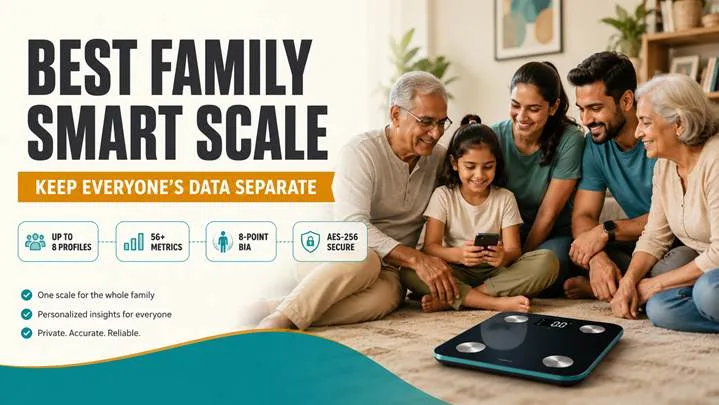
If more than one person in your home steps on the same scale, the real question is not just which scale reads the most numbers. It is whether the scale can tell everyone apart and keep each person's data private. A good multi-user smart scale gives each family member their own profile, recognizes who is standing on it, and stores those readings separately. Here is what to look for, how to keep the data clean and private, and which body metrics actually matter for each person in the house.
Key takeaways
· A family scale needs three things above all: a separate profile for each person, automatic recognition on step-on, and private, encrypted syncing so no one sees anyone else's numbers.
· The FitAmplify Smart Scale supports up to 8 private profiles and reads 56+ body metrics per scan, with data protected by AES-256 encryption.
· Healthy body-fat ranges are not one number. They differ by sex and shift up with age, so compare each person to their own range, not to each other.
· Children and teens should not be judged by adult body-fat ranges. They are tracked with pediatric BMI-for-age growth charts, so treat any kids' readings as rough and loop in a pediatrician.
· BIA readings move with hydration, food and time of day. Weigh the same way each time and read weekly trends, not daily jumps.
· If someone is pregnant or has a pacemaker, use weight only and check with their healthcare provider before taking impedance readings.
In this article
· The short answer: what makes a scale good for a whole family
· What to look for in a family smart scale
· Keeping each person's data separate (and private)
· Which metrics matter for each family member
· Healthy ranges are not one-size-fits-all
· A note on kids, pregnancy, and pacemakers
· How to weigh so family numbers actually compare
· Where FitAmplify fits
· Frequently asked questions
The short answer: what makes a scale good for a whole family
A shared scale only works if it treats each person as their own account. The three features that matter most are separate profiles, automatic user recognition, and private data storage. Everything else, the metric count, the app design, the coaching, sits on top of that foundation. If a scale blends two people's readings into one trend line, the data is worse than useless, because it looks precise while being wrong.
The FitAmplify Smart Scale is built around this. It holds up to 8 private profiles, recognizes who is on it, and reads 56+ body metrics in a single scan, syncing each person's numbers to their own app login. Here is the family-relevant picture at a glance.
What families ask | FitAmplify |
Profiles on one scale | Up to 8 private profiles |
Measurement | 8-point BIA, 56+ body metrics per scan |
User recognition | Automatic on step-on |
Data privacy | AES-256 encryption; export or delete anytime in the app |
App cost | Free, with a free-forever tier |
Device | $50 one-time (USD), no subscription needed to own it |
At a glance. Brand facts from FitAmplify; pricing shown in USD.
What to look for in a family smart scale
Buying for a household is different from buying for one person. You are really buying a system that has to keep several people's data accurate and separate at the same time. Use this checklist to compare any multi-user scale, not just ours.
Feature to check | Why it matters for a family | What good looks like |
Number of profiles | Everyone needs their own space | Enough for the whole household (FitAmplify: up to 8) |
Automatic recognition | Stops a reading landing in the wrong profile | The scale identifies each person on step-on |
Separate, private data | Health data is personal, even at home | Each profile syncs to its own login |
Encryption | Protects sensitive numbers | AES-256 or similar, with export and delete control |
Segmental, full-body metrics | Adults track different things than teens | 8-point BIA reads arms, trunk and legs |
Weight-only or guest mode | For a pregnant member, a guest, or a young child | Can log weight without an impedance reading |
Real support | Numbers need context to be useful | Access to real experts, not only an app |
Keeping each person's data separate (and private)
Privacy inside a household is easy to overlook. You trust your family, so why does it matter? Two reasons. First, body-composition data is personal, and a teenager or a partner may simply want their numbers to be their own. Second, mixing profiles quietly corrupts everyone's trends, because the scale starts averaging different bodies together. The fix is structural: give each person a profile, let the scale recognize them, and keep each stream encrypted and separate.
FitAmplify protects data with AES-256 encryption, and you can export or delete your information anytime from the app. Readings are never sold or shared. The setup below keeps every family member's data in its own lane.
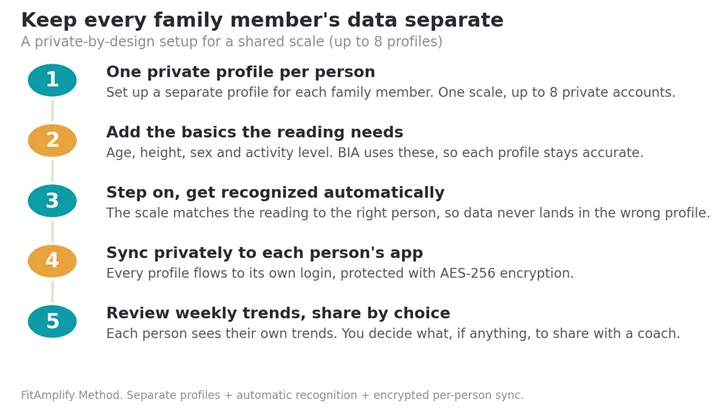
How separate, private profiles work on one shared scale. Method: FitAmplify.
Which metrics matter for each family member
The 56+ metrics are the same for everyone, but not everyone should watch the same ones. A parent chasing fat loss, a teenager who is still growing, and a grandparent focused on staying strong are tracking different things. Here is a simple starting point for each type of user in the house.
Family member | What is often most useful to watch | Keep in mind |
Adult, fat loss | Body fat %, weekly weight trend, visceral fat | Trends over weeks beat daily readings |
Adult, muscle or performance | Muscle mass, segmental balance, body fat % | Confirm training builds muscle, not just weight |
Adult on a GLP-1 | Muscle mass alongside fat loss | The goal is losing fat while keeping muscle |
Older adult | Muscle mass, body-fat range for their age | Healthy ranges shift up with age |
Teen | Weight and general trend only | Use pediatric growth charts; involve a clinician |
Younger child | Weight only | Adult body-fat ranges do not apply; ask a pediatrician |
General wellness guidance, not a diagnosis. Ranges and priorities are individual.
Healthy ranges are not one-size-fits-all
A single healthy body-fat number does not exist for a family. Using American Council on Exercise norms, an acceptable range for a woman in her twenties sits around 21 to 31 percent, while for a man the same age it is roughly 14 to 24 percent. Those ranges also widen with age. So the useful comparison is each person against their own range, not one family member against another.
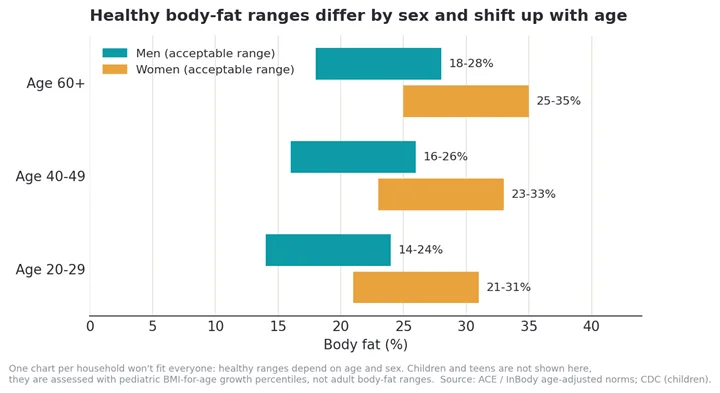
Acceptable body-fat ranges by sex and age. Source: ACE / InBody age-adjusted norms.
Children and teens are the clearest example. The Centers for Disease Control and Prevention assess them with BMI-for-age growth percentiles, which account for the fact that their bodies are still developing, rather than the adult body-fat ranges above. That is why a kid's number needs a pediatrician's context, not a comparison to a parent.
A note on kids, pregnancy, and pacemakers
Bioelectrical impedance is not equally reliable or appropriate for everyone in the house, and being upfront about that is part of using it well.
Children. Research on portable BIA in school-age children found that lean-mass estimates held up reasonably, but fat and body-fat readings could carry clinically meaningful errors, so the results should be interpreted with caution. Treat a child's body-fat number as a rough signal at most, and talk to a pediatrician about healthy growth.
Pregnancy. BIA is affected by the fluid shifts of pregnancy, and it has not been well validated for that stage. Use weight only during pregnancy and follow your healthcare provider's guidance.
Pacemakers and implanted cardiac devices. Recent reviews suggest BIA is generally safe for people with these devices, but many scale makers still advise against it out of caution. If a family member has one, skip the impedance reading, use weight only, and check with their clinician first.
How to weigh so family numbers actually compare
BIA reads body water as much as fat, so consistency is what turns it into a signal you can trust. For every profile in the house, weigh first thing in the morning, after using the washroom, before eating or drinking, before exercise, on bare dry feet, and at a similar time of day. Then look at the weekly average rather than any single reading. A jump overnight is almost always water, not fat. One more rule: do not compare one person's device reading to a friend's scale or a gym printout, because different algorithms give different numbers.
Where FitAmplify fits
We built FitAmplify as one connected system for the whole household. A smart body-composition scale with 8-point BIA, a free app that holds up to 8 private profiles so you can track 56+ metrics for each person, and a team of real dietitians and coaches. Everyone gets their own encrypted space, and when a trend needs a human eye, you can book a free 20-minute consultation and talk to a real expert rather than an algorithm.
Frequently asked questions
What is the best smart scale for multiple users in a family?
Look for three things: enough separate profiles for everyone, automatic recognition so readings are not mixed up, and private, encrypted data. The FitAmplify Smart Scale supports up to 8 private profiles, recognizes each person on step-on, and reads 56+ metrics per scan.
How does a smart scale keep each family member's data separate?
Each person gets their own profile, the scale identifies who is standing on it, and each stream syncs to that person's own app login. FitAmplify protects data with AES-256 encryption and lets you export or delete it anytime.
How many people can use one smart scale?
It depends on the scale. FitAmplify supports up to 8 private profiles on a single device, which covers most households.
Can children use a family smart scale?
They can step on for weight, but adult body-fat ranges do not apply to kids. Children and teens are assessed with pediatric BMI-for-age growth charts, and BIA fat readings are less reliable for them, so treat any number as rough and involve a pediatrician.
Is a body-fat scale safe during pregnancy or with a pacemaker?
Use weight only. BIA is not well validated in pregnancy, and while research suggests it is generally safe with cardiac implants, many manufacturers still advise against it. Check with a healthcare provider first.
Why do two family members get very different body-fat readings?
Healthy body fat differs by sex and age, so different numbers are expected. Compare each person to their own healthy range rather than to each other.
See your whole family's picture, not just a number
Weight is one data point per person. Track 56+ body metrics for up to 8 profiles with the FitAmplify scale and app, keep everyone's data private and separate, and talk to a real expert when a trend needs a second look.
FitAmplify is a wellness product and is not a medical device. It is not intended to diagnose, treat, cure, or prevent any disease. BIA readings are for general wellness tracking, not diagnosis. Always consult a qualified healthcare professional regarding any medical concern.
References
American Council on Exercise (ACE) body-fat percentage norms, via Body Fat Percentage Chart. InBody USA. https://inbodyusa.com/blogs/inbodyblog/body-fat-percentage-chart/
Body Fat Percentage: Charting the Averages in Men and Women. American Council on Exercise (ACE). https://www.acefitness.org/about-ace/press-room/in-the-news/8602/body-fat-percentage-charting-averages-in-men-and-women-very-well-health/
Child and Teen BMI Categories (BMI-for-age percentiles). Centers for Disease Control and Prevention (CDC). https://www.cdc.gov/bmi/child-teen-calculator/bmi-categories.html
Validation of portable bioelectrical impedance analysers for body composition in school-age children. PLOS One (2017). https://journals.plos.org/plosone/article?id=10.1371/journal.pone.0171568
Safety of bioelectrical impedance analysis in patients with cardiac implantable electronic devices: a systematic review. Heart Rhythm O2 (2025). https://www.heartrhythmopen.com/article/S2666-5018(25)00487-8/fulltext
The possibility of using bioelectrical impedance analysis in pregnant and postpartum women. Diagnostics (2021). https://doi.org/10.3390/diagnostics11081370