Best Smart Scale for Weight Loss Tracking: Your Guide
Best Smart Scale for Weight Loss Accountability: Features That Actually Keep You Consistent
The FitAmplify Team · Reviewed by Ms. Shivani Tomar, RD, Registered (clinical) Dietician, M.Sc Nutrition, 12 years' experience · Updated August 2026 · 11 min read
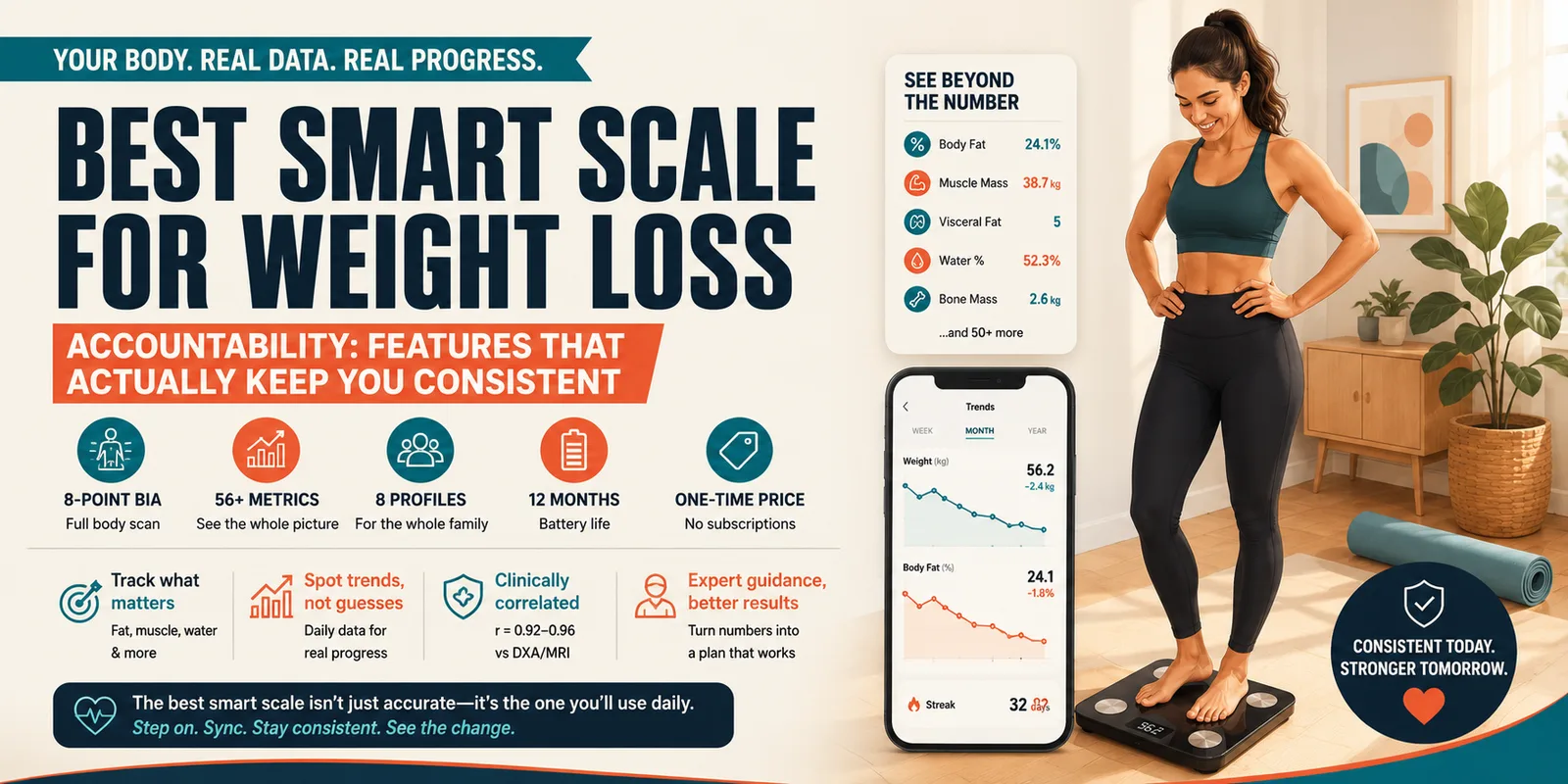
If you're staring at your bathroom scale wondering why the number won't budge even though your jeans fit differently, you need more than a weight reading. The best smart scale for weight loss tracking measures body fat, muscle, and water shifts, not just pounds. Devices like the FitAmplify Smart Scale use 8-point BIA and correlate strongly with clinical body scans. Paired with a body composition scale that tracks real trends, daily weigh-ins have been linked to steady, downward progress.
What Makes a Smart Scale Good for Weight Loss
A good scale answers the question your bathroom scale can't: what's actually changing underneath the number? A smart scale for weight loss tracking needs to separate fat loss from muscle loss and water shifts, because those three things move independently and a single pound reading blends them together. That's the difference between a basic bathroom scale and a body fat scale smart enough to read your body in layers.
Not every device gets there the same way. Some smart fitness scale models rely on a single impedance path, while stronger designs use multiple points of contact for a fuller read. Accuracy also depends on who's standing on it: BIA readings validated for one population don't always transfer cleanly to another, since body impedance itself varies by ethnicity.
Feature | Bipolar/tetrapolar consumer BIA scale | Multi-point BIA scale |
|---|---|---|
Correlation with DXA/MRI (r) | 0.92 | 0.96 |
Mean bias in body fat estimate (%) | 1.5 | 1.5 |
Health Canada BMI "normal" upper bound | 24.9 | 24.9 |
Health Canada BMI "obese" threshold | 30.0 | 30.0 |
None of these numbers mean much without daily use behind them. A scale you step on once a month tells you almost nothing, but consistent daily weigh-ins have been tied to a steadier downward trend across every BMI group. That's why talk to a registered dietitian if you want help turning raw numbers into a plan that fits your body specifically.
Smart Scale Comparison for 2025
Once you start comparing actual scales, the box marketing stops mattering. What matters is whether the device tells you what it measures and how it got there, whether that's a Renpho smart scale, a big-box brand, or something newer. A genuinely top rated smart scale in 2025 is judged on sensor count, validation, and what you get for the price, not on how many colors it comes in.
Here's what to line up side by side before you call anything the best smart scale 2025 has to offer:
What to Check | Value | Why It Matters |
|---|---|---|
Body metrics captured per scan (count) | 56 | More data points mean fewer blind spots in your reading |
BIA sensor points (count) | 8 | Full-body segmental reads catch left-right imbalances a 2-point scale misses |
Battery life (months) | 12 | Fewer battery swaps mean fewer skipped weigh-ins |
Private profiles supported (count) | 8 | One scale can track a whole household separately, without mixing up data |
One-time price (CAD $) | 50 | No subscription needed just to see your own numbers daily |
None of these specs mean much if the underlying BIA reading was never validated for people who look like you. Before you buy, check that any smart body-composition scale discloses both its sensor count and the population it was tested on, not just a headline number on the box.
Which Metrics Actually Track Fat Loss
Battery specs and profile counts help you pick hardware. They tell you nothing about whether the number on the screen after you step off is actually true. That's a different question, and it comes down to which metrics you watch and how you read them.
Body fat percentage and visceral fat
Body fat percentage is the headline number, but it's an estimate, not a lab result. Independent testing on consumer BIA devices found correlation of 0.92 to 0.96 against DXA and MRI scans, with mean bias under 1.5% body fat. That's close enough to be useful for spotting trends, not close enough to treat as diagnostic. Visceral fat readings carry the same caveat: trust the direction of travel over weeks, not the exact figure on any single day.
Muscle mass and hydration
Hydration status skews everything. Dehydration pushes impedance up, which falsely inflates your body fat percentage, while overhydration does the opposite and understates it. So a muscle mass or hydration reading is really a snapshot of your water balance that morning, not a fixed trait. This is also why validation matters by population, since body impedance varies by ethnicity and a smart scale for body composition tested on one group won't necessarily read accurately on another.
None of this means the scale is useless. In a study of 9,768 users tracked for an average of 1,085 days, only people who weighed in daily showed a consistent downward weight trend, regardless of starting BMI. The best body composition scale isn't the one with the most decimal points. It's the advanced smart scale you'll actually step on every morning, paired with someone qualified to help you read the trend line.
How Accurate Are Smart Scales
Accuracy is the question everyone asks, and the honest answer is: closer than you'd think, with real limits. Independent testing of consumer BIA devices found correlation of 0.92 to 0.96 against DXA and MRI scans, with average bias under 1.5% body fat. That's a strong showing for a device you keep in your bathroom, not a research lab.
But even the most accurate smart scale can be thrown off by things that have nothing to do with the hardware. Dehydration makes your body fat reading look artificially high, while overhydration pushes it artificially low, because both change how electricity moves through your tissue. Drink your normal amount of water, weigh in at a consistent time, and you'll see far less noise in your numbers.
There's also a population issue worth knowing about. BIA algorithms are calibrated and validated against specific groups, so a best body fat scale for one population may not read as precisely for another, since impedance itself varies by ethnicity. This isn't a flaw unique to any one device. It's a limitation of the technology itself, which is why pairing your smart digital scale with a professional who can interpret your trend over time matters more than chasing a perfect single reading.
Does the App Matter More Than the Scale
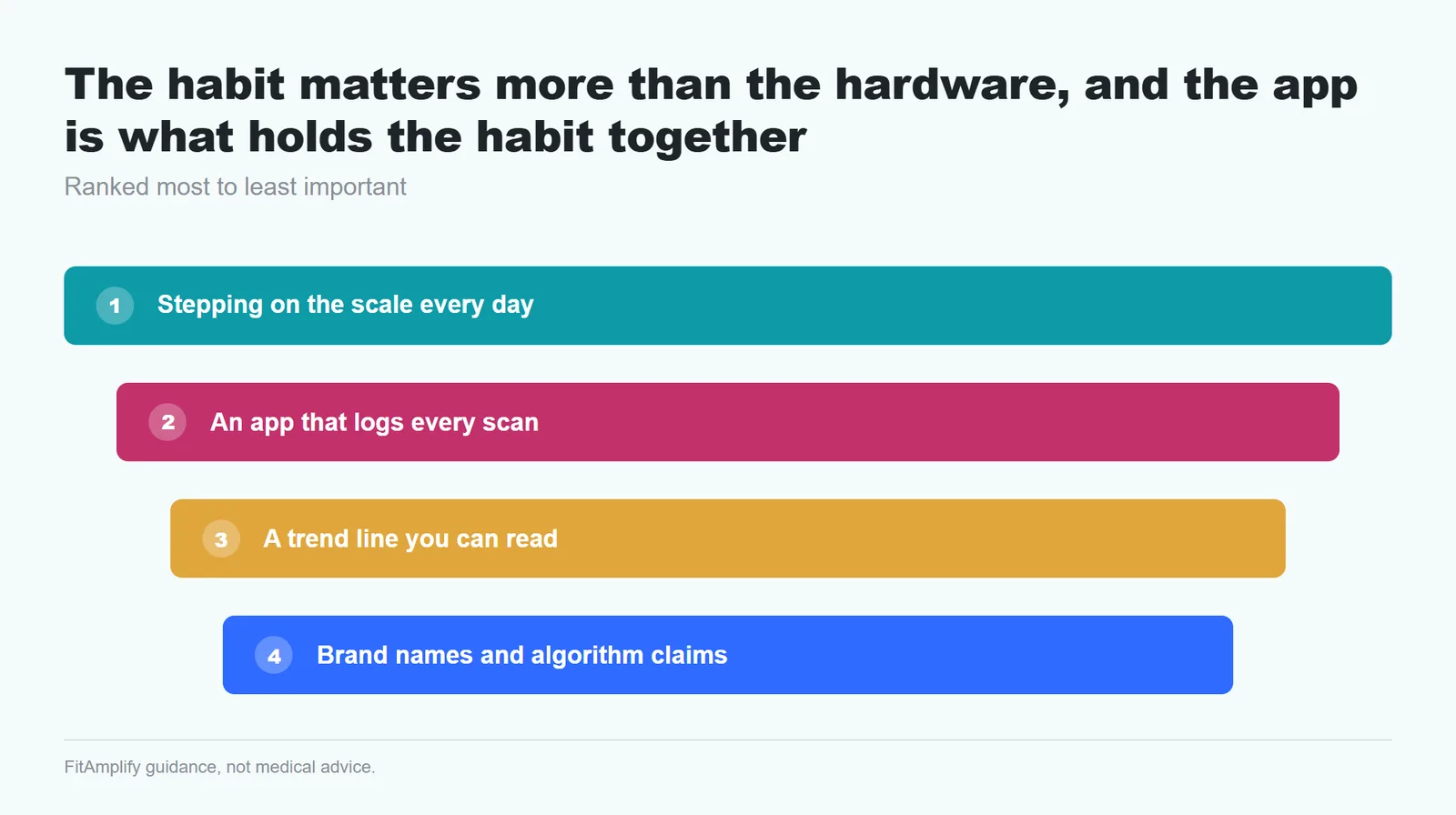
Here's a number worth sitting with: in a study of 9,768 smart scale users tracked for an average of 1,085 days, the only habit tied to actual weight loss over time was stepping on the scale every day. Not a specific device. Not a fancy algorithm. Just showing up daily and having somewhere to see the pattern.
That's where the smart scale app earns its keep. A smart bluetooth scale is only as useful as the smart scale application behind it, because the scale takes the reading but the app is what turns scattered numbers into a trend you can actually read. Without it, you're just staring at digits with no memory of yesterday.
A good app should log every scan automatically, plot your history, and flag drift before it becomes discouraging. This is also where you can track 56+ metrics in the app instead of eyeballing one weight figure that jumps around for reasons that have nothing to do with fat loss. The scale collects the data. The app is what makes that data mean something.
How to Get an Accurate Reading
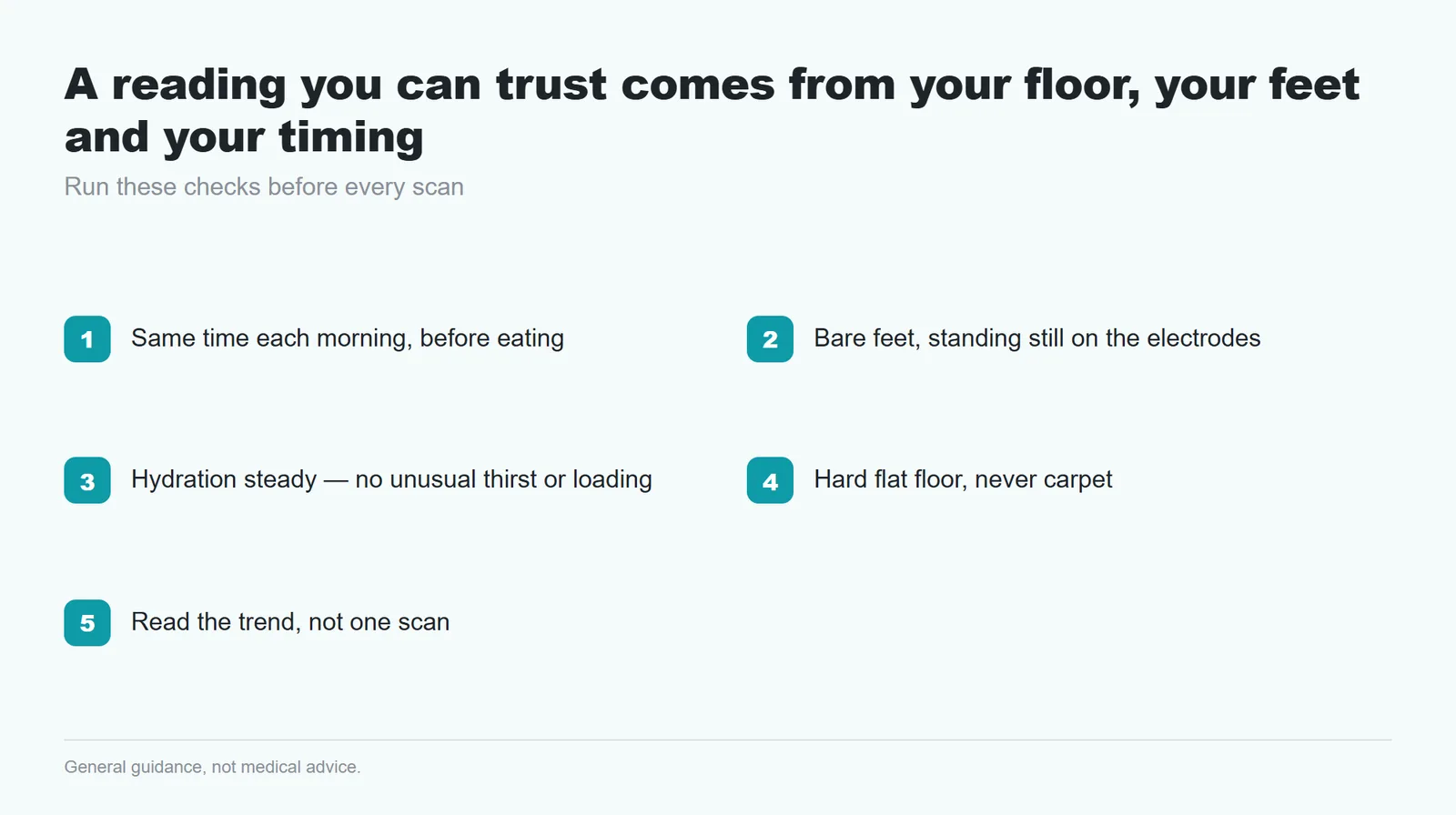
A few small habits make the difference between a number you can trust and one that just confuses you. Follow this checklist before every scan:
Weigh at the same time each day, ideally in the morning before eating or drinking. Daily self-weighing is the one habit tied to an actual downward weight trend over time.
Stand still with bare feet on the electrodes so the scale gets a clean signal.
Check your hydration. Dehydration falsely inflates your body fat reading, while overhydration falsely lowers it.
Use it on a hard, flat floor, not carpet, whether you own a smart weigh scale, a bluetooth smart weight scale, or a basic smart bathroom scale.
Read trends, not single scans. Even validated BIA devices carry some bias against DXA and MRI, and results can vary by population group.
For help making sense of what you see, you can always talk to a registered dietitian.
Choosing the Right Scale in Canada
If you're weighing yourself here, Health Canada's BMI categories are the backdrop: under 18.5 is underweight, 18.5 to 24.9 is normal, 25.0 to 29.9 is overweight, and 30.0 and up is obese. That framework is useful, but it's just one number. The best rated smart scale for you is one you'll actually step on every morning, because daily weigh-ins are the habit tied to a losing trend across every BMI group in long-term tracking.
So the real question isn't which device claims the fanciest sensors. It's whether you'll use it consistently, and whether someone can help you read the results. The best smart bathroom scale for weight loss tracking pairs steady daily data with a person who understands your history, not just an algorithm guessing in isolation.
If you want that second part covered, you can book a free consultation and talk through your numbers with someone who's trained to read them. A best smart weight scale earns its keep over months, not on the first scan. Pick one you'll keep using, then get real feedback on what the trend line actually means.
FAQ
What's the best smart scale for weight loss tracking?
Look for one with 8-point BIA and full-body segmental analysis, not just a single reading between your feet. That design tends to track closer to lab methods like DXA, with studies showing correlation as high as 0.92 to 0.96 and a mean bias under 1.5% body fat. A smart scale best suited to weight loss is the one you'll actually step on every day.
How accurate is a body scale smart enough to trust?
Fairly accurate for trends, less reliable for a single exact number. Validation studies show strong correlation with lab methods, but BIA accuracy also depends on your ethnicity, since body impedance varies between populations and not every device is validated across all of them. Treat the number as a helpful trend, not a diagnosis.
Does a smart scale actually help with weight loss?
The habit matters more than the hardware. In one study following 9,768 users for an average of 1,085 days, only people who weighed in daily showed a downward weight trend, across every BMI group. A scale you use consistently outperforms a fancier one collecting dust.
Why do my smart scale readings jump around?
Hydration is usually the culprit. Dehydration raises impedance and can push your body fat reading up, while overhydration does the opposite and pushes it down. Weigh in at a similar time of day, under similar hydration, for the most consistent picture.
Can a smart scale replace a dietitian?
No, and it isn't meant to. The number on the screen is a data point, and a person who can read your full history turns that data into a plan. You can talk to a registered dietitian to help make sense of what your trend line is actually telling you.
Conclusion
A smart scale is not a lab test. It is a tool that shows you a trend, and trends are what actually help you lose weight and keep it off. Research on nearly 10,000 users found that people who weighed in daily were the only group with a consistent downward trend across every BMI category. That is the real value here: not one perfect number, but a habit that shows you where you are heading.
If you want the best smart scale for weight loss tracking, look for one with validated accuracy and a history you can actually read. Step on it, watch the trend, and when you are ready for a second opinion, book a free consultation with a real expert.
References
Is bioelectrical impedance accurate for use in large epidemiological studies?, NCBI/PMC
Frequency of Self-Weighing and Weight Change: Cohort Study With 10,000 Smart Scale Users, NCBI/PMC
Canadian Guidelines for Body Weight Classification in Adults, Health Canada / Canada.ca
FitAmplify is a wellness product and is not a medical device. It is not intended to diagnose, treat, cure, or prevent any disease. Always consult a qualified healthcare professional regarding any medical concern.