Best Time of Day to Use a Smart Scale for Consistency
Best Time of Day to Weigh Yourself on a Smart Scale for Consistent Body Fat Readings
The FitAmplify Team · Reviewed by Ms. Shivani Tomar, RD, Registered (clinical) Dietician, M.Sc Nutrition, 12 years' experience · Updated August 2026 · 13 min read
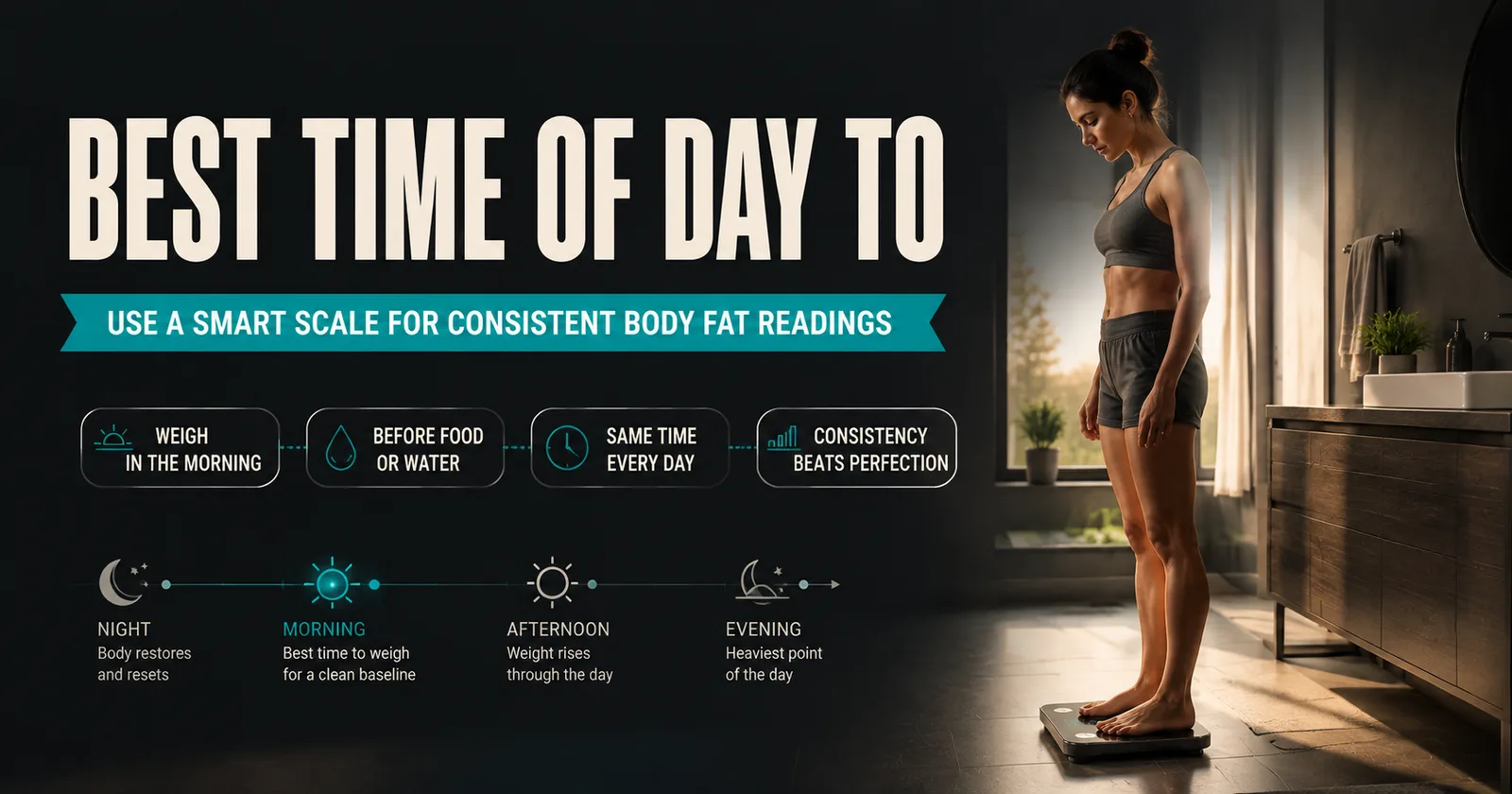
Best time of day to use a smart scale? Right after you wake up, before food or water. Weight naturally shifts through the day, so a smart scale reading at 8 p.m. will not match one at 7 a.m. Same-time tracking matters more than the exact hour [7]. Even under controlled conditions, body mass can vary 0.1-0.7 kg day to day [6], so consistency, not perfection, is what makes your numbers trustworthy.
When Should You Weigh Yourself Each Day
The right time isn't magic. It's a habit you repeat.
Pick a moment early in your day, before breakfast and before your first glass of water, and stick with it. That single choice does more for your results than any feature on a smart scale for weight tracking. In a 6-month study, people who weighed in daily lost significantly more weight than those who weighed in less often, a difference of about 6.1 kg on average [1].
The one hour window that matters
You don't need to hit the exact same minute every day. You need the same general window, ideally within an hour of waking up, before you've eaten or had coffee. That's the part your smart weigh scale can't do for you. It can log the number, but only you can decide when to step on.
Consistency also beats frequency over the long haul. In a 9-month maintenance study, people who weighed in 6 to 7 days a week were better protected against regaining weight than people who simply weighed in often but irregularly [2]. Timing built the habit. The habit built the result.
That habit matters even more once a diet ends. People who cut back on self-weighing gained an average of 4.0 kg over the following year, while those who kept weighing at the same pace gained only 1.8 kg, and those who weighed in more gained just 1.1 kg [3]. A smart bathroom scale sitting untouched in the closet doesn't protect you. One you actually step on, at the same hour, does.
So before you worry about which numbers to track or how to read them, lock in your window. Same hour, same conditions, most days of the week. Everything else in your routine builds on that foundation.
Why Morning Weigh Ins Are Most Consistent
What shifts overnight
Your body isn't a fixed number. It changes hour by hour, and the biggest swing happens while you sleep. You lose water through breathing and sweat, your digestive system empties out, and by morning you're about as "settled" as your body gets. That's why a scan first thing, before food or drink, gives you the cleanest baseline for the day.
This isn't just about the number on top. A body composition scale reads muscle, water, and fat using a small electrical signal, and that signal is sensitive to how much fluid is moving through you. Catch it after a full night's rest and you're measuring your body at its most stable point, not chasing a moving target.
What food and water do
Eat a meal or drink a big glass of water, and your weight jumps immediately, before any of it has actually changed your body. A smart digital scale can't tell the difference between real change and a stomach full of breakfast. Wait until after you've eaten and you're adding noise, not insight.
Even under controlled lab conditions, body mass readings drifted by 0.1 to 0.7 kg between different days, and by up to 0.2 kg within the same day [6]. That's normal, expected variation, not a sign anything is wrong with your scale. Weighing at the same point each morning, before food or water, keeps that natural noise from looking like real progress or real regression.
The payoff shows up over time, not in a single scan. People who weighed in daily lost significantly more weight over six months than those who weighed less often [1]. A steady morning habit gives you the same time of day, the same starting conditions, and it's why the routine matters more than the number itself.
How Timing Skews Body Fat Readings
Hydration and impedance
Body fat percentage on a bioelectrical impedance scale depends on how much water is moving through your body at that exact moment. The electrodes send a faint current through your tissue, and water conducts that current more easily than fat does. Drink a glass of water or a glucose-heavy shake right before you step on, and the reading can shift within minutes. One study found glucose drinks pushed body fat estimates higher immediately after drinking and for up to 20 minutes afterward, even though the actual change was under 1% [5].
That's the trap with a single scan. The number moves because your hydration moved, not because your body composition changed overnight. A smart scale for body composition tracking is only useful when you control for that variability, which is exactly why the same-time, same-conditions routine from the last section matters so much.
Food timing plays a smaller role than most people expect. A standardized breakfast changed fat-free mass estimates by a maximum of just 0.4% three hours later, a difference too small to matter for real tracking [4]. So skipping breakfast to "get a better number" isn't necessary. Consistency in when you weigh yourself, not what you ate that morning, is what keeps your data honest.
Day-to-day mass itself also drifts. Under standardized conditions, body mass varied by up to 0.7 kg between different days [6]. None of this means your body fat scale smart readings are broken. It means a single scan is a snapshot, not a verdict, and the most accurate smart scale readings come from patterns tracked over weeks, not any one morning's number.
Best and Worst Times to Weigh
The morning-versus-evening question misses the bigger issue: how often you actually get on the scale. Research on self-weighing found that people who weighed in daily lost significantly more weight than those who weighed less often, with an average difference of 6.1 kg over six months [1]. Timing matters less than showing up.
That said, some slots make the data easier to trust than others. Use the table below to see where each window falls on convenience and reliability.
When You Weigh | Reading Reliability | Data Consistency | Best Use Case |
|---|---|---|---|
Early morning, before food or water | High, 0.0-0.2 kg same-day drift [6] | 6-7 days per week is the strongest habit builder [2] | Daily tracking baseline |
Right after waking, before dressing | High, minimal clothing weight added | Easiest slot to repeat every day | New routine starters |
Midday, after meals | Low, meal and fluid weight skews the number | Hard to match day to day | Not recommended for trend data |
Evening, after a full day of eating and drinking | Low, most variable reading of the day | Rarely consistent week to week | Avoid for tracking purposes |
Once a week only | Moderate, less noise from daily swings | Weaker at preventing weight regain than daily or near-daily habits [2] | Light monitoring, not active tracking |
Skipping weigh-ins for stretches | Not applicable, no data collected | Linked to 4.0 kg more weight gained at one year versus staying consistent [3] | Highest risk for losing track of progress |
A smart fitness scale won't fix a random schedule, but it does make the good habit easier to keep. Because a body scale smart syncs your reading automatically, you don't have to remember what you weighed three days ago. It just shows up in your history, already timestamped and ready to compare.
How to Build a Weigh In Routine
You don't need a rigid system, just one you can actually repeat. Here's a simple checklist to lock in a routine that holds up over weeks and months, not just the first few days.
Pick one time and stick with it. Right after you wake up, before food or coffee, works well for most people. The exact hour matters less than doing it the same way every time [7].
Weigh in most days of the week. Aim for 6 to 7 days rather than a random day here and there. Consistent weighing is one of the strongest habits linked to keeping weight off long term [2].
Keep the conditions identical. Same spot on the floor, same scale, similar clothing. Small setup changes can shift your reading even when your body hasn't changed much at all [6].
Let the scale do the remembering. A smart bluetooth scale syncs each reading straight to your phone, so you're not scribbling numbers on a sticky note or trying to recall Tuesday's weight from memory.
Check trends in your smart scale app, not single days. Open the track 56+ metrics in the app view weekly and look at the line, not the dot. One-day jumps are usually water or timing, not fat gain.
Weigh daily if you're actively trying to lose weight. Daily weighers have lost significantly more weight than infrequent weighers in research trials [1]. If you're maintaining, near-daily works just as well.
Review your smart scale application data monthly. Look back at the bigger picture, not just this week's number, and adjust your routine if it's slipping.
Choosing a Smart Scale for Consistent Timing
A scale is only as useful as the routine you actually stick to. If it's slow to sync, awkward to store, or gives you a different login screen every morning, you'll skip it, and the timing habits from the last section fall apart. This is where picking the best rated smart scale matters more than people expect.
Look for three things: quick sync so you're not standing around waiting, segmental readings so you can trust the trend line, and enough battery life that a dead scale never becomes your excuse. Between the day-to-day noise in bioelectrical impedance readings [6] and the small shifts diet and hydration can cause [4][5], you want a device that removes friction, not adds it. Consistency, not the brand name, is what actually predicts results [2].
Here's how a few common options stack up on the factors that affect your daily routine:
Feature | FitAmplify Smart Scale | Typical Renpho Smart Scale | Basic Bathroom Scale |
|---|---|---|---|
Price | $50 (from $80) | $30-40 | $15-25 |
Body metrics tracked | 56+ | 13 | 1 (weight only) |
Sync method | Bluetooth 5.0 app sync | Bluetooth/Wi-Fi app sync | None |
Segmental analysis (arms, legs, trunk) | Yes, 8-point BIA | No | No |
Battery life | About 12 months (3 AAA) | Varies by model | 1-2 years (coin cell) |
Private profiles | Up to 8 | Varies by model | Not applicable |
The extra metrics only help if someone explains what they mean for you. That's why pairing your scale with the track 56+ metrics in the app and, when a reading looks off, a chance to talk to a registered dietitian matters more than shaving a few dollars off the price tag.
The best body composition scale for you isn't necessarily the one with the longest spec sheet. It's the one that fits into the same two-minute window every morning without a fight. A scale you keep tucked in a closet, or one that makes you re-enter your weight by hand, quietly trains you to skip days, and skipped days are what break the timing habits that make readings comparable in the first place.
That's also why segmental data matters more than raw metric count when you're comparing models. A device that reads your arms, trunk, and legs separately gives you a fuller picture than one that only spits out a single body fat number, especially if you're trying to spot a trend rather than chase a daily figure. Whichever scale you land on, the real test is simple: will you still be stepping on it, at the same time, in three months.
FAQ
What's the best time of day to weigh myself?
Morning, right after you wake up and before breakfast or coffee, gives the most consistent numbers. Your body hasn't taken on any food, water, or exercise yet, so the reading reflects a stable baseline. Pick a time you can repeat daily, since the consistency matters more than the exact hour.
Do I need the best smart scale 2025 has to offer, or will any bluetooth scale work?
You don't need the flashiest model on the market. What matters more is picking a bluetooth smart weight scale that syncs automatically, so you're not tempted to skip a weigh-in because logging feels like a chore. A steady daily habit on a mid-range scale beats sporadic use of a premium one.
Is a smart scale better than a regular bathroom scale for tracking progress?
A regular scale only gives you total weight, which can bounce around for reasons that have nothing to do with fat loss. The best body fat scale options use bioelectrical impedance to estimate body composition, so you can watch trends like muscle and fat separately instead of one number. Daily weighers using this kind of tracking lost meaningfully more weight over six months than people who weighed in less often [1].
How many days a week should I actually step on the scale?
Aim for most days, ideally 6 to 7 days a week, since consistency predicts long-term success better than sheer frequency [2]. People who cut back on how often they weighed in gained more weight over the following year than those who kept a steady habit or weighed in more [3]. If daily feels like too much pressure, a steady few-times-a-week routine still beats an inconsistent one.
Why does my weight look different if I weigh in at a different time of day?
Body mass can shift by a small amount even within the same day under controlled conditions, and it shifts more between different days [6]. Food, water, and clothing all add temporary weight that has nothing to do with fat or muscle. That's why sticking to one time of day, on one smart body-composition scale, keeps your trend line honest.
Conclusion
The best time of day to weigh yourself is whatever time you can repeat every single day. Morning, before food or water, tends to give the steadiest numbers, but consistency matters more than the clock. People who step on the scale daily lose more weight than those who weigh in less often [1], and keeping that habit steady is what protects your progress over the following months [2]. Skip too many days in a row and the scale tends to creep back toward old patterns [3].
An advanced smart scale makes that routine easier to keep, because it tracks more than just pounds. Look for the best smart weight scale that pairs body composition data with real guidance from a real person, not just a number on a screen. If you want help turning your daily readings into an actual plan, book a free 20-minute consultation with a member of the FitAmplify team.
References
Weighing every day matters: daily weighing improves weight loss and adoption of weight control behaviors, PubMed (NIH)
Frequency and Consistency of Self-Weighing to Promote Weight-Loss Maintenance, PubMed (NIH)
Consistent self-monitoring of weight: a key component of successful weight loss maintenance, PubMed (NIH), National Weight Control Registry
Having breakfast has no clinically relevant effect on bioelectrical impedance measurements in healthy adults, PMC (NIH/NCBI)
Acute Fluid Intake Impacts Assessment of Body Composition via Bioelectrical Impedance Analysis. A Randomized, Controlled Crossover Pilot Trial, PMC (NIH/NCBI)
Reliability, biological variability, and accuracy of multi-frequency bioelectrical impedance analysis for measuring body composition components, PMC (NIH/NCBI)
When is the best time of day to weigh yourself?, Medical News Today
FitAmplify is a wellness product and is not a medical device. It is not intended to diagnose, treat, cure, or prevent any disease. Always consult a qualified healthcare professional regarding any medical concern.