Most Accurate Smart Scale for Muscle Mass: What to Look For
Most Accurate Smart Scale for Muscle Mass Tracking: What to Look For
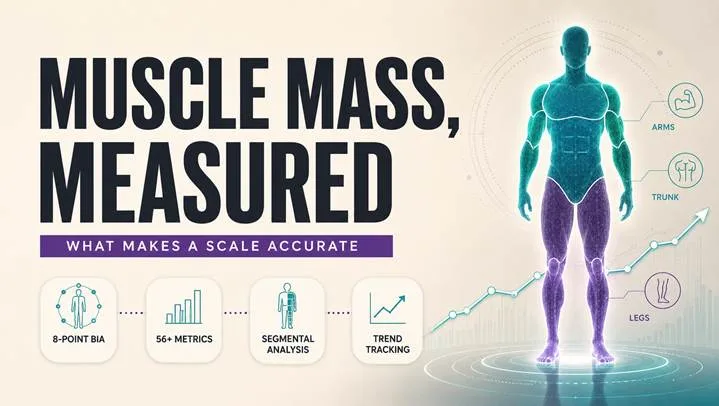
By The FitAmplify Team · Updated July 2026 · 7 min read
If you are lifting to build muscle, the number on a basic scale is close to useless. It cannot tell you whether you gained muscle, lost fat, or just drank more water. A body-composition scale that estimates muscle mass can, if you know what makes one accurate. There is good news for lifters here. Muscle mass is one of the readings bioelectrical impedance handles relatively well. Here is what actually drives accuracy, what to look for, and how to read the number so it means something.
Key takeaways
· No smart scale matches a lab, but for tracking muscle-mass change over time, a good bioelectrical impedance (BIA) scale is accurate and reliable enough for most lifters.
· Muscle (lean) mass is one of BIA's stronger readings. Research finds it agrees closely with DEXA, more so than body-fat estimates.
· The measurement path matters. Hand-to-foot, 8-electrode scales are more accurate than foot-to-foot scales, because the current travels through your upper body too.
· Multi-frequency BIA reads your body water more completely than single-frequency, which sharpens the muscle estimate.
· Consistency beats everything. Same time, same conditions, and read the weekly trend rather than a single number.
· Numbers are only half the job. A metric is most useful when someone can tell you what to do about a stall.
In this article
· Can a smart scale really measure muscle mass?
· How a smart scale estimates muscle
· What makes a scale accurate for muscle mass
· How the methods compare
· Track the trend, not the single number
· How to get a reading you can trust
· Where FitAmplify fits
· Frequently asked questions
Can a smart scale really measure muscle mass?
Strictly speaking, no scale measures muscle directly. It estimates it. A smart scale sends a tiny, safe electrical current through your body and measures the resistance, which is called bioelectrical impedance analysis, or BIA. Because muscle holds far more water than fat, it conducts that current more easily, so the scale can estimate how much lean, muscle-rich tissue you carry. The reassuring part for lifters is that lean mass is one of the readings BIA does relatively well. Studies comparing BIA with DEXA, a clinical reference, find the muscle-mass estimates line up closely, and dual-frequency BIA has been judged accurate and reliable for measuring lean muscle mass.
The question | The short answer |
Does a scale measure muscle directly? | No, it estimates it from body water using BIA |
Is muscle mass a reliable BIA reading? | Yes, it agrees closely with DEXA |
What is the most accurate setup? | 8-point (hand-to-foot), multi-frequency BIA |
Single reading or trend? | Trend. Track weekly change, not one day |
What FitAmplify uses | 8-point BIA, 8 electrodes, 56+ metrics |
Lab reference, if you want one | DEXA, for an occasional snapshot |
At a glance. Details and sources follow below.
How a smart scale estimates muscle
BIA does not weigh your muscle, it calculates it. The current's resistance depends on how much water your body holds, and because fat-free tissue like muscle, organs and bone is roughly 73% water, the scale uses that relationship to estimate your fat-free and muscle mass. It is also why the same scale can separate fat from muscle. Fat resists the current, while lean tissue lets it through. The catch is that anything changing your body water, such as hydration, a salty meal, or a hard workout, changes the estimate. That is not a flaw to fear. It is the reason to measure consistently, which we come back to below.
What makes a scale accurate for muscle mass
When people ask for the most accurate smart scale for muscle mass, they are really asking which features drive accuracy. Four matter most.
Feature | Why it matters for muscle accuracy | What good looks like |
Electrode setup | Hand-to-foot beats foot-to-foot, because the current reaches your arms and trunk, not just your legs | 8 electrodes / 8-point BIA (hands and feet) |
Frequencies | Multi-frequency reads intracellular and extracellular water, which sharpens the lean estimate | Multi-frequency BIA |
Segmental analysis | Shows muscle in arms, trunk and legs, so you can spot imbalances | A per-limb breakdown |
Your inputs | Age, height and sex feed the equation. Wrong inputs, wrong muscle number | An accurate profile for each user |
Consistency and trends | The reading is only as good as your routine and history | An app that stores weekly trends |
How the methods compare
Not every muscle-mass tool is equal, and the measurement path is what separates them. Here is how the common options stack up, from a basic scale to a clinic.
Method | How it reads muscle | Accuracy for muscle mass | Best for |
Foot-to-foot BIA scale | Current through the legs only | Lower. It misses the upper body | Rough, casual tracking |
8-point (hand-to-foot) BIA scale | Current through arms, trunk and legs | Good for tracking change over time | At-home muscle tracking |
DEXA scan | X-ray based tissue breakdown | Clinical reference standard | An occasional lab snapshot |
BIA estimates vary with hydration. DEXA is a clinical reference and is not needed for weekly tracking.
Track the trend, not the single number
Here is the mistake that makes people distrust a good scale: reading it like a bathroom scale. A single muscle-mass number carries noise from your hydration and last meal. The signal is in the trend. Watch the weekly direction over a month and the day-to-day wobble fades. It is also why muscle mass is worth tracking at all, because your scale weight can barely move while you are quietly gaining muscle and losing fat, a change called body recomposition.
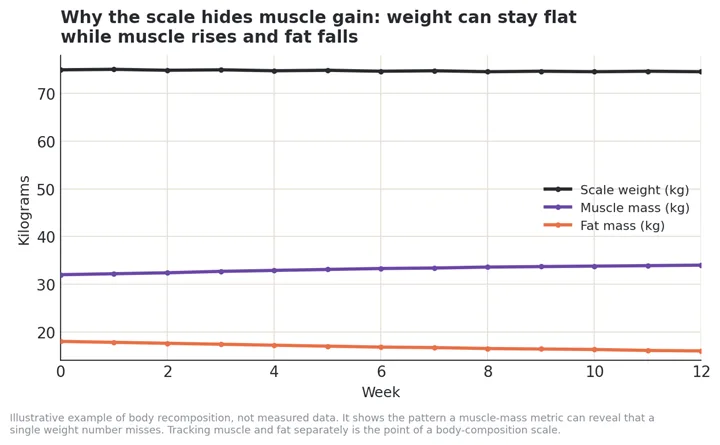
An illustrative body-recomposition pattern. Muscle and fat change while total weight looks flat.
That flat weight line is exactly what frustrates lifters who only watch total weight. A muscle-mass metric is what makes the progress visible. And it matters for the long run, because adults tend to lose muscle with age unless they train to keep it.
How to get a reading you can trust
You cannot turn a BIA scale into a lab, but you can make it consistent, and that consistency is what turns a noisy estimate into a clean trend. Weigh under the same conditions every time.
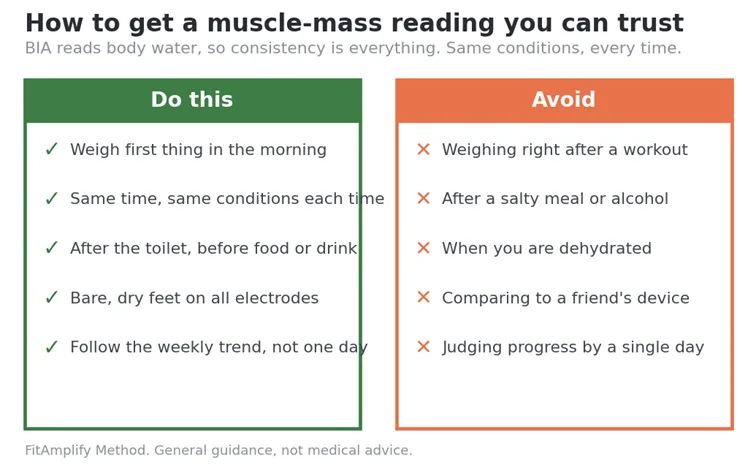
Get the conditions right and the day-to-day noise fades, so the real muscle trend shows through.
One more rule. Never compare your number with a friend's scale or a gym machine. Different devices use different algorithms, so the trend on your own scale is the thing that counts.
Where FitAmplify fits
The FitAmplify Smart Scale uses 8-point BIA with 8 electrodes, sending current through both hands and feet for a segmental read across your arms, trunk and legs. It tracks muscle mass among 56+ body metrics and stores the weekly trends in a free app, so you are reading direction rather than daily noise. And because BIA is an estimate, the numbers do not stop there. A real coach or dietitian can read your muscle and fat trends together and tell you whether a stall means eat more, train differently, or simply wait. You can book a free 20-minute consultation to have someone look at your data with you.
Frequently asked questions
What is the most accurate smart scale for muscle mass?
The most accurate home setup uses 8-point, hand-to-foot BIA with multiple frequencies, because the current reaches your whole body and reads body water more completely. No home scale matches a DEXA scan, but a good 8-point scale tracks muscle-mass change reliably.
Are smart scales accurate for muscle mass?
For tracking change, yes. Muscle (lean) mass is one of BIA's stronger readings and agrees closely with DEXA in studies. A single reading can be off, but the weekly trend is dependable if you measure consistently.
Is an 8-electrode scale better than a foot-to-foot one?
For muscle, yes. Hand-to-foot measurements have been shown to be more accurate than foot-to-foot, because the current travels through your upper body as well as your legs.
How often should I check muscle mass?
Once or twice a week, under the same conditions, and judge the monthly trend. Daily readings mostly show water changes, not real muscle change.
Why did my muscle mass drop overnight?
Almost certainly water, not muscle. Muscle does not appear or vanish in a day. Dehydration, a workout, or a salty meal can shift the reading, so look at the weekly trend instead.
Do I still need a DEXA scan?
Only if you want an occasional precise snapshot. For week-to-week tracking, a consistent 8-point BIA scale is more practical and follows change well.
See your muscle, not just your weight
Weight alone hides the work you are putting in. Track muscle mass among 56+ body metrics with the FitAmplify scale and app, read the trend over weeks, and talk to a real coach when the numbers stall.
FitAmplify is a wellness product and is not a medical device. It is not intended to diagnose, treat, cure, or prevent any disease. BIA readings are for general wellness tracking, not diagnosis. Always consult a qualified healthcare professional regarding any medical concern.
References
1. Bioelectric Impedance Analysis (method overview: hand-to-foot versus foot-to-foot, single versus multi-frequency, hydration and standardization). MRC Epidemiology Unit Measurement Toolkit, University of Cambridge. https://www.measurement-toolkit.org/anthropometry/objective-methods/bioelectric-impedence-analysis
2. Concordance between muscle mass assessed by bioelectrical impedance analysis and by dual-energy X-ray absorptiometry: a cross-sectional study. BMC Musculoskeletal Disorders (2015). https://link.springer.com/article/10.1186/s12891-015-0510-9
3. Dual-Frequency Bioelectrical Impedance Analysis is Accurate and Reliable to Determine Lean Muscle Mass in the Elderly (2022). PubMed. https://pubmed.ncbi.nlm.nih.gov/36567160/
4. Preserve your muscle mass. Harvard Health Publishing, Harvard Medical School. https://www.health.harvard.edu/staying-healthy/preserve-your-muscle-mass