Personalized Health Coaching vs a Fitness App: Which Wins?
Personalized Health Coaching vs a Fitness App: Which Gets You Results Faster?
By The FitAmplify Team · Updated July 2026 · 7 min read
It is the question behind every January download. Do you need a real coach, or is a good fitness app enough? The honest answer from the research is less about the tool and more about you. Apps are cheap, convenient and genuinely effective for self-motivated people. Coaching adds accountability and a plan built for your body. And the format that gets results fastest is usually the one you will actually stick with. Here is what the evidence shows, where each option wins, and how to choose.
Key takeaways
· There is no single winner. A good app and a good coach can both produce real results. What predicts success is adherence and personalization, not the delivery format.
· In a 2023 meta-analysis, adding a human coach to a self-monitoring app clearly beat doing nothing, but its extra edge over a good app used alone was small and not statistically significant for weight.
· Apps win on cost, convenience and habit-tracking. Coaching wins on accountability, personalization, and adjusting the plan when you stall.
· Human support tends to lift engagement. In one review, low-activity rates fell while a human coach was involved and rose again when people used the tool alone.
· “Faster” is the wrong question. The tool you keep using for months beats the perfect tool you abandon in three weeks.
· The best-supported approach for lasting change pairs accurate data (a scale and app) with a real person who reads it and adjusts.
In this article
· The honest answer: it depends on you
· What a fitness app is great at
· What personalized coaching adds
· What the research actually shows
· So which is faster?
· Which one should you choose?
· Where FitAmplify fits
· Frequently asked questions
The honest answer: it depends on you
It is tempting to want a clear winner, but the research does not hand one over. Both a well-designed app and a skilled coach can drive meaningful change, and both can fail if you stop using them. What separates people who get results from people who do not is rarely the app icon on their phone. It is whether the approach fits their life, keeps them accountable, and adapts as their body changes. Here is the short version before we get into the evidence.
The question | The honest answer |
Which is cheaper? | A fitness app, usually by a lot |
Which is more personalized? | Personalized coaching |
Which keeps you accountable? | Coaching, though good apps help |
Which is better for tracking data? | An app, or a connected scale |
Which gets results faster? | The one you will actually stick with |
Best-supported for lasting change? | The two combined |
At a glance. The rest of this article backs each answer with research.
What a fitness app is great at
A good app is a remarkable deal. For little or nothing, it gives you workout libraries, reminders, streaks, and a place to log food and weight. That self-monitoring is not fluff. In a digital weight-management program that paired an app with coaching, participants lost about 7% of their body weight at a year, comfortably past the 5% that tends to bring health benefits, and people who engaged more with lessons and tracking tended to lose more. If you are self-motivated and your goal is straightforward, an app may be all you need to start. Where apps struggle is the human part. They cannot notice you have quietly stopped opening them, and they hand you numbers without always telling you what to do next.
What personalized coaching adds
A coach changes the equation in three ways: accountability, personalization, and interpretation. Someone is expecting your check-in, which is a real behavioural lever. Your plan is built around your body, your history and your constraints, not a template. And when a number moves the wrong way, a coach can tell you whether it is water, stress, a plateau, or a genuine signal to change course. In FitAmplify's model, that person is a registered dietitian or coach reading your actual scan data, not a script. The trade-off is cost and scheduling, because coaching asks more of your time and wallet than a free app.
Before the studies, here is the head-to-head in plain terms. Neither column is a loser. They are simply good at different things.
Where it counts | Fitness app | Personalized coaching |
Cost | Free to low monthly | Higher (your time and fees) |
Personalization | Templated, rules-based | Built around your body and history |
Accountability | Reminders and streaks | A real person expects your check-in |
Adjusts when you stall | Rarely on its own | Yes, a coach changes the plan |
Making sense of your data | Shows you the numbers | Tells you what to do next |
Convenience | Always in your pocket | Needs scheduling |
Best for | Self-motivated, simple goals | Plateaus, complex or specific goals |
What the research actually shows
The evidence is encouraging and refreshingly honest. Here is a plain-language summary of three recent studies, followed by the numbers that matter most.
Study | What it found | Takeaway |
2023 meta-analysis (JMIR) | App + coaching beat usual care by about 2.3 kg; the edge over an app alone (about 1.8 kg) was not statistically significant | Coaching helps versus nothing, and a good app alone is already effective |
Digital program + 1-on-1 coaching (PLOS One) | About 7% body-weight loss at 12 months; more engagement was linked to more loss | Digital tools plus coaching can reach clinically meaningful results |
Human, AI and hybrid review (Frontiers) | Human support raised engagement; low-activity rates fell with a coach and rose without one | Human contact tends to keep people engaged |
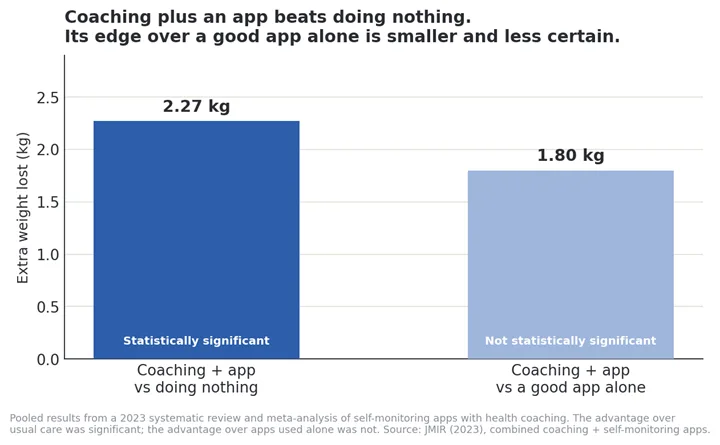
Adding a coach to an app: extra weight lost versus each comparison group. Source: JMIR meta-analysis (2023).
Read together, the studies say something useful. The delivery format matters less than sticking with it, and the biggest gains come from pairing consistent tracking with real accountability.
So which is faster?
Here is the part people do not want to hear. No study crowns one approach as universally faster, because speed depends on adherence. A coach can produce quick early wins by removing guesswork and keeping you consistent. A motivated person with a good app can move just as fast for a fraction of the cost. The approach that gets you there fastest is the one you will keep doing in week ten, not just week one. That is why we avoid promising a set number of pounds by a set date. Real, lasting change does not run on a guarantee.
Which one should you choose?
Use this as a starting point, then adjust to your budget and how you like to work.
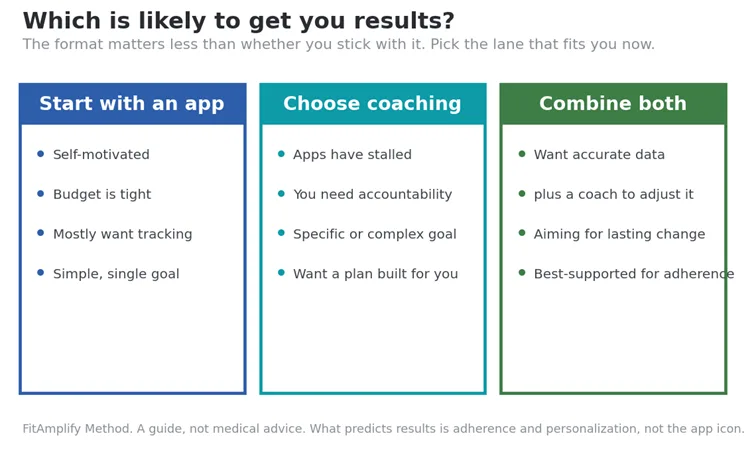
A simple way to pick your lane. None of these is permanent.
None of these lanes is a life sentence. Plenty of people start with an app, stall, add a coach to break through, then later coast on their own habits with a scale for feedback.
Where FitAmplify fits
We are not neutral here, so we will be plain about it. FitAmplify is built on the combine-both lane. The smart scale and free app give you accurate data across 56+ metrics. Then a real dietitian or coach reads that data, builds a plan around it, and keeps you accountable through the Measure, Review, Adjust, Improve loop. If you are happy self-driving with an app, that is genuinely fine. If apps keep fizzling out for you, a real person may be the missing piece. You can book a free 20-minute consultation to see which lane fits.
Frequently asked questions
Is personalized health coaching better than a fitness app?
Not universally. Coaching adds accountability and personalization, while apps win on cost and convenience. Research shows coaching plus an app beats doing nothing, but a good app used consistently is already effective. The best choice depends on your goal, budget and how self-motivated you are.
Which gets results faster, a coach or an app?
Whichever you stick with. Speed depends on adherence, not format. A coach can speed up early progress by removing guesswork, and a motivated person with an app can match that. There is no guaranteed timeline for either.
Are fitness apps actually effective for weight loss?
Yes, when used consistently. In a digital program pairing an app with coaching, participants lost about 7% of body weight at a year, and more engagement was linked to more loss. Self-monitoring is one of the more reliable habits in behaviour change.
What does a health coach do that an app cannot?
A coach notices when you drift, builds a plan around your body rather than a template, and interprets your numbers so you know what to change. That accountability and personalization is hard for software alone to replicate.
Do I have to choose one or the other?
No, and the research suggests you should not. Pairing accurate data from an app or scale with a real person who reads it and adjusts is the best-supported approach for lasting change.
Can I start with an app and add coaching later?
Absolutely. Many people begin with an app, hit a plateau, bring in a coach to break it, then maintain with a scale for feedback. Your approach can evolve as your goals do.
Pick the lane that fits, and start
The winner is not an app or a coach. It is the approach you will keep. If you want accurate data and a real person to help you act on it, track 56+ body metrics with the FitAmplify scale and app, and book a free consultation with a dietitian or coach to find your lane.
FitAmplify is a wellness product and is not a medical device. It is not intended to diagnose, treat, cure, or prevent any disease. Individual results vary. Always consult a qualified healthcare professional regarding any medical concern.
References
1. Effectiveness of Combined Health Coaching and Self-Monitoring Apps on Weight-Related Outcomes in People With Overweight and Obesity: Systematic Review and Meta-analysis. Journal of Medical Internet Research (2023). https://www.jmir.org/2023/1/e42432
2. Outcomes in a digital weight management intervention with one-on-one health coaching. PLOS One (2020). https://journals.plos.org/plosone/article?id=10.1371/journal.pone.0232221
3. Systematic review exploring human, AI, and hybrid health coaching in digital health interventions: trends, engagement, and lifestyle outcomes. Frontiers in Digital Health (2025). https://www.frontiersin.org/journals/digital-health/articles/10.3389/fdgth.2025.1536416/full