How to Set Up a Smart Scale Correctly: Accurate Readings
Smart Scale Setup Guide: Get Accurate Readings From Your Very First Weigh-In
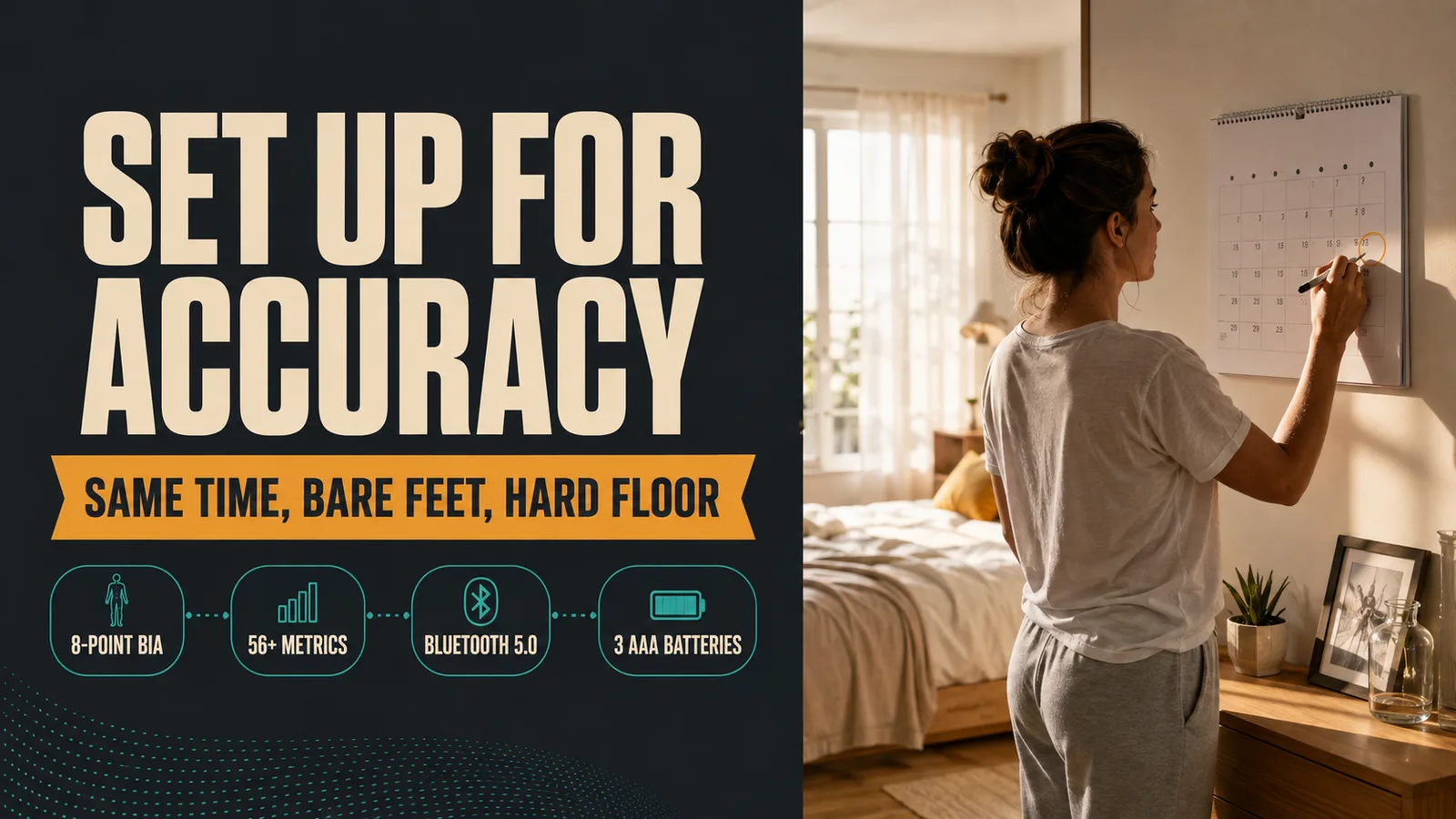
The FitAmplify Team · Reviewed by Ms. Shivani Tomar, RD, Registered (clinical) Dietician, M.Sc Nutrition, 12 years' experience · Updated August 2026 · 14 min read
How to set up a smart scale correctly starts with where you stand, not what you buy. Get the setup right and your numbers become trustworthy day to day. Get it wrong and every reading, from body fat to muscle mass, drifts off course before you even see it.
Stand with your heels together and toes turned out at roughly a 60-degree angle, weight even on both feet. That stance, paired with a properly placed smart body-composition scale, is what turns a shaky first reading into one you can actually trust.
What You Need Before You Start
Before you step on, sort three things: your timing, your phone, and what the numbers actually mean.
Timing matters more than most people realize. For a reading you can trust, weigh in at the same time each day, and skip strenuous exercise for 48 hours, alcohol for 24 hours, and food, caffeine, or nicotine for about 10 hours beforehand. Bioelectrical impedance reads the water in your body, and all of those things change your hydration enough to shift what shows up on the screen.
Next, get the scale itself ready. Most smart bathroom scales, including this one, run on batteries rather than a plug, so check that yours are fresh alkaline cells before your first weigh-in. Rechargeable batteries can throw off the reading, so it is worth using what came in the box.
Then pair your phone. Download the smart scale app before you step on, since a smart bluetooth scale is only half the system. The scale reads the electrical signal, but pairing it right is what lets you track 56+ metrics in the app instead of just a number on the screen. If more than one person in your house is weighing in, set up separate profiles first. The app supports up to 8, and it will recognize each person automatically once you are set up.
Last, set realistic expectations. A healthy BMI generally falls between 18.5 and 24.9, with 25 to 29.9 counted as overweight and 30 or higher as obese. Body fat ranges are wider and split by sex, with 25-31% typical for women and 18-24% typical for men outside of athletes. Keep those ranges in mind, and if a number seems off, talk to a registered dietitian instead of guessing at what it means.
Where to Place Your Scale
Your smart scale is only as good as the floor under it. Set it on a hard, flat surface, tile, hardwood, or laminate all work well. Skip carpet and rugs entirely, since any give in the surface throws off contact and can produce a reading that swings several pounds from the real number.
A wobble is your first warning sign. Rock the scale gently with your foot before you ever step on it, and if it tips even slightly, move it or shim it until it sits flat. A body composition scale sends a small electrical signal through your feet to measure resistance, and an unstable base disrupts that signal before it even starts.
Foot position matters just as much as the floor. Standard testing protocol has you stand with your heels together and your toes pointed outward at roughly a 60-degree angle, weight spread evenly across both feet. Try to land in close to the same spot and stance each time you weigh in, since a smart weigh scale reads bioelectrical signals through your skin, and shifting foot placement changes the path that current travels.
Bare feet are non-negotiable for body composition readings. Socks, tights, and lotion all interfere with the electrical signal, so keep your feet dry and skin-to-plate contact clean. A smart digital scale that cannot get a clean read will still spit out a number, it just will not be one you can trust.
Set Up Your Smart Scale Step by Step
Once you know where the scale will live and what to avoid before stepping on, the setup itself only takes a few minutes. Here is how to set up a smart scale correctly from unboxing to first sync.
Unbox and check the battery compartment. Most models, including the FitAmplify Smart Scale, run on 3 AAA batteries. Use alkaline batteries rather than rechargeables, since rechargeables often deliver slightly lower voltage and can throw off your readings.
Place the scale on a hard, flat floor. Carpet or uneven tile can cause the scale to rock, which throws off both weight and body composition numbers.
Download the companion app. A smart scale application is where your data actually becomes useful. It is where you will create your profile, log your height and age, and watch your metrics change over weeks and months instead of staring at one number on a screen.
Pair the scale over Bluetooth. A bluetooth smart weight scale needs to sync with your phone before it can save any readings. Open the app, find the pairing menu, and follow the prompts. This usually takes under a minute.
Set up your personal profile. Enter your height, age, and biological sex. Body composition scales use this information along with the electrical signal to calculate your results, so accuracy here matters.
Add other household members if needed. Many apps, including FitAmplify's, support multiple private profiles and recognize each person automatically once everyone has stepped on the scale a time or two.
Do a test weigh-in. Step on with bare, dry feet, heels together, toes pointed outward at roughly a 60-degree angle. This confirms the pairing worked and gives you a baseline reading to compare future weigh-ins against.
Once the app shows your first synced reading, setup is done. From here, consistency matters more than any single number, and a healthy BMI range is generally considered 18.5 to 24.9, so use that as context rather than a verdict on any one scan.
How to Take Your First Accurate Reading
That baseline scan is only useful if the numbers behind it are trustworthy. A few small habits in the first few weigh-ins make the difference between data you can act on and noise you end up ignoring.
Weigh in at the same time each day, ideally in the morning before food or water and after using the bathroom. Body weight shifts throughout the day, so comparing a morning reading to an evening one will always look off, even on the most accurate smart scale. Stand with heels together and toes pointed outward at roughly a 60-degree angle, feet flat and dry on the plates. That stance matters more than people expect. Bioelectrical impedance depends on a clean electrical path through your body, and a shifted foot or a damp heel can throw off contact enough to skew the reading.
Stay still for the full scan. Fidgeting, talking, or shifting your weight mid-read introduces the same kind of noise. Once the number comes through, resist the urge to judge it against a single cutoff. A body fat scale smart enough to break down composition still reports a range, not a verdict, and ACE places typical nonathlete body fat around 25-31% for women and 18-24% for men, with anything below 14% or 6% considered dangerously low.
Think of this first reading as a reference point, not a report card. A smart scale for weight tracking earns its value over weeks of consistent scans, where the trend line tells you more than any one morning does.
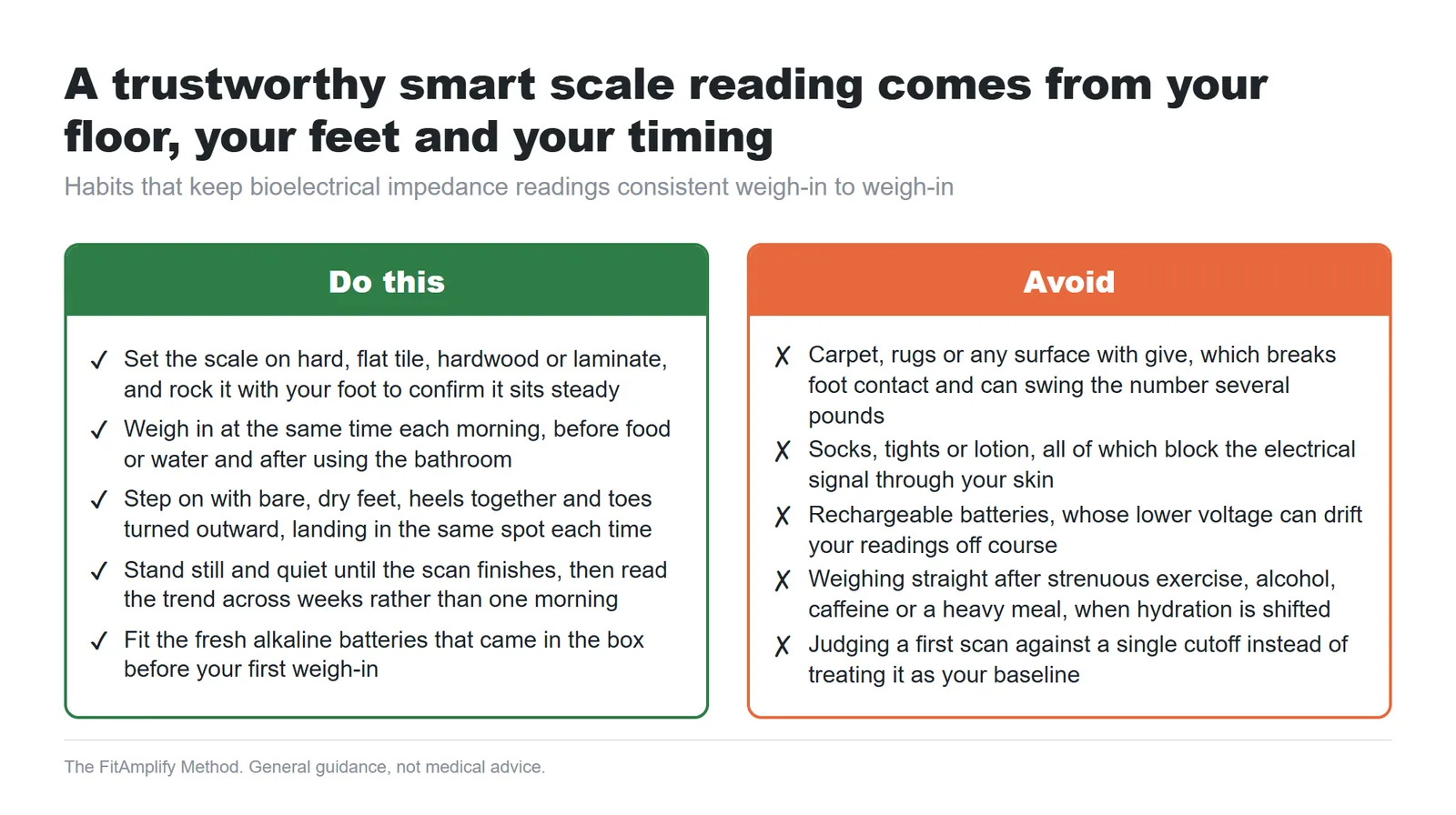
Bioelectrical impedance depends on a clean electrical path, so surface, skin contact and timing shift your numbers before you ever see them.
Figure 2. Bioelectrical impedance depends on a clean electrical path, so surface, skin contact and timing shift your numbers before you ever see them.
What Each Body Metric Means
Body fat percentage, BMI, visceral fat, metabolic age, muscle mass, hydration, bone mass, protein, BMR, TDEE, lean mass, health score, heart rate. A screen full of numbers doesn't help much if you don't know what any of them are telling you.
Start with the marker most people already recognize. BMI compares your weight to your height, and the NIH defines a healthy adult range as 18.5 to 24.9, with 25 to 29.9 flagged as overweight and 30 or above as obese. It's a fast screen, not a diagnosis, since it can't tell muscle from fat.
Body fat percentage is where a smart scale for body composition actually earns its keep, because it splits that single weight number into what's fat and what isn't. ACE puts typical nonathlete body fat at 25-31% for women and 18-24% for men, treating anything under 14% or 6% as dangerously low rather than a goal to chase.
Group and Marker | Body Fat Threshold (%) | Classification |
|---|---|---|
Women, typical range (low end) | 25 | Nonathlete normal |
Women, typical range (high end) | 31 | Nonathlete normal |
Men, typical range (low end) | 18 | Nonathlete normal |
Men, typical range (high end) | 24 | Nonathlete normal |
Women, danger threshold | 14 | Dangerously low |
Men, danger threshold | 6 | Dangerously low |
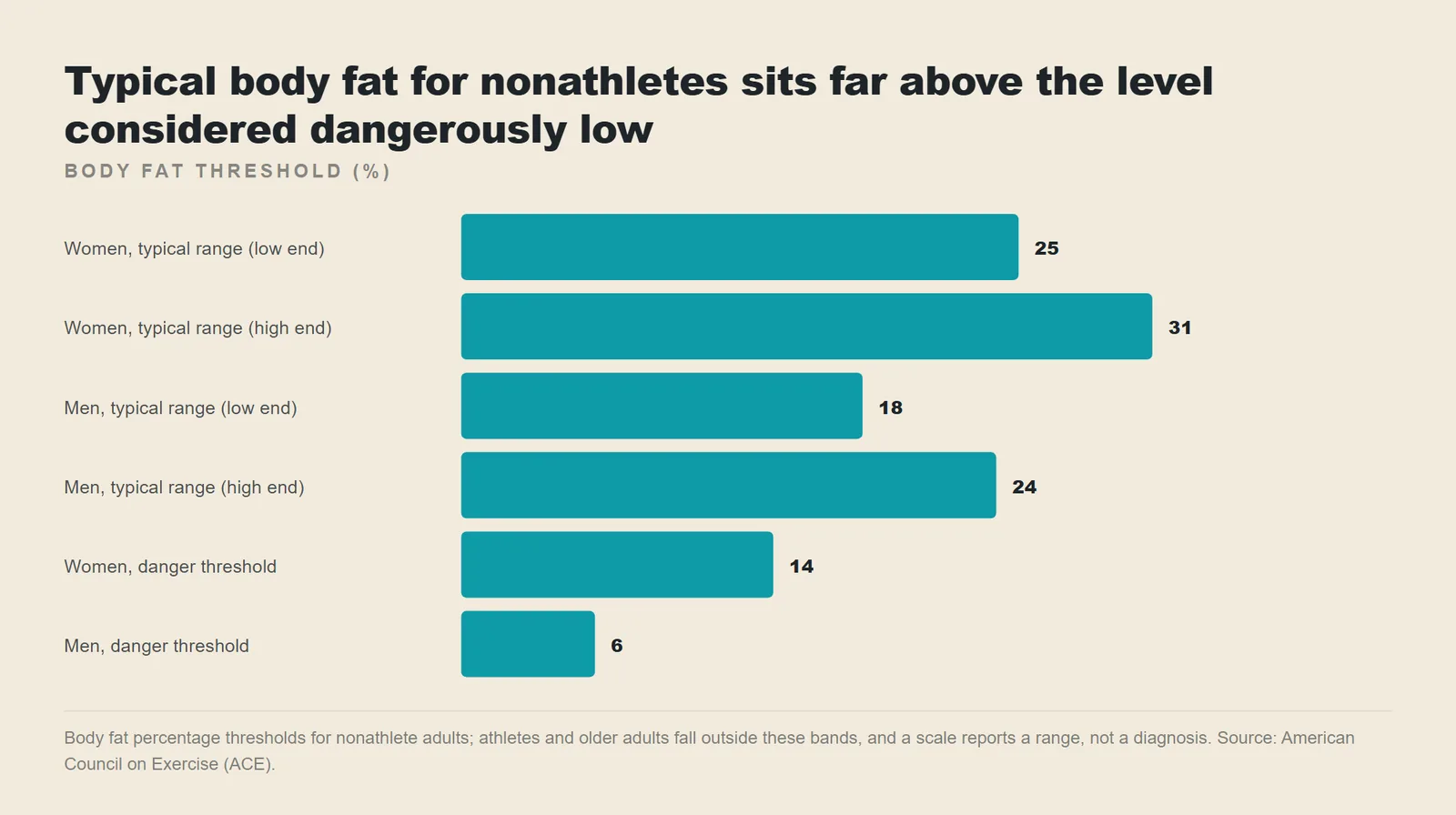
The gap between a normal nonathlete range and the danger threshold is wide for both sexes, so a single reading inside the band is context rather than a verdict.
Figure 1. The gap between a normal nonathlete range and the danger threshold is wide for both sexes, so a single reading inside the band is context rather than a verdict.
The rest of the readout builds the picture around those two numbers. Visceral fat, hydration, bone mass, protein, and lean mass are why the best body composition scale never leans on one figure alone. An advanced smart scale is only as useful as your ability to read it, so if the full breakdown feels like a lot, you can track 56+ metrics in the app and let someone walk you through how expert review works instead of guessing at what a single scan means.
Setup Mistakes That Skew Your Numbers
Your stance is probably the first thing throwing off your readings. The standard protocol calls for heels together and toes pointed outward at roughly a 60-degree angle, with your weight spread evenly across both feet. Stand crooked, shift your weight to one side, or curl your toes, and the current path through your body changes, which means your numbers change too.
Timing trips people up next. Weighing yourself right after a workout, a big meal, or a shower adds water to the equation that wasn't there an hour earlier. A smart fitness scale reads impedance, not fat directly, so anything that changes your hydration in the moment nudges body fat, water, and muscle mass readings along with it.
Skin contact is another quiet culprit. Dry feet, lotion, thick socks, or standing on a rug between you and the plate all interfere with the signal. Even the best body fat scale needs clean, direct contact with bare skin to get a reliable read.
Context matters more than the number itself. A single scan can flag body fat outside the typical 25-31% range for women or 18-24% for men, or a BMI outside the 18.5-24.9 healthy band, but one reading rarely tells the full story on its own. If your numbers look off no matter what you try, it might be less about your Renpho smart scale or any other model and more about setup, and that's worth a second look before you assume something is wrong. When a reading really worries you, talk to a registered dietitian instead of guessing at what caused it.
How to Compare Smart Scales Before You Buy
Shopping for a scale usually means scrolling past a dozen listings that all claim to be the best rated smart scale on the market. The marketing is loud, but the spec sheet tells you more than a star rating ever will. Before you buy, line up a few real numbers side by side instead of trusting a badge that just says "top rated smart scale."
Electrode count is a good place to start. A basic scale treats your whole body as one reading, while an 8-point BIA smart body-composition scale measures your arms, trunk, and legs on their own, which is how it catches an imbalance a cheaper model would miss entirely. Metric count matters too. Some entry-level scales stop at weight and BMI, while others pull dozens of readings out of a single step-on.
Use this as a checklist when you're weighing options, including whatever gets crowned the best smart scale 2025 by the next review roundup:
Spec | FitAmplify Smart Scale | Why It Matters |
|---|---|---|
Electrode points (#) | 8 | Segmental analysis catches left-right imbalances |
Body metrics reported (#) | 56 | One scan covers fat, muscle, water, and more |
Private profiles (#) | 8 | Each household member keeps a separate history |
Battery life (months) | 12 | Fewer swaps, more consistent daily readings |
One-time price (CAD $) | 50 | No subscription required to see your numbers |
Once you've picked a scale, download the free FitAmplify app so those numbers turn into trends you can actually read, week over week, instead of a single score you forget by morning.
Build a Weighing Routine That Sticks
One clean reading tells you almost nothing. Weight shifts with hydration, meals, and even the time of day, so the real value of a body scale smart enough to track trends only shows up after a week or two of consistent use. Pick one time, usually morning, before food and water, and stick with it.
Standing position matters more than most people realize. The NHANES protocol, used in national health surveys, has people stand with heels together and toes angled outward at about 60 degrees, weight spread evenly across both feet. Copy that stance every time you step on, and your numbers will actually mean something when you compare them week to week.
Don't panic over one number in isolation, either. BMI alone only tells you if you fall between 18.5 and 24.9, which counts as a healthy range, with 25 to 29.9 flagged as overweight and 30 or higher as obese. Body fat percentage adds context BMI can't, since a typical nonathlete range runs 25-31% for women and 18-24% for men, with anything below 14% or 6% considered dangerously low.
That's why the best smart weight scale for you is the one you'll actually use every week, not just the one with the longest spec sheet. If you want help reading what your trend lines actually mean, you can always talk to a registered dietitian instead of guessing on your own.
FAQ
How long does setting up a smart scale correctly actually take?
Most people are done in under ten minutes. You download the app, sync the scale over Bluetooth, enter your height and a few basics, and step on for your first scan. The slow part isn't the setup itself, it's remembering to weigh in at the same time each day so your trend line means something.
Do I really need to stand a specific way on the scale?
Yes, and it matters more than people think. Foot placement changes how the electrical signal travels through your body, which changes your readings. Research protocol has participants stand with heels together and toes pointed outward at roughly a 60-degree angle, weight spread evenly across both feet, and copying that stance at home keeps your numbers consistent.
What makes a smart bathroom scale worth buying over a basic one?
A basic scale gives you one number: weight. A best smart bathroom scale pick should hand you a fuller picture, things like body fat, muscle mass, and hydration, pulled from a single scan on the smart body-composition scale. Look for one with segmental analysis too, since that catches imbalances a regular scale can't see.
Why do my scale and my app show different numbers?
This usually comes down to sync timing or profile mix-ups, not a scale malfunction. If two people share a device without separate profiles, the app can misattribute a reading. Check that you're logged into your own profile, then re-sync before assuming anything is broken.
Can multiple people use the same smart scale app?
Yes, most smart scale apps support several private profiles, and the FitAmplify app allows up to eight, recognizing each person automatically once profiles are set up. That means your whole household can track separately without mixing up data. If sync issues come up along the way, support can help you sort them out.
Conclusion
Setting up a smart scale correctly is not complicated, but it does take a few minutes of care. Placing it on a hard, flat floor, standing in the right position with heels together and toes angled out, and weighing in at the same time each day all make a real difference in how much you can trust your numbers.
Remember that a body composition scale gives you a snapshot, not a diagnosis. Numbers like BMI or body fat percentage are useful markers, but they mean more when a real person helps you read them in context.
If you want that context, you can talk to a registered dietitian and turn your readings into an actual plan, not just a stream of numbers on a screen.
References
Heart-Healthy Living - Aim for a Healthy Weight, NHLBI, NIH
Body Fat Percentage: Charting Averages in Men and Women (Very Well Health), American Council on Exercise (ACE)
FitAmplify is a wellness product and is not a medical device. It is not intended to diagnose, treat, cure, or prevent any disease. Always consult a qualified healthcare professional regarding any medical concern.