Smart Scale vs Fitness Tracker Which to Buy First
Do You Need a Smart Scale and a Fitness Tracker, or Is One Enough?
The FitAmplify Team · Reviewed by Ms. Shivani Tomar, RD, Registered (clinical) Dietician, M.Sc Nutrition, 12 years' experience · Updated August 2026 · 13 min read
Smart scale vs fitness tracker which to buy first comes down to what you actually want to track. A smart scale like the FitAmplify body composition scale uses bioelectrical impedance to estimate fat, muscle, and water, though independent testing shows these estimates can vary widely between devices. A fitness tracker watches daily movement and heart rate instead. If body composition trends matter more to you than step counts, start with the scale.
Which Should You Buy First
Start with your goal, not the gadget. If you want to see fat, muscle, and water shift over months, a smart scale for weight tracking gives you a clear starting point. If you care more about daily movement and heart rate, a fitness tracker earns the spot on your wrist first.
Neither device replaces a lab. The gold-standard methods for measuring body fat, like DEXA or total body water, are accurate but expensive and hard to get to for most people, which is exactly why a smart fitness scale at home is worth having for tracking trends over time. Excess belly fat also carries its own health risk separate from total body fat, so a tool that breaks down where fat sits matters more than one that only tracks steps. Here is how the accuracy research on each device type stacks up.
Data pointToolAccuracy variance (%)Devices in study (n)Step count accuracy windowFitness tracker105Body composition error, best-performing deviceSmart scale-3.515Body composition error, worst-performing deviceSmart scale11.715Devices matching 4-compartment reference modelSmart scalen/a5Total BIA devices tested against referenceSmart scalen/a15
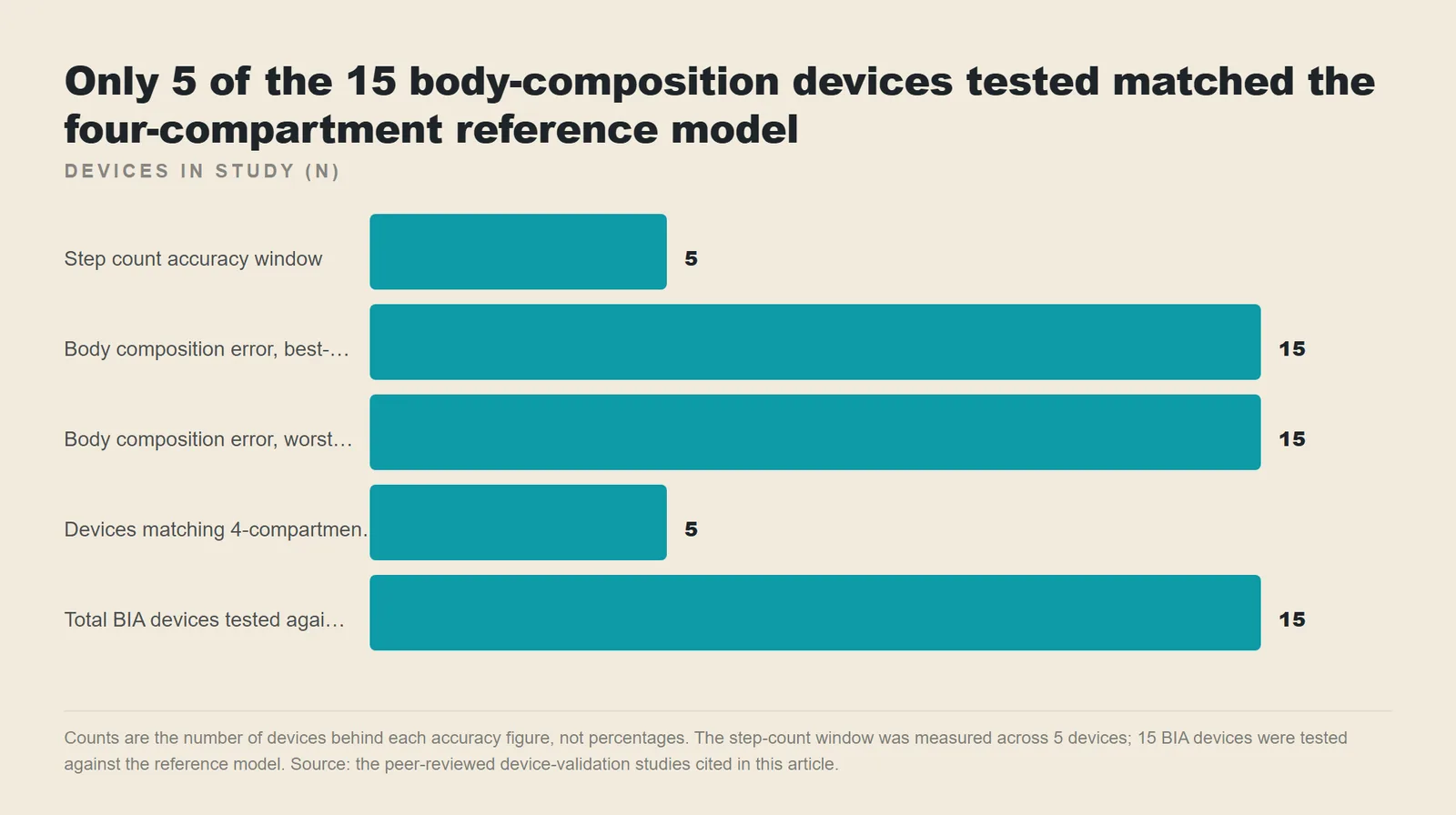
The accuracy claims above rest on small device samples, and just a third of the scales tested were statistically equivalent to the lab reference.
Figure 2. The accuracy claims above rest on small device samples, and just a third of the scales tested were statistically equivalent to the lab reference.
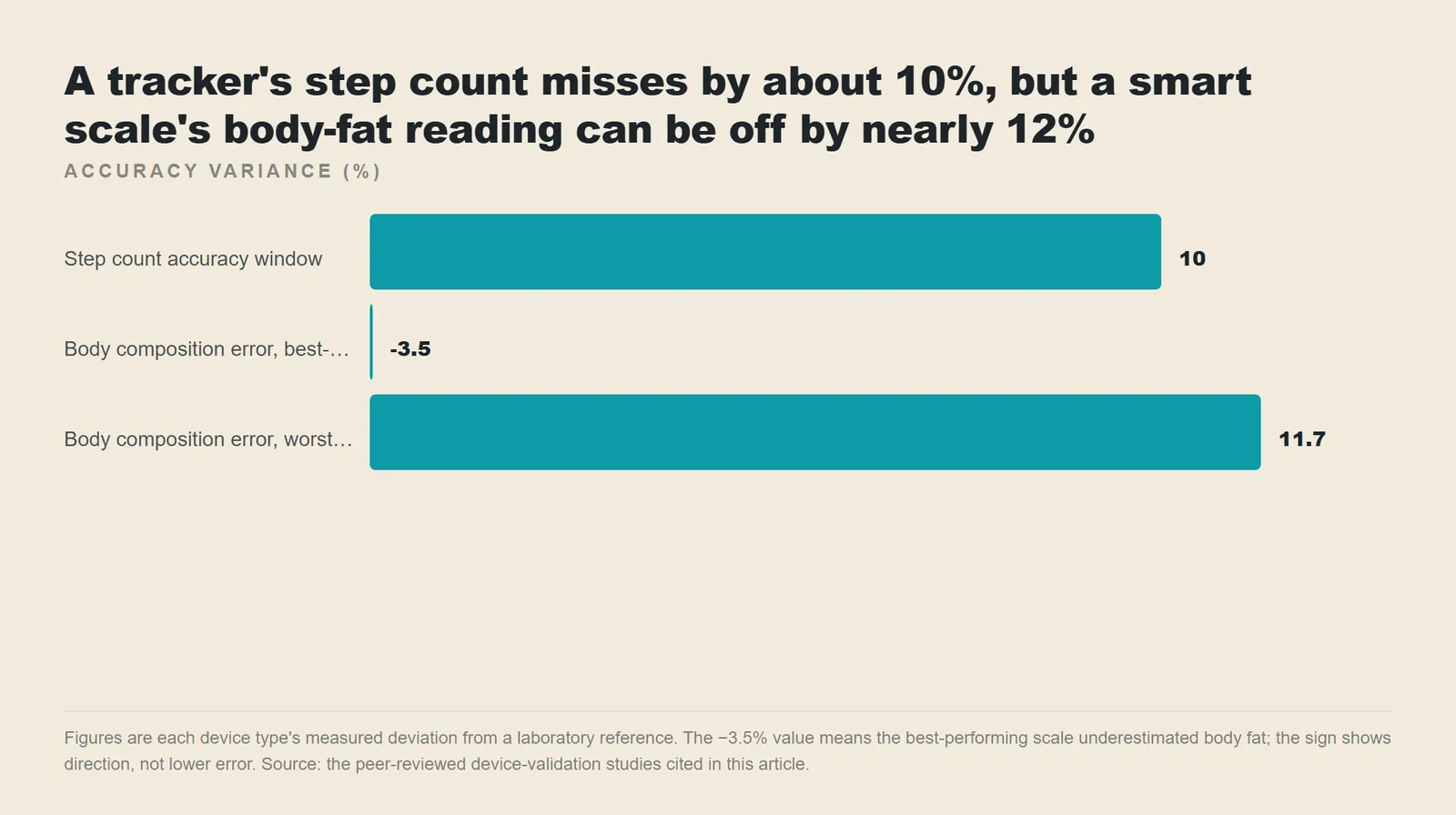
Step counting sits inside a single-digit error window, while body-fat estimates range from 3.5% under the lab reference to 11.7% over it.
Figure 1. Step counting sits inside a single-digit error window, while body-fat estimates range from 3.5% under the lab reference to 11.7% over it.
Trackers were tighter and more consistent on step counts. Scales varied more, since only 5 of 15 tested devices matched the reference model closely. If you're still unsure which fits your situation, you can book a free 20-minute consultation and talk it through with a real person.
What a Smart Scale Actually Measures
A scale that only tells you pounds is basically guessing. Your weight moves with water, food, even the time of day, so a number alone can't tell you if you're losing fat or just losing sleep. That's the gap an advanced smart scale for body composition is built to close.
Beyond weight: fat, muscle, and water
The FitAmplify Smart Scale runs 8-point BIA (bioelectrical impedance analysis), sending a faint current through eight electrodes to read your body in segments: arms, trunk, and legs, checked individually. That segmental read is what catches a left-right imbalance a bathroom scale would never notice. One scan returns 56+ metrics, including body fat percentage, muscle mass, visceral fat, hydration, bone mass, and metabolic age.
It's worth being upfront about how this technology works. Bioelectrical impedance is one of several accepted ways to estimate body fat, alongside methods like total body water or DEXA, precisely because the gold-standard options are expensive and hard to access outside a lab. BIA scales aren't lab equipment, and accuracy varies by device. Testing across 15 consumer BIA devices found constant error ranging from -3.5% up to 11.7% against a 4-compartment reference model, and only 5 of the 15 came close enough to be called statistically equivalent.
That's not a reason to ignore the data. It's a reason to treat any single scan as a data point, not a verdict, and to watch the trend over weeks instead of obsessing over one reading. If a number looks off or you want help reading what it means, you can talk to a registered dietitian who reviews real results, not just raw output from a body fat scale smart enough to flag them.
What a Fitness Tracker Actually Measures
A fitness tracker doesn't try to look inside your body. It watches what your body does, counting steps, tracking heart rate, and estimating how many calories you burned during a walk or a workout. That's a different job than a smart bluetooth scale is doing, and it's worth being clear about the difference before you decide which one to buy first.
Step counting is the feature most people actually rely on, and it holds up reasonably well. Wearable trackers correlate with manual step counts at 0.80 or higher, and trackers worn on the hip tend to outperform ones worn on the wrist. A separate study from the American Council on Exercise found that five different activity trackers all predicted step counts within 10 percent accuracy across treadmill walking, running, and elliptical sessions. That's solid enough to trust for daily movement goals.
Where trackers stay quiet is body composition. They can't tell you your body fat percentage, your muscle mass, or where you're carrying visceral fat, because they're not scanning tissue at all. That gap is exactly what a smart scale app is built to fill, translating an 8-point BIA scan into metrics a step counter was never designed to produce. If you're trying to build a full picture instead of just a movement log, that's the piece a tracker leaves out.
Smart Scale vs Fitness Tracker Compared
Numbers settle this faster than opinions do. Here is how the two tools compare on the accuracy studies that actually tested them, not on marketing copy.
Comparison PointCategoryAccuracy / Error (%)NotesStep-count accuracy across treadmill, running, and elliptical sessionsFitness Tracker10All five trackers in the study stayed within this marginBody-fat estimate error vs. a 4-compartment reference, best caseSmart Scale (BIA)-3.5The closest device came in hereBody-fat estimate error vs. a 4-compartment reference, worst caseSmart Scale (BIA)11.7The widest gap recorded among the 15 devices testedDevices statistically equivalent to the reference modelSmart Scale (BIA)33Only 5 of 15 devices matched closely enough
A fitness tracker's job is narrow, and that narrowness is what makes it reliable. Counting steps is a simpler problem than estimating tissue, so the error margin stays tight and consistent.
A smart scale is solving a harder problem, and the spread above shows it. Even the most accurate smart scale on the market works within the physics of BIA, and that range of -3.5% to 11.7% is why no brand can honestly promise lab-grade precision. What separates a genuinely top rated smart scale from the rest isn't a flashy number, it's whether the company shows you testing data like this instead of burying it. That's also the difference between a best rated smart scale and one that just looks good in a photo: transparency about where BIA falls short, paired with 56+ metrics you can actually track over time.
Pick the Right Tool for Your Goal
Pick the Right Tool for Your Goal
There's no universal winner here. The right pick depends on what you're actually trying to change, and the two devices measure completely different things.
Fat loss and GLP-1 journeys
If your goal is losing fat, especially if you're on a GLP-1 medication, a body composition scale earns its place first. GLP-1 drugs can shrink the number on the scale fast, but they don't tell you what's shrinking. A best body composition scale shows whether that drop is coming from fat or from muscle, which matters when rapid weight loss puts muscle mass at risk. Total body fat is normally measured with tools like DEXA or bioelectrical impedance, and while those methods have real limits, they still give you a fuller picture than a bathroom scale ever could. That context is worth more than a daily number when your medication is doing a lot of the work for you.
Muscle gain and performance
If you're training for strength or performance, a fitness tracker earns its spot first instead. You need workout intensity, heart rate trends, and recovery data day to day, and that's what activity trackers are built to capture. Muscle gain is a slower story that a body scale tells better over weeks, not hours, so pair the two once your training routine is steady. Segmental analysis is especially useful here since it flags left-right imbalances a tracker never could.
Watching your middle, not just your weight
Whichever goal you have, abdominal fat deserves separate attention. Fat that collects around the abdomen, out of proportion to your total body fat, raises health risks on its own, independent of overall weight. That's a case where an everyday smart scale beats a fitness tracker outright, since a tracker never measures fat distribution at all.
How to Choose a Smart Scale
Once you've decided a smart scale earns a spot in your routine, use this checklist to sort real options from marketing noise.
Count the electrodes. An 8-point design reads arms, trunk, and legs separately, which is what makes segmental analysis possible. A basic two-plate scale can't do this, no matter how the box is worded.
Check what body fat method sits behind the numbers. Home methods like bioelectrical impedance exist because gold-standard options such as DEXA and total body water testing are expensive and rarely available outside a clinic. That tradeoff is normal. The question is whether the brand is upfront about it.
Set your accuracy expectations before you buy. Independent testing of 15 bioelectrical impedance devices against a 4-compartment reference found error ranging from -3.5% to 11.7%, and only 5 of the 15 matched closely enough to be called equivalent. Any smart digital scale, including this one, sits somewhere in that range. Trend tracking is the realistic use case, not lab-grade diagnosis.
Confirm app support before you commit. Look for iOS and Android sync, a free tier with no card required, and enough profile slots for your household. The FitAmplify app covers all of this if you want a reference point.
Ask how you'll get help reading the results. A pile of numbers is only useful if someone can explain them. Scales tied to real coaching, where you can talk to a registered dietitian about your report, close that gap.
Run any "best smart scale 2025" shortlist through these five checks, and the marketing gets a lot easier to see through.
A quick gut check before you buy: what makes the best smart bathroom scale for one household is a bad fit for another. A single person tracking one goal just needs solid electrodes and a clean app. A family of four sharing one scale needs profile slots, automatic recognition, and reports each person can actually read on their own.
What You Pay in Canada
Budget matters here, so let's talk real numbers instead of vague ranges. A basic bathroom scale runs you $20 to $30. A smart scale with body composition readings usually lands between $40 and $100, and a fitness tracker can cost anywhere from $50 for a basic band to $400 for a GPS-loaded watch.
Renpho and other popular picks
Search "best smart weight scale" and the Renpho smart scale shows up on almost every list, alongside a dozen other budget-friendly options that all promise similar numbers. Most of these entry-level scales use two or four contact points, which is one reason bioelectrical impedance devices can vary so much from each other. Testing across 15 BIA devices found constant error ranging from -3.5% to 11.7% against a lab reference, and only 5 of 15 matched it closely enough to call statistically equivalent. That's not a knock on any one brand. It's just the reality of squeezing a lab method into a smart bathroom scale, so a $30 scale and a $90 scale can both be "accurate enough" for tracking trends while still disagreeing on your exact body fat number.
The FitAmplify Smart Scale sits at $50, discounted from $80, and uses 8 electrodes instead of the usual 2 or 4 for full-body segmental readings. On the tracker side, price mostly buys you extra sensors like GPS or ECG, not better step counting. Five trackers tested by ACE all landed within 10 percent of actual step counts on a treadmill, so a $60 band can track steps about as well as a $300 watch.
FAQ
Should you buy a smart scale or a fitness tracker first?
If your main goal is understanding your body, start with a smart body-composition scale. It gives you a fuller starting picture in one scan, including body fat percentage and muscle mass, while a tracker mostly counts steps and heart rate. Add the tracker later once you want daily activity data too.
Is a smart weigh scale accurate for body fat percentage?
It is accurate enough to spot trends, but it is not a lab replacement. Research comparing 15 bioelectrical impedance devices against a full lab reference found errors ranging from -3.5% to 11.7%, and only 5 of the 15 matched the lab closely. Treat your number as a starting point for tracking change over time, not a diagnosis.
Do you need a fitness tracker to use a bluetooth smart weight scale?
No. A bluetooth smart weight scale works fine on its own and does not need a tracker to be useful. It pairs with your phone through the FitAmplify app, and you can always add a tracker later if you want step counts and heart rate alongside your body composition numbers.
What does a smart scale application actually track?
A good smart scale application should give you more than a single weight number. The FitAmplify app logs 56+ metrics per scan, including hydration, bone mass, and segmental readings for your arms, trunk, and legs, and it keeps a full history so you can watch trends over weeks and months.
What is the best body fat scale for home use?
The best body fat scale for home use is one you will actually step on every week and one that syncs its data somewhere you will check it. Visceral fat matters here because excess fat around the abdomen, out of proportion to your total body fat, is linked to health risk on its own. Full lab methods for measuring total body fat are often expensive and hard to access, so a home scale is a practical way to track the trend instead.
Conclusion
A fitness tracker shows how much you moved today. A smart scale shows what your body is made of, from muscle to visceral fat to hydration. They answer different questions, and a real coach or dietitian can help you read either one in context. Home BIA devices vary in accuracy against lab methods, so treat your scale readings as a trend to watch, and let a professional weigh in on what the numbers actually mean.
If your goal is tracking body composition over months, start with a smart body-composition scale and build your history from there. Ready to make sense of your numbers? Talk to a real expert and get a clear next step.
References
Treatment Guidelines - Clinical Guidelines on the Identification, Evaluation, and Treatment of Overweight and Obesity in Adults, National Heart, Lung, and Blood Institute (NIH)
Assessing the reliability and cross-sectional and longitudinal validity of fifteen bioelectrical impedance analysis devices, NIH National Library of Medicine (PMC)
ACE-Sponsored Research: Are Activity Trackers Accurate?, American Council on Exercise (ACE)
Systematic review of the validity and reliability of consumer-wearable activity trackers, NIH National Library of Medicine (PMC)
Executive Summary - Clinical Guidelines on the Identification, Evaluation, and Treatment of Overweight and Obesity in Adults, National Heart, Lung, and Blood Institute (NIH)
FitAmplify is a wellness product and is not a medical device. It is not intended to diagnose, treat, cure, or prevent any disease. Always consult a qualified healthcare professional regarding any medical concern.