Smart Scale vs InBody: Can You Get Gym-Grade Readings at Home?
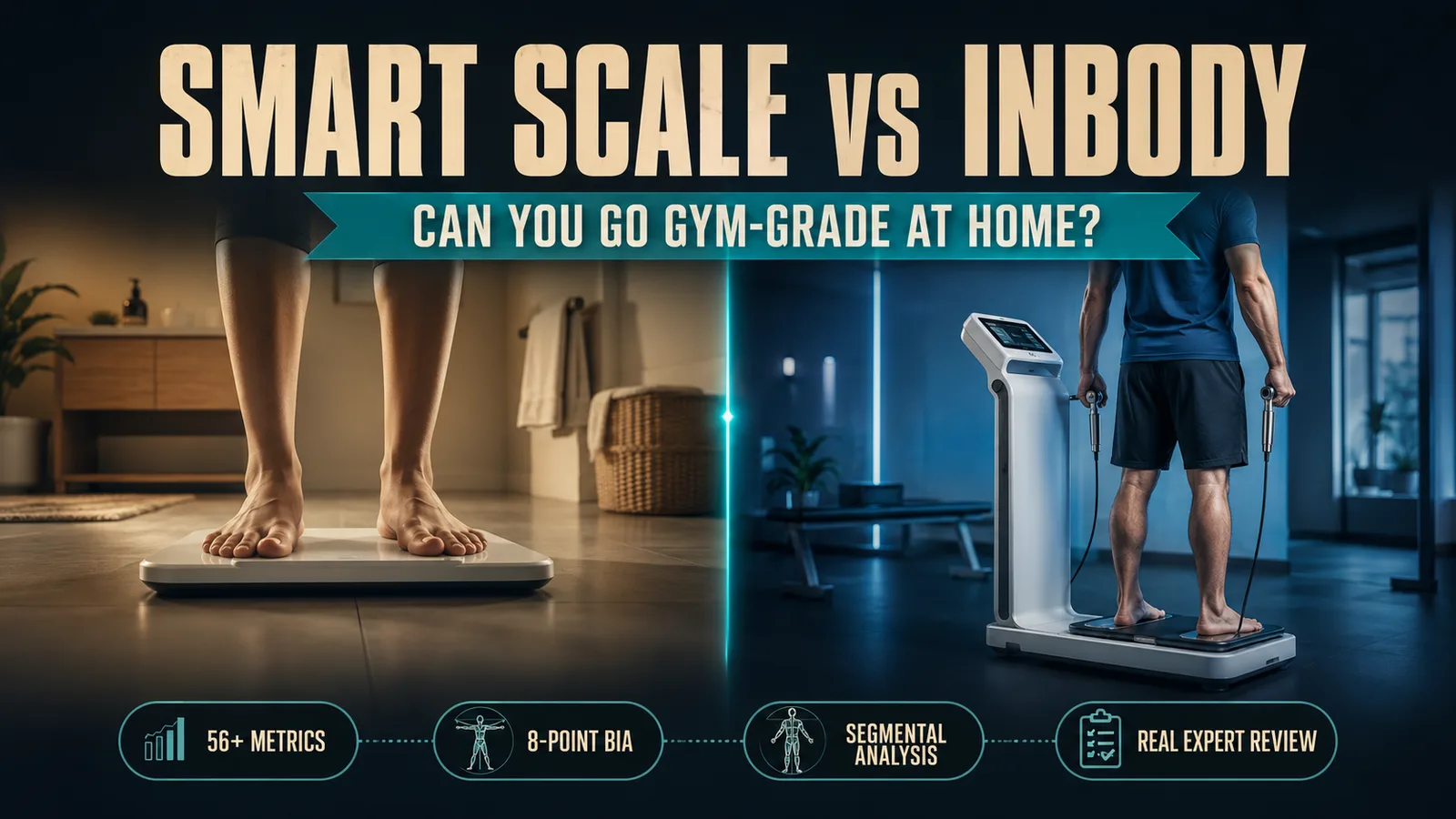
Smart Scale vs InBody: Can You Get Gym-Grade Body Fat Readings at Home?
By The FitAmplify Team · Updated July 2026 · 9 min read
If you have ever stood on a body-composition machine at a gym in Edmonton and wondered whether your scale at home could do the same job, this is the smart scale vs InBody question in a nutshell. Both use the same underlying technology to estimate your body fat. The difference is in how much detail each one captures, how often you can use it, and who helps you read the results. Here is what a professional InBody analyzer actually does differently, how close a good home scale gets, and where each one fits.
The short answer
You cannot expect a home scale to reproduce a clinic InBody reading number for number, because a professional analyzer measures with more detail and fewer assumptions. But for the job most people actually need, which is watching their own body fat and muscle trend over weeks and months, a good home smart scale does the job well. The honest catch is that neither one is a laboratory reference. Even a professional InBody correlates strongly with a DEXA scan yet does not match it exactly [2]. So the smart move is not to chase one perfect number. It is to pick the tool that lets you track the right trend often enough to act on it.
What an InBody actually does differently
InBody machines are the tall, standing analyzers you see in gyms, clinics and wellness studios, where you hold two hand electrodes and stand on two foot plates. Under the hood they use bioelectrical impedance analysis, or BIA, the same principle inside a smart scale: a small, safe electrical signal passes through your body, and the device estimates fat, muscle and water from how that signal travels. Three design choices set a professional analyzer apart.
First, it uses multiple frequencies. InBody sends currents across a wide range, stated as 1 kHz to 3 MHz, which lets it read water inside and outside your cells rather than relying on a single frequency [1]. Second, it uses direct segmental measurement, reading your arms, trunk and legs as separate cylinders instead of treating the body as one lump [1]. Third, InBody states that it avoids empirical estimation, meaning it does not adjust results using assumptions about your age, sex or ethnicity [1]. All of this runs through an 8-point tactile electrode system that contacts your hands and feet at fixed points [1]. The payoff is a detailed, less-assumption-driven snapshot in a single sitting.
What a home smart scale does, and where scales differ
A smart scale runs the same BIA idea in a form you can step on any morning. The important thing to know is that not all home scales are built the same, and the gap between them is bigger than the price tag suggests.
Cheaper scales use foot-to-foot measurement. The signal enters through one foot and exits the other, so it travels mainly through your lower body and estimates the rest. That is fine for a quick body-fat number, but it cannot truly read your upper body. A more capable home scale uses an 8-point setup with handholds, so the current also passes through your arms and trunk. That hand-and-foot path is what makes segmental, limb-by-limb readouts possible at home, closer in spirit to how a professional analyzer contacts the body. FitAmplify's smart body-composition scale is an 8-point BIA scale with eight precision electrodes and segmental analysis, reading 56+ metrics from a single scan and syncing them to a free app. It is a home device built for frequent tracking, not a clinical diagnostic tool, and that distinction matters.
Method | Signal and electrodes | Segmental read | Where you use it | Best for |
Basic bathroom scale | No BIA, weight only | No | Home | A weight trend only |
Foot-to-foot smart scale | 2 electrodes, lower-body path, often single frequency | Estimated, not measured | Home | A quick body-fat estimate, frequent tracking |
8-point smart scale | 8 electrodes, hand and foot path | Yes, arms/trunk/legs | Home | Frequent segmental tracking at home |
Professional analyzer (InBody) | 8-point, multi-frequency (1 kHz to 3 MHz), no empirical estimation | Yes, direct segmental | Gym or clinic | A detailed periodic assessment |
DEXA scan | Low-dose X-ray, not BIA | Yes, regional | Clinic | A reference-grade snapshot |
Table 1. How home scales, a professional InBody analyzer, and DEXA compare.
So can you get gym-grade readings at home?
Here is the part worth being precise about. A professional analyzer is more detailed than a home scale, but detail is not the same as flawless accuracy. When researchers compared InBody analyzers to DEXA, a common reference method, the correlations were very high: about 0.99 for fat-free mass and 0.97 for body fat mass [2]. That sounds almost perfect, and for tracking it is excellent. But the same study noted that a strong correlation is not the same as exact agreement. Lin's concordance, which measures how closely two methods actually match, came in around 0.94 [2]. In plain terms, even a gym-grade InBody is not a stand-in for DEXA, and DEXA itself is used as the reference precisely because BIA involves estimation [4].
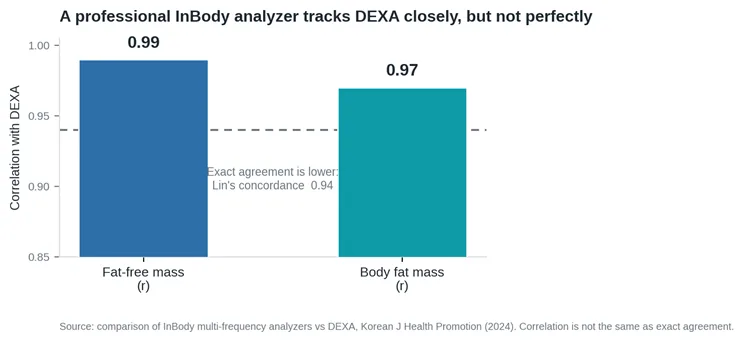
Figure 1. Professional InBody analyzers correlate strongly with DEXA, though exact agreement is lower. Source: Korean Journal of Health Promotion, 2024.
What does that mean for your bathroom scale? Modern BIA is very repeatable. One 2024 study reported test-retest reliability for percent body fat at an intraclass correlation of about 0.998, which is outstanding [3]. The same research also found a systematic offset against DEXA of a few percentage points [3]. Put those two facts together and the picture is clear. A good home scale may not report the same absolute number as a gym InBody or a DEXA scan, but it is consistent with itself. That consistency is exactly what you need to see whether your body fat is trending down and your muscle is holding or climbing.
Where a home scale genuinely wins
There is one advantage a gym analyzer cannot match, and it is a big one: frequency. You might visit a gym InBody once a month, if that. You can step on a home scale most mornings. Because body fat changes are small and slow, and daily readings bounce around with water and food, the trend only becomes clear when you sample it often. A monthly scan shows you three dots in a quarter. A home scale shows you the whole line between them.
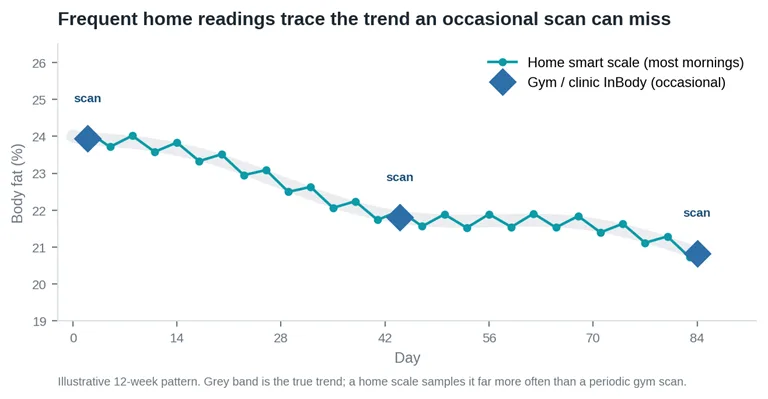
Figure 2. Frequent home readings trace the trend that occasional gym scans can only sample. Illustrative pattern.
This is why the smart scale vs InBody choice is not really either-or for most people. A periodic professional scan can give you a detailed baseline, while a home scale fills in the day-to-day trend that tells you if your plan is working. The two answer different questions.
How to get an InBody-style reading at home
Because BIA responds to how hydrated you are and what you have eaten, your habits around the scale decide how clean your data is. Standardize the conditions and your home trend becomes something you can trust.
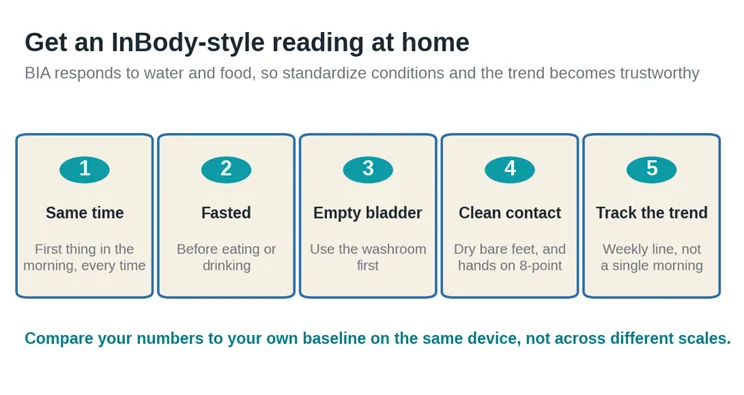
Figure 3. Five habits that make home readings comparable from one day to the next.
The single most important rule is to compare your numbers only to your own history on the same device. A reading from your scale and a reading from a gym InBody are two different instruments with different methods, so the gap between them is expected and does not mean either is broken. Watch your own line, not the difference between machines.
Which one is right for you?
The best choice depends on the question you are trying to answer, not on which device has the bigger reputation.
Your goal | Better fit | Why |
Track progress week to week at home | 8-point home smart scale | Frequent, repeatable readings reveal the trend. |
One detailed assessment in person | Professional InBody analyzer | Multi-frequency, direct segmental detail in a single session. |
The most accurate one-time snapshot | DEXA scan | A reference method, though it needs a clinic appointment. |
Catch left-right imbalances at home | 8-point home smart scale | Reads arms, trunk and legs separately. |
Know what the numbers mean and what to do | A scale plus a real coach or dietitian | A person turns raw data into a plan. |
Table 2. Matching the tool to the job.
The FitAmplify approach: measure often, then let a human read it
A number, however precise, does not change anything on its own. That is the gap FitAmplify is built to close. Our coach Chandradip Ghosh puts it plainly: "I don't guess. Every program I write starts from your body scan results." The idea is to pair frequent, honest home measurements with people who know how to interpret them.
With FitAmplify, you scan at home, the app turns 56+ metrics into plain-language trends, and a real dietitian, coach and clinical reviewer read your actual data before recommending anything. You can see how the real expert review works, explore the app that tracks 56+ metrics, or meet the expert team. It will not replace a clinical diagnostic device, and it is not meant to. It is built to help you see the full picture at home and act on it with real guidance, week after week.
Want the full picture at home, with real people reading your numbers? See what FitAmplify tracks and book a free 20-minute consultation with a dietitian or coach.
Frequently asked questions
Smart scale vs InBody: what is the main difference?
A professional InBody analyzer uses multi-frequency BIA, an 8-point electrode system and direct segmental measurement, and it avoids age or sex based estimation, so it captures more detail in one sitting. A home smart scale uses the same BIA principle in a form you can use daily. The trade-off is detail and setting versus frequency and convenience.
Is InBody more accurate than a smart scale?
For a single detailed reading, generally yes, because it measures more of the body with fewer assumptions. But InBody is still a BIA method, so it is not a laboratory reference. It correlates very strongly with DEXA, around 0.97 to 0.99, while exact agreement is lower. A quality home scale is less detailed but very repeatable, which is what matters for tracking.
Can a home smart scale replace an InBody or a DEXA scan?
Not exactly, and it does not need to. A DEXA scan is a reference-grade snapshot and an InBody gives a detailed periodic reading. A home scale is for frequent tracking between those checkpoints. Many people use a professional scan occasionally and a home scale routinely, because they answer different questions.
Why are my smart scale and InBody body fat numbers different?
Because they are different instruments using different methods and electrode setups, and BIA also shifts with hydration and food. A gap between the two is expected. Compare each reading only to its own history on the same device, and follow the trend rather than the difference between machines.
Is InBody accurate compared to DEXA?
Studies show InBody analyzers correlate very highly with DEXA, roughly 0.99 for fat-free mass and 0.97 for body fat mass. However, exact agreement is lower, with concordance around 0.94, so InBody is best treated as an excellent tracking tool rather than a perfect substitute for DEXA.
What is the best way to track body fat at home?
Use a body-composition scale under the same conditions each time, first thing in the morning, before eating or drinking, and read the weekly trend rather than daily numbers. Pairing that with expert review helps you turn the trend into action.
Medical disclaimer: FitAmplify is a wellness product and is not a medical device. It is not intended to diagnose, treat, cure, or prevent any disease, and body-composition readings are for general wellness tracking, not medical diagnosis. Always consult a qualified healthcare professional about any medical concern. Seek prompt care for red flags such as sudden or severe pain, significant swelling, numbness or loss of sensation, or signs of infection.
References