Smart scale vs tape measure for fat loss: Which Works?
Smart Scale vs Tape Measure: Which Actually Shows You're Losing Fat?

The FitAmplify Team · Reviewed by Ms. Shivani Tomar, RD, Registered (clinical) Dietician, M.Sc Nutrition, 12 years' experience · Updated August 2026 · 12 min read
Smart scale vs tape measure for fat loss comes down to what each tool actually captures. A tape measure gives you inches, which is real and useful, but it cannot separate fat from muscle. A body composition scale uses electrical signals to estimate body fat percentage, though even quality BIA scales show only fair agreement with clinical DXA scans. That gap matters for how you read your weekly numbers.
What Each Tool Actually Measures
A tape measure only ever gives you one number: the distance around your waist. Stand up straight, wrap the tape just above your hipbones, and take the reading right after you breathe out. That single number still says a lot, since a thick waist points to visceral fat stored around your organs, and that kind of fat carries different health risk than fat stored on your hips or thighs.
A smart scale for body composition works differently. Instead of one number, it sends a faint, painless electrical current through your body and estimates dozens of values at once, from muscle mass to bone density. It works because it is really a smart body fat scale built into an ordinary smart bathroom scale, so you step on once and walk away with a fuller picture than a tape alone can give you.
| Metric | Tool | Value | Detail |
|---|---|---|---|
| Metrics captured (count) | Tape measure | 1 | Waist circumference only |
| Metrics captured (count) | Smart scale | 56 | Body fat, muscle mass, visceral fat, and more |
| Electrode contact points (count) | Smart scale | 8 | Reads arms, trunk, and legs separately |
| Home-to-technician agreement (ICC) | Tape measure | 0.97 | Near-perfect match with a trained measurer |
| Readings within ±10% of technician (%) | Tape measure | 93 | Most home measurements land close to the pro's |
| Battery life (months) | Smart scale | 12 | Runs on 3 AAA batteries with daily use |
Neither tool is guessing. A tape in your own hands is nearly as reliable as having a trained professional measure you, which is a big reason it has stuck around for decades. The scale is chasing something harder: what is happening inside your body, not just around it. That is a different job, not a better or worse one, and it is worth keeping straight before you start comparing the two side by side.
Smart Scale vs Tape Measure Side by Side
Once you accept that these tools are solving different problems, the comparison gets a lot easier to read. Line them up, and the real difference comes down to depth versus simplicity, not one winning outright.
| Metric (unit) | Tool | Value | Note |
|---|---|---|---|
| Body metrics reported per scan (count) | Smart scale | 56 | Fat percentage, muscle mass, visceral fat, and more come from a single scan |
| Body metrics reported per scan (count) | Tape measure | 1 | Waist circumference only, measured by hand just above the hipbones |
| Contact points used per reading (count) | Smart scale | 8 | 8-point BIA checks arms, trunk, and legs separately instead of guessing at a full-body average |
| Profiles stored on device (count) | Smart scale | 8 | One household scale can recognize up to 8 people automatically |
| One-time cost ($) | Smart scale | 50 | Discounted from $80, with no monthly fee attached |
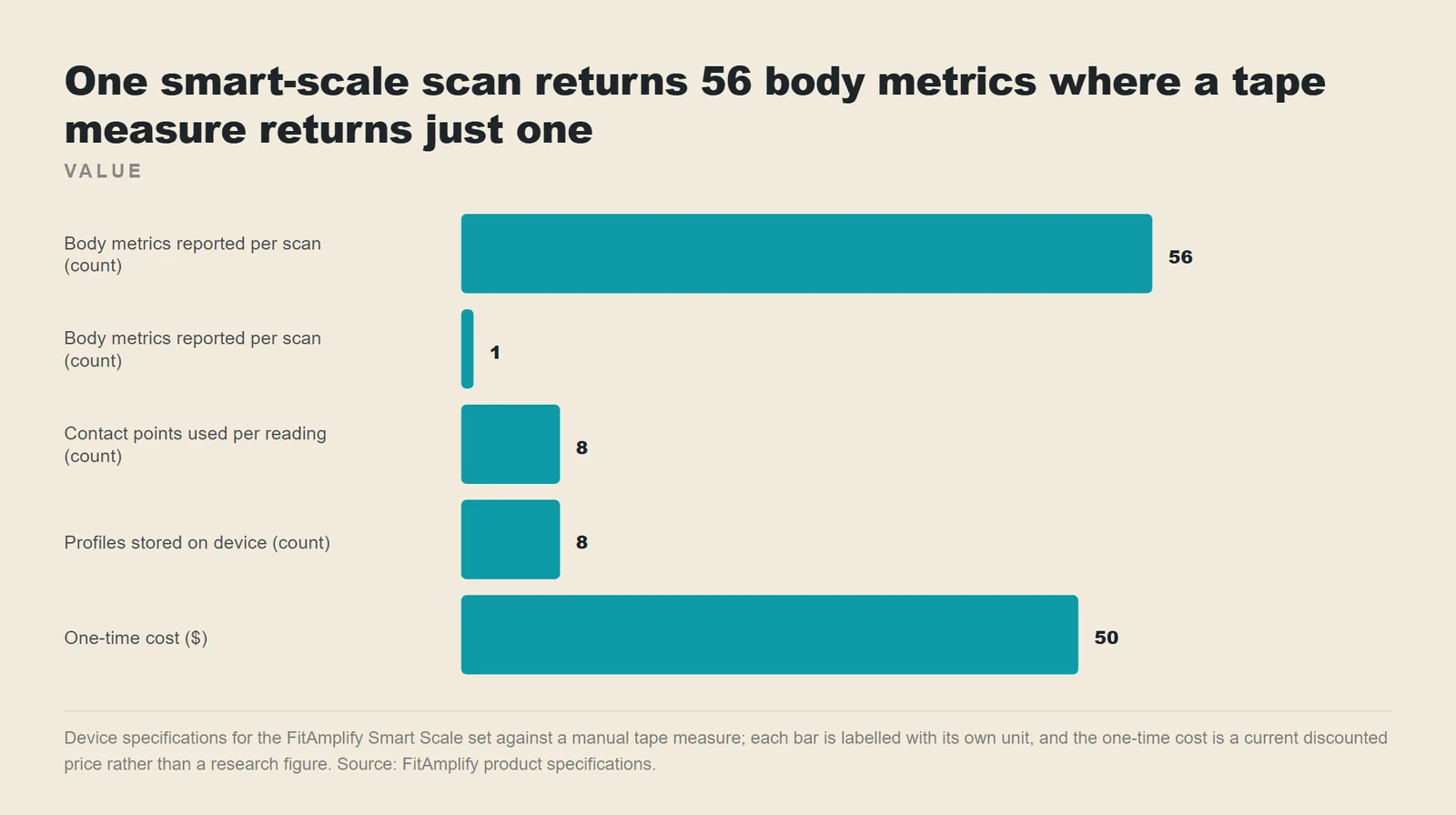
Even the best body composition scale will not replace a hand around your waist first thing in the morning, and a tape measure will not tell you what is happening under your skin. What a smart digital scale adds is volume: you can track 56+ metrics in the app after one scan instead of writing down a single inch measurement. Just keep the limits in mind before you treat any smart weigh scale as the final word on small week-to-week changes. Research on consumer BIA devices found only poor to moderate agreement with DXA scans, with limits too wide to trust for tracking an individual's body fat over time.
How Accurate Is Each Method
Volume only matters if the numbers are trustworthy, so it's fair to ask which tool actually gets closer to the truth. The honest answer is neither one is perfect, and each fails in a different place.
Why BIA readings shift day to day
A body composition scale sends a faint electrical current through your body and estimates fat from how much that current resists. Hydration changes that resistance, so a glass of water, a workout, or even the time of day can nudge the number up or down. That's part of why consumer BIA devices showed only poor to moderate agreement with DXA scans in research, with error margins too wide to trust for small individual changes. Even the most accurate smart scale on the market is still an estimate, not a lab result, and the FitAmplify Smart Scale is built to be one of the more advanced smart scale options through 8-point segmental BIA, but it does not escape that basic physics.
Where tape measurements go wrong
A tape measure has its own failure point: technique. Wrap it too high, too low, or pull it too tight, and the number drifts. NHLBI guidance is specific about this: stand up, wrap the tape around your middle just above your hipbones, and read it right after you breathe out, not while holding your breath.
Get that part right and the tool holds up well. Self-measured waist circumference matched technician measurements almost perfectly, with 93% of home readings landing within 10% of a professional's. That consistency is one reason a tape measure still earns a place next to even the best body fat scale on the market, especially since waist measurements track visceral, apple-shaped fat that carries its own distinct health risk.
Why Waist Inches Drop Before Weight Does
Here's the frustrating part: your jeans fit looser, your energy is up, but the number on the scale hasn't moved. That gap makes sense once you understand what each tool is actually reading. Weight is total mass, fat, muscle, water, and bone all mixed together, so early fat loss can get hidden behind small shifts in water or muscle.
Your waistline doesn't have that problem. Because it tracks the visceral fat sitting around your middle, inches often disappear before the scale's overall number reflects any change at all.
A smart scale for weight still earns its place here. A single scan can hand you body fat percentage, muscle mass, and several other markers at once, which a tape measure alone can't do. But bioelectrical impedance has real limits worth knowing. Four commercial BIA scales showed only poor to moderate agreement with DXA scans, and the gap between readings was wide enough that researchers called them unsuitable for tracking an individual's body fat changes day to day.
That's not a reason to skip the scale, it's a reason to read it as a trend, not a verdict. The best smart weight scale is one you check weekly and watch move over time, not one you judge by a single Tuesday morning reading. Pair that pattern with your waist tape and you get the fuller story: a body scale smart enough to flag shifts in muscle and hydration, plus a tape measure that confirms the visceral fat is actually going down.
When the numbers still don't add up, it helps to talk to a registered dietitian who can look at both data sets together instead of one number in isolation.
How to Track Fat Loss Every Week
Weekly tracking works because it smooths out the noise and shows you the real pattern underneath. Here's a simple routine to follow.
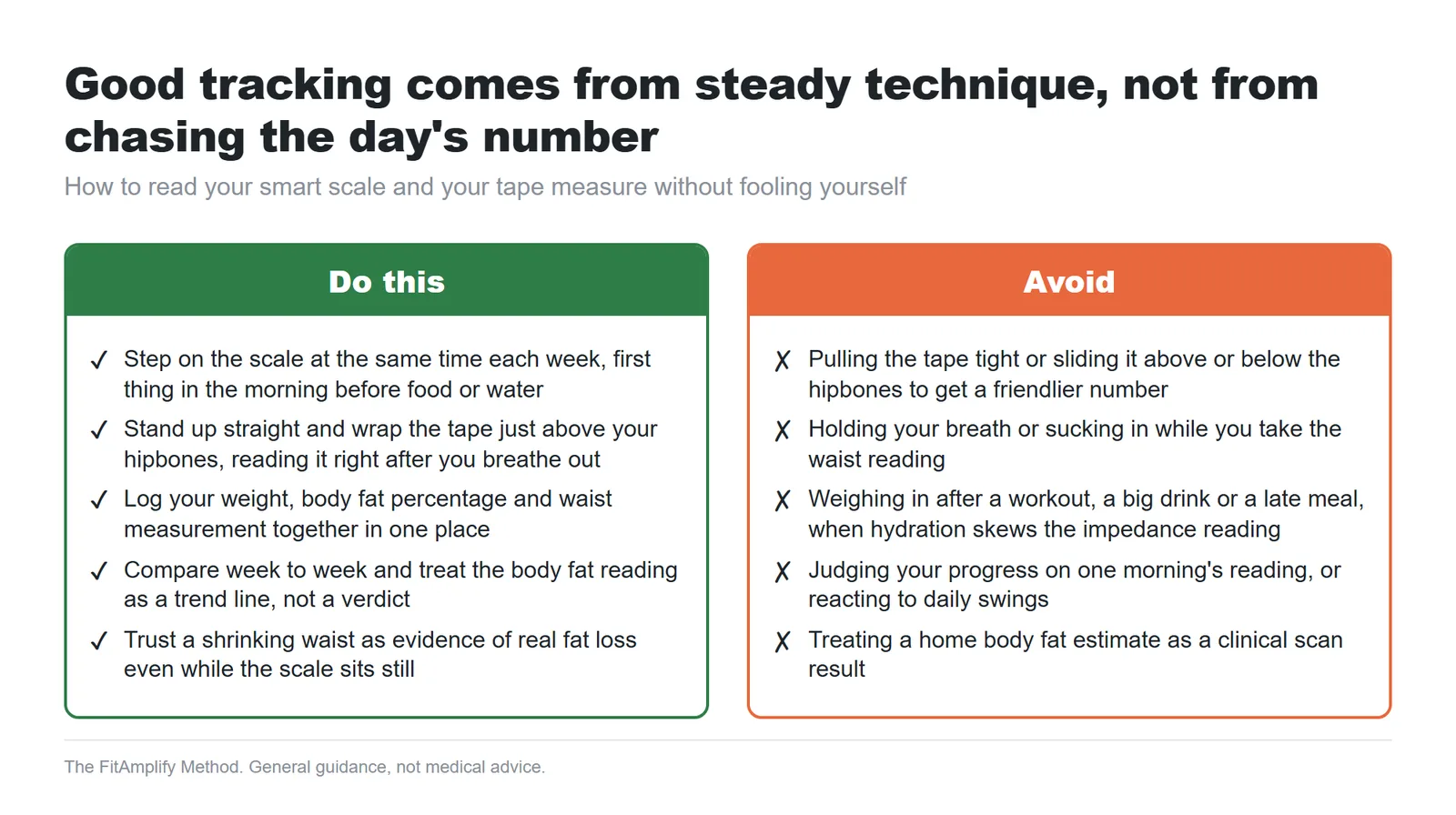
- Weigh in on your smart bluetooth scale at the same time each week, ideally first thing in the morning before food or water. Consistency in timing matters more than the exact day you pick.
- Measure your waist with a tape measure right after you exhale. Stand up straight, wrap the tape just above your hipbones, and read it after you breathe out, not before. This isn't guesswork: self-measured waist readings match technician measurements almost exactly, with 93% falling within 10% of a professional's reading.
- Log both numbers in the same place, whether that's the FitAmplify app or a simple notebook. Seeing weight, body fat percentage, and waist inches side by side is what turns raw data into a story.
- Compare week to week, not day to day. A bluetooth smart weight scale is built to catch trends in muscle and hydration, but body fat readings from bioelectrical impedance can vary widely against clinical standards like DXA, so don't chase small daily swings.
- Watch the waist number for the fat story. Because it tracks visceral fat around your organs rather than fat elsewhere on your body, a shrinking waist often confirms real fat loss even when the scale stalls.
- Check in with your data monthly. If the numbers from your smart fitness scale and your tape measure start telling different stories, that's worth a second look with someone who can read both together.
Four data points, once a week, in the same spot. That's the whole system.
Which Tool Fits Your Fat Loss Goal
Your answer depends on what you're actually trying to see. If you just want to know whether your pants fit looser, a tape measure is enough. Wrap it around your waist just above your hipbones and read the number right after you breathe out.
But if you want to understand why the scale won't budge while your waist keeps shrinking, you need more than one number. That's where a body composition tool earns its place, because it shows you fat, muscle, and water separately instead of one blended weight.
Search for the best rated smart scale or the top rated smart scale online, and you'll find long lists that include names like the Renpho smart scale alongside dozens of other budget options. Most of them give you a rough body fat estimate. Few of them break that number down by body part or pair it with a person who can explain what it means over time.
That gap is worth thinking about before you buy. A smart body-composition scale that reads 56+ metrics through 8-point BIA gives you the segmental detail a single tape measurement can't, catching left-right imbalances and tracking visceral fat alongside your waist number. Then talk to a real expert about what the readings actually mean, and you get the full picture: the number and the story behind it.
If you're comparing options for the best smart scale 2025 has to offer, look past the marketing and ask one question: does it connect you to a person, or just a number? A tape measure will always have a place in your routine. But your fat loss goal deserves more than a string and a mirror.
FAQ
Is a smart scale better than a tape measure for tracking fat loss?
Neither one wins outright. A tape measure is simple and reliable for waist changes, since self-measured waist circumference showed near-perfect agreement with technician readings in one study. A smart scale gives you more angles, like segmental muscle and visceral fat data, but it works best alongside a person who can help you read the numbers.
How accurate is a smart scale app compared to lab testing?
Be honest with yourself here. Research on several BIA scales found only poor to moderate agreement with DXA scans, and the differences were too wide to trust for tracking small changes in body fat over time. Use your smart scale app for trends across weeks, not as a substitute for a lab test.
What is the best way to measure my waist at home?
The NIH's approach is straightforward: stand up, wrap the tape around your middle just above your hipbones, breathe out, and take the measurement right after you exhale. Do this at the same time of day each week so your numbers stay comparable. It takes ten seconds and needs no charging or syncing.
Why do smart scale application results vary from one week to the next?
Hydration, food timing, and even the temperature of your feet can shift a BIA reading. That is not a flaw unique to any smart scale application, it is how bioelectrical impedance works. Look at your 4-week trend line instead of any single day's number.
Is there really a smart scale best suited for fat loss tracking?
The best smart scale is the one you actually use next to someone who can explain what the readings mean. A device that gives you 56+ metrics is only half the picture. If you want that context, you can book a free consultation and talk through your numbers with a real person.
Conclusion
Your tape measure and your scale are not rivals. They measure different things, and together they tell a fuller story than either one alone. The tape reads fat distribution around your waist, the number every doctor already trusts, while a best smart bathroom scale layers in muscle mass, hydration, and dozens of other metrics no string can capture.
Both tools ask you to be consistent. A tape measure held the same way each week gives readings close to what a technician would find, and a smart scale used at the same time each day smooths out the day-to-day noise that BIA is known for.
Pick one, use it weekly, and let the trend line do the talking, not any single number. If you want a device that pairs those numbers with a real explanation, look at the smart body-composition scale or talk to a registered dietitian about what your results actually mean.
References
- Assessing Your Weight and Health Risk, NHLBI (NIH)
- Anthropometric Measurements: When to Use this Assessment, American Council on Exercise (ACE)
- Reliability and criterion validity of self-measured waist, hip, and neck circumferences, National Institutes of Health (NCBI/PMC)
- Validity of Four Commercial Bioelectrical Impedance Scales in Measuring Body Fat among Chinese Children and Adolescents, National Institutes of Health (NCBI/PMC)
FitAmplify is a wellness product and is not a medical device. It is not intended to diagnose, treat, cure, or prevent any disease. Always consult a qualified healthcare professional regarding any medical concern.