Why Is My Smart Scale Weight Different From the Doctor's Scale?
Why Is My Smart Scale Weight Different From the Doctor's Scale?
You weigh yourself at home in the morning, feel good about the number, then step on the scale at your doctor's office a few hours later and it reads two or three pounds heavier. It is a small, oddly deflating moment, and it makes people wonder which scale is lying. Here is the reassuring answer: almost certainly neither. The gap is not a broken scale or a dishonest one. It is the completely normal result of weighing at different times, in different clothes, on different devices. This guide explains exactly why the two numbers differ, how much daily change is normal, and how to compare them fairly so the difference stops bothering you.
Key takeaways
· A difference of a few pounds between your home scale and the doctor's scale is normal and expected. Usually neither one is broken.
· Your body weight naturally swings by about five to six pounds across a day, mostly from water and food.
· The biggest reasons for the gap are time of day, clothing and shoes, and what you have eaten or drunk since morning.
· Two different scales will rarely show the exact same number, but each can still be perfectly consistent with itself.
· The fix is not to hunt for the correct scale. It is to pick one scale, weigh under the same conditions, and follow your own trend.
· The doctor's scale is the reference for a clinical visit. Your consistent home scale owns your day-to-day trend.
In this article
· The short answer: both scales are probably fine
· How much does weight change in a day?
· The real reasons the two numbers differ
· Is one scale more accurate than the other?
· How to compare your weight fairly
· Which number should you actually trust?
· Where FitAmplify fits
· Frequently asked questions
The short answer: both scales are probably fine
Let us take the worry off the table first. If your home scale and the doctor's scale disagree by a pound or a few, that is not a sign that either one is faulty. It is what you should expect. Your weight is not a single fixed number that follows you around all day. It rises and falls constantly as you eat, drink, sweat, and use the bathroom, so the reading you get depends heavily on when and how you step on. The doctor weighed you in the afternoon, in your clothes, after lunch and a coffee. You weighed yourself at home in the morning, undressed, before breakfast. Those are two different measurements of a moving target, so of course they differ.
The mistake is assuming one number is the truth and the other is an error. In reality both can be accurate readings of your body at that moment. Once you understand what is actually moving, the gap stops being mysterious, and you can start using your scale in a way that gives you information you can genuinely trust.
The question | The short answer |
Is my scale broken? | Almost certainly not |
Why the difference? | Different time, clothes, and food or drink |
Normal daily swing | About five to six pounds |
Which scale is right? | Both, for different jobs |
What should I do? | Pick one scale and weigh consistently |
The number that matters | Your own trend, not a single reading |
At a glance. The rest of this article explains each answer.
How much does weight change in a day?
Most people badly underestimate how much their weight moves within a single day. According to Cleveland Clinic, the normal daily fluctuation for someone at a healthy weight is a window of about five to six pounds, which is roughly two to three pounds in either direction. That is not fat appearing and vanishing. It is mostly water, along with the food and drink moving through you at any given moment.
A single glass of water weighs about half a pound. A large, salty meal can make your body hold onto water for a day. Carbohydrates cause you to store water too, hormones shift things around across the month, and even a hard workout can nudge the number through fluid changes. Add all of that up and a two or three pound difference between morning and afternoon is not just possible, it is completely typical.
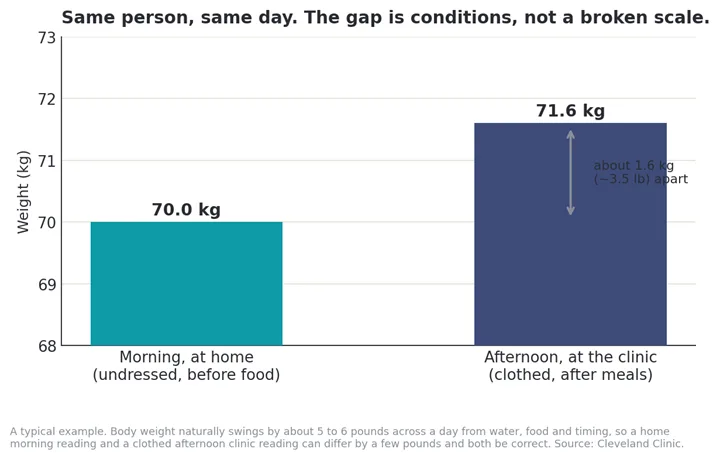
A typical home-morning versus clinic-afternoon reading, both inside the normal daily window. Source: Cleveland Clinic.
So when your morning home reading and your afternoon clinic reading sit a few pounds apart, they are very likely both sitting inside that normal daily window. Neither scale is wrong. They simply caught your body at two different points in its normal daily rhythm, and the one taken later in the day, after food and drink, is naturally the higher of the two.
The real reasons the two numbers differ
Zoom in on a typical home-versus-clinic comparison and you can usually account for the entire gap without blaming the hardware at all. A handful of everyday factors do almost all of the work.
Reason | What it does | Typical effect |
Time of day | You are lighter in the morning, heavier by evening | Up to a few pounds |
Clothing and shoes | Clinic weigh-ins are often done clothed and shod | One to a few pounds |
Food and drink | Anything eaten or drunk since morning adds weight | Varies through the day |
Water and sodium | A salty or carb-heavy meal makes you hold water | Up to a few pounds |
A different scale | Two devices rarely agree down to the ounce | A small offset |
The floor surface | A home scale on carpet can read inconsistently | Variable |
Notice how quickly these stack up. Clothes and shoes alone can be a pound or two. Lunch and a couple of coffees, another pound. Weigh in the afternoon instead of first thing, and the natural daily rise adds still more. Put them together and a three-pound gap between home and clinic is fully explained before you ever need to question whether a scale is accurate.
Is one scale more accurate than the other?
It is natural to assume the doctor's scale, being a medical device, is the true one. It is usually well calibrated, and for that clinical visit it is the reference. But accurate does not mean the clinic is measuring the real you while your home scale measures a fake you. Both are accurate readings, just taken under different conditions.
A good home scale measures weight to within about a tenth of a kilogram, which is plenty precise for tracking. Where cheaper scales can drift is placement and calibration. A scale on a soft or uneven surface, like a bathroom carpet, cannot sit level and can read inconsistently, so a hard, flat floor genuinely matters. And any scale, home or clinical, is only as consistent as the conditions you use it in.
The more useful way to think about it is this. For a single clinical snapshot, the doctor's scale is the reference. For watching your own change over weeks, your home scale is actually the better tool, because you can control the conditions and weigh the same way every single time. Consistency, not the badge on the device, is what makes a weight trend trustworthy.
How to compare your weight fairly
You cannot force two different scales to agree, and the good news is that you do not need to. What you can do is make your own readings consistent enough to mean something, which is where the real value lives. The trick is to remove as many of the moving variables as you can, so that the only thing left changing from week to week is your actual body.
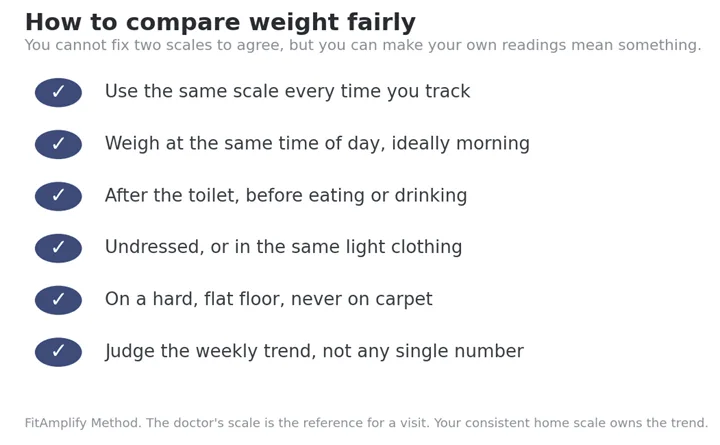
Remove the moving variables and your real trend shows through, whatever the absolute number is.
Do that and the day-to-day noise settles down, letting your real trend show through. If you do want to compare your home number with the clinic's, the fairest approach is to weigh yourself at home the same morning, before your appointment, then simply accept that the clinic's later, clothed reading will run a little higher. The two will not match to the ounce, and that is completely fine. You are looking for the same story over time, not the same number on the day.
Which number should you actually trust?
Here is the resolution, because you do deserve a practical answer. Trust both, for different jobs. When your doctor is tracking your health, screening for a concern, or adjusting a medication, their scale at that visit is the reference point, and that is the number that belongs in your medical record. When you are following your own progress week to week, your home scale is the one to trust, as long as you use it consistently, because the trend it shows is cleaner than any one-off clinic reading taken under whatever conditions the day happened to bring.
What you should not do is bounce between scales and treat every difference as a problem to solve. That is a fast route to anxiety and to bad decisions made on noise. Pick your home scale, weigh under the same conditions, and let the weekly trend guide you, while letting the doctor's scale do its own separate job at your visits. Two tools, two roles, and no real conflict between them.
Role | Your home scale | The doctor's scale |
Main job | Tracking your own trend | A clinical checkpoint |
When you weigh | Same time, usually morning | Whenever the appointment falls |
Clothing | Undressed or the same light clothing | Usually clothed |
Best used for | Week-to-week direction | The reading in your medical record |
Trust it for | Your progress over time | That day's clinical measurement |
Two tools, two roles. Neither replaces the other.
Why FitAmplify ?
This is really a story about consistency and context, which is exactly what FitAmplify is built around. The smart scale gives you a steady, controllable home reading, and the free app turns your day-to-day numbers into a weekly trend, so a single high or low reading does not throw you off. Instead of reacting to one number, you see the direction, which is the part that actually reflects your health.
And because a scale only ever hands you numbers, a real dietitian or coach can put them in context, including how your home trend and a clinic reading fit together, so you are never left guessing what a difference means. If a weight change genuinely concerns you, that is a conversation for your healthcare provider, and a consistent home trend gives them better information to work with. You can book a free 20-minute consultation if you would like someone to look at your numbers with you.
Frequently asked questions
Why is my weight different at the doctor's office than at home?
Mostly because you weigh at different times and in different clothes. At home you likely weigh in the morning, undressed, before eating. At the clinic it is often afternoon, clothed, after meals. Your weight naturally swings several pounds across a day, so both readings can be correct.
How much can my weight change in a single day?
For most people, about five to six pounds, roughly two to three in either direction. It is mostly water and food moving through you, not fat gained or lost. That is why a home reading and a clinic reading taken hours apart can differ by a few pounds and both be normal.
Is my home scale or the doctor's scale more accurate?
Both can be accurate. The doctor's scale is the reference for a clinical visit. A good home scale is precise to about a tenth of a kilogram and is better for tracking your own trend, because you control the conditions. Consistency matters more than which device it is.
Should I weigh myself in the morning or the evening?
Morning, for tracking. First thing, after using the washroom and before eating or drinking, gives the most consistent reading with the least food and water in your system. The exact time matters less than always using the same one.
Why does my scale read differently on carpet?
Soft or uneven surfaces stop a scale from sitting level and spreading your weight evenly, which can make the reading drift. Always weigh on a hard, flat floor, and in the same spot, so the surface is one less thing changing your number.
Which weight should I record for tracking?
Use your home scale, taken the same way each morning, and follow the weekly trend rather than any single day. Keep the doctor's readings as separate clinical checkpoints. Trying to reconcile the two down to the exact pound is not worth the worry.
Stop chasing the number, follow the trend
A few pounds between your home scale and the doctor's scale is normal, not a problem to solve. Pick one scale, weigh the same way each morning, and watch the trend that actually reflects your health. With the FitAmplify scale and app you can track your weight alongside 56+ body metrics and clear weekly trends, and book a free consultation with a real coach or dietitian who can help you read the numbers with confidence.
FitAmplify is a wellness product and is not a medical device. It is not intended to diagnose, treat, cure, or prevent any disease. BIA readings are for general wellness tracking, not diagnosis. Always consult a qualified healthcare professional regarding any medical concern.
References
1. Why Does My Weight Fluctuate So Much? Cleveland Clinic. https://health.clevelandclinic.org/weight-fluctuations
2. Bioelectric Impedance Analysis (standardizing measurement conditions; hydration effects). MRC Epidemiology Unit Measurement Toolkit, University of Cambridge. https://www.measurement-toolkit.org/anthropometry/objective-methods/bioelectric-impedence-analysis
3. Evaluating altered hydration status on the effectiveness of body composition analysis using bioelectrical impedance analysis. PMC. https://www.ncbi.nlm.nih.gov/pmc/articles/PMC9407416/