Why Does My Smart Scale Show Different Body Fat Every Day?
Why Does My Smart Scale Show Different Body Fat Every Day? What the Numbers Really Mean
If your body fat reads 22% one morning and 24% the next, nothing has gone wrong with your scale or your body. A smart scale estimates body fat from how easily a small signal moves through you, and that signal is shaped mostly by your body water. Water shifts all day with what you drink, eat, and do, so the daily number moves with it. The fix is not a better scale. It is learning to read the weekly trend instead of the daily verdict.
Key takeaways
• Smart scales use bioelectrical impedance (BIA), which infers body fat from body water, so hydration changes move the number.
• Real fat loss is slow, so a jump of a point or two overnight is almost always water, not fat.
• A daily swing of a couple of pounds of body weight is normal and expected.
• BIA is very repeatable but reads a few points differently from a lab scan, so treat it as a trend tool, not a diagnosis.
• Weigh under the same conditions each time and judge the weekly and monthly direction.
• Sudden, large, or unexplained changes are worth a conversation with a health professional.
In this article
• The short answer: you are seeing water, not fat
• How a smart scale actually estimates body fat
• What makes your daily reading jump
• So how much daily change is normal?
• How to get readings you can actually compare
• What your body-fat number is really for
• When a changing number is worth a closer look
The short answer: you are seeing water, not fat
Real fat gain or loss happens over weeks, not overnight. Losing a single pound of fat takes roughly a 3,500 calorie deficit, so a genuine drop of a point or two in body fat is the work of weeks. Yet your scale can show that much change between Monday and Tuesday. That gap is the tell. What changed overnight was not your fat. It was your body water and the food moving through you. Because a smart scale reads body fat indirectly through water, an ordinary day of drinking, eating, and sweating is enough to nudge the percentage up or down.
How a smart scale actually estimates body fat
A smart scale does not measure fat directly. It uses bioelectrical impedance analysis, or BIA. When you step on, the scale sends a small, safe signal up through your body. Muscle and other lean tissue hold a lot of water and let the signal pass easily. Fat holds far less water and slows it down. The scale measures that resistance, estimates your total body water and lean mass, and works out fat from what is left. The FitAmplify scale uses 8-point BIA with eight precision electrodes to read your arms, trunk, and legs separately for 56+ body metrics.
Here is why that matters for daily swings. Because the whole estimate starts from body water, anything that changes your water changes the reading. Research on multi-frequency BIA shows it is remarkably repeatable from one reading to the next, yet it can still sit a few percentage points away from a lab scan such as DXA. One 2024 analysis found BIA read about four points lower than DXA on average. So the device is consistent, but the number it gives is a good estimate, not a lab result.
What makes your daily reading jump
Here is what is really moving when the percentage shifts overnight. Notice that almost every item works by changing your body water, not your fat.
What is moving | What it does | Effect on the reading | Real fat change? |
Water you drink | Adds body water your scale can read | Body fat % can dip, weight rises | No |
Carbs and glycogen | Each gram of glycogen holds about 3 g of water | Higher water and a shifted reading next day | No |
Salty meals | Sodium makes you hold on to water | Higher water and weight for a day or two | No |
Food still digesting | Adds weight until it passes through | Small swing either way | No |
Time of day | Body water redistributes as you stand and move | Morning and evening readings differ | No |
Exercise and sweat | Fluid lost through sweat | Temporary drop in body water | No |
Alcohol | Dehydrates first, then you rebound | Reading can swing across 1 to 2 days | No |
Menstrual cycle | Hormones drive water retention | Reading rises for part of the cycle | No |
Table 1. Common causes of a changing daily body-fat reading. Sources: Cleveland Clinic; BIA hydration research.
Carbohydrates deserve a special mention. Your body stores carbs as glycogen, and every gram of glycogen holds roughly three grams of water with it. Eat a large pasta dinner and you can carry extra water the next morning, which a BIA scale may read as more weight and a shifted body fat number, even though you have gained no fat at all.
So how much daily change is normal?
More than most people expect. The Cleveland Clinic notes that daily body weight can move within a window of about five to six pounds, roughly two to three pounds in either direction, mostly from water and food passing through you. On a BIA scale, that water movement shows up as a wobbling body fat percentage. Studies that measure the same people repeatedly find body water can shift by up to half a litre from one day to the next, even under controlled conditions. In plain terms, a daily bounce of a point or two is the system working normally, not a warning sign.
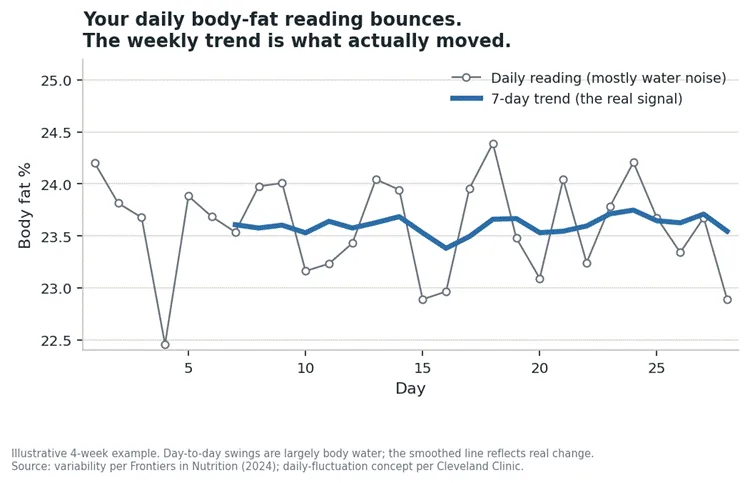
Chart 1. A four-week example: daily readings bounce, while the smoothed weekly line shows the real direction.
Want to see your own signal instead of the daily noise? The FitAmplify app charts your body-composition trends over weeks and months, so the real pattern is easy to spot. See how it works.
How to get readings you can actually compare
You cannot stop your body water from moving, but you can measure at the same point in its daily cycle so your readings line up. Consistency is what turns a noisy number into a usable trend. FitAmplify and BIA researchers give the same practical advice: standardize the conditions, then look at the pattern over time rather than any single day.
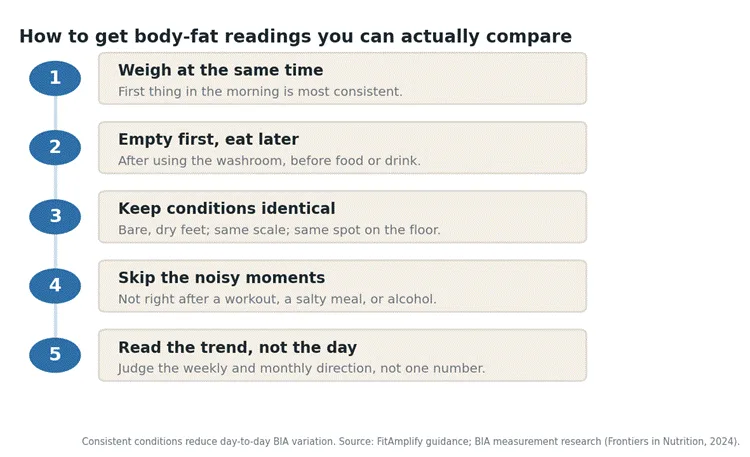
Chart 2. Five habits that make your body-fat readings comparable from day to day.
What your body-fat number is really for
Once you are reading the trend, the percentage becomes genuinely useful. It can tell you whether your body composition is moving in the direction you want, which weight alone cannot. For context, here are widely used healthy body fat ranges from the American Council on Exercise. Treat them as general reference points rather than targets to chase, since healthy ranges vary with age, sex, and individual health.
Category | Women (body fat %) | Men (body fat %) |
Essential fat | 10 to 13% | 2 to 5% |
Athletes | 14 to 20% | 6 to 13% |
Fitness | 21 to 24% | 14 to 17% |
Average / acceptable | 25 to 31% | 18 to 24% |
Above average | 32% and higher | 25% and higher |
Table 2. General body-fat percentage categories. Source: American Council on Exercise.
Where FitAmplify fits
This is where a number turns into a plan. Our expert team reads your actual body-composition trends, not a single reading, and helps you decide what to adjust. A registered dietitian or coach can often tell whether a stall on the scale is water masking real fat loss, or a genuine plateau that calls for a change. As our dietitian Ms. Shivani Tomar, RD puts it, every body is biochemically different, so your plan should be too. That is the difference between a scale that hands you data and a system built around real people who read it with you.
When a changing number is worth a closer look
Day-to-day wobble is normal. A few situations deserve more than a shrug. If you notice a large, rapid, or unexplained change in weight or body water over a short period, ongoing swelling, or other symptoms alongside it, that is a reason to speak with a qualified healthcare professional rather than adjust your routine from a scale reading. BIA body-composition readings are for general wellness tracking, not medical diagnosis.
Frequently asked questions
Why does my body fat percentage change every day?
Because a smart scale estimates fat from your body water using BIA, and your water shifts constantly with hydration, food, salt, exercise, and time of day. Those daily changes are mostly water, not fat.
Is my smart scale broken if the numbers keep changing?
Almost certainly not. Multi-frequency BIA is very repeatable, so if you step on twice in a row you should get nearly the same result. Changes across days reflect real shifts in your body water, which is expected.
How accurate are smart scales for body fat?
They are good for tracking change over time, less so as a one-time lab-grade figure. BIA can read a few percentage points away from a DXA scan, so the trend is more reliable than any single number.
What is the best time of day to check body fat?
First thing in the morning, after using the washroom and before eating or drinking. That is when your body water is most consistent from one day to the next.
How often should I weigh myself?
A few consistent readings a week is plenty for body composition. Look at the weekly and monthly direction rather than reacting to any single day.
Can drinking water change my body fat reading?
Yes. Extra water in your body lowers the electrical resistance the scale measures, which can shift the body fat percentage even though your actual fat has not changed.
See your full body picture. Explore the FitAmplify smart body-composition scale, track 56+ metrics in the app, and book a free 20-minute consultation with a real dietitian or coach when you want a plan built around your data.
References
1. Cleveland Clinic: Why Does My Weight Fluctuate So Much?
6. American Council on Exercise: Body fat percentage categories for men and women
Disclaimer: FitAmplify is a wellness product and is not a medical device. It is not intended to diagnose, treat, cure, or prevent any disease. Body-composition readings are for general wellness tracking, not medical diagnosis. Always consult a qualified healthcare professional regarding any medical concern.